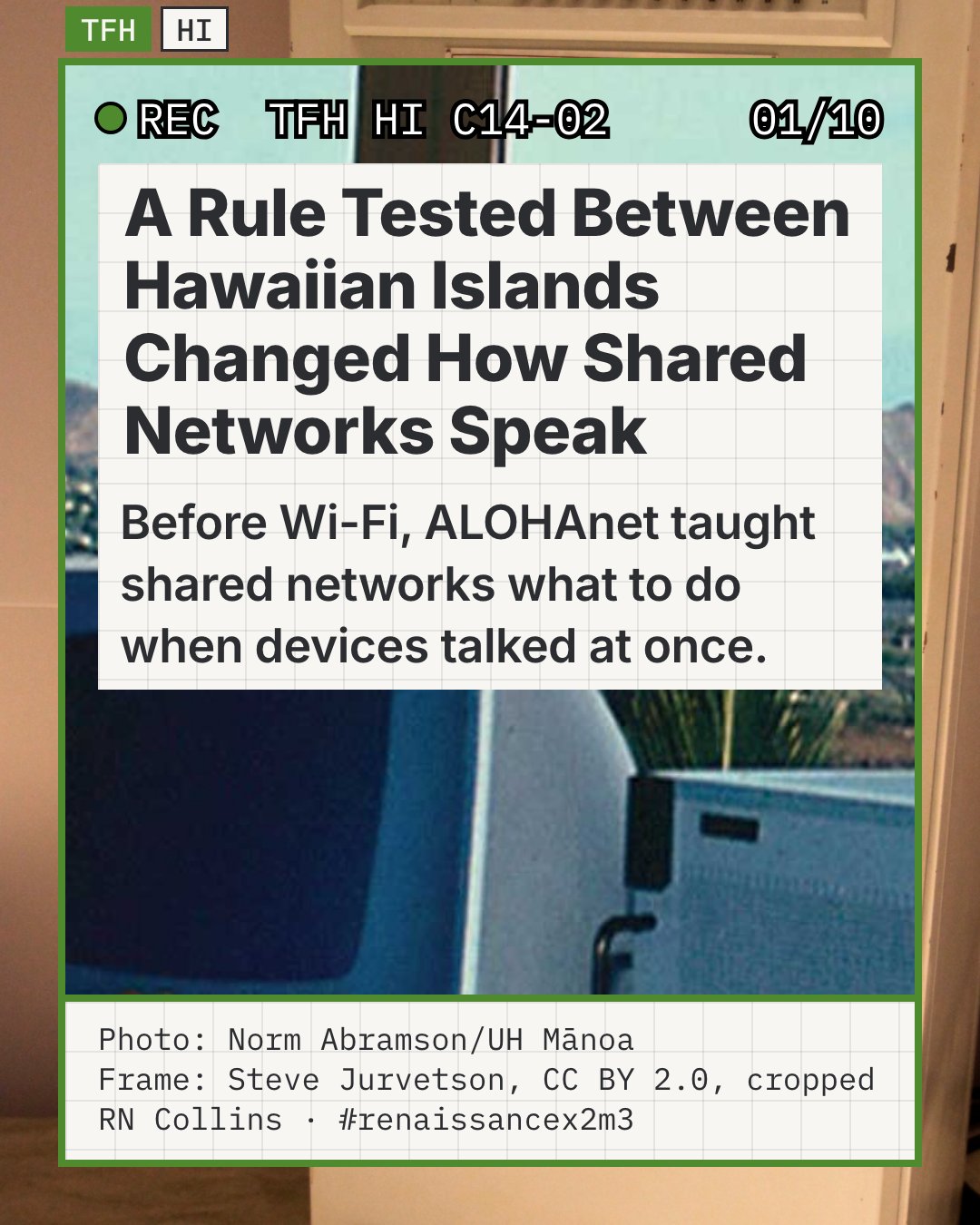
The story
Before a device can send a message, it has to answer a deceptively political question: who gets to speak when everyone shares the same channel?
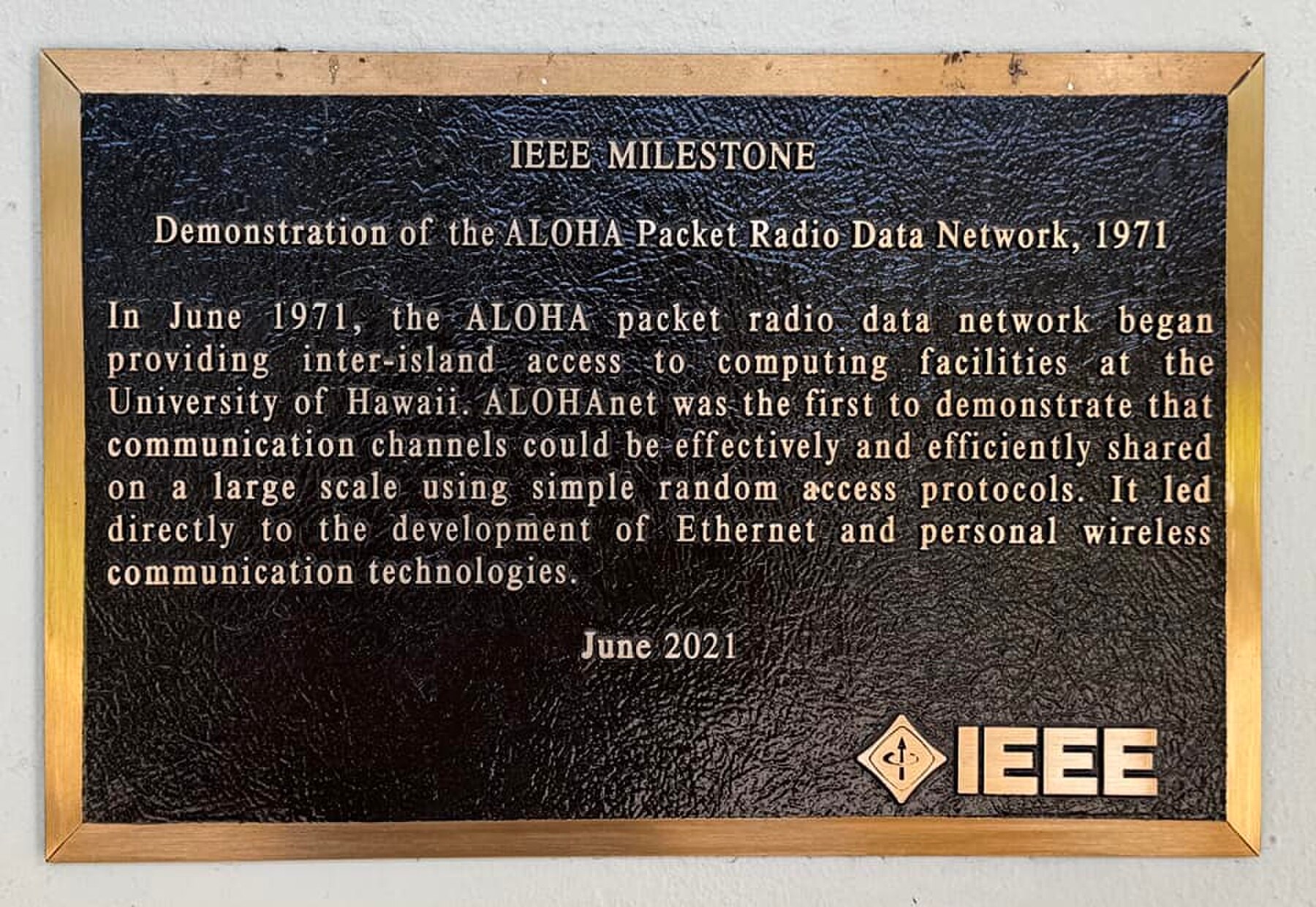
Who gets to speak when everyone shares the same channel?
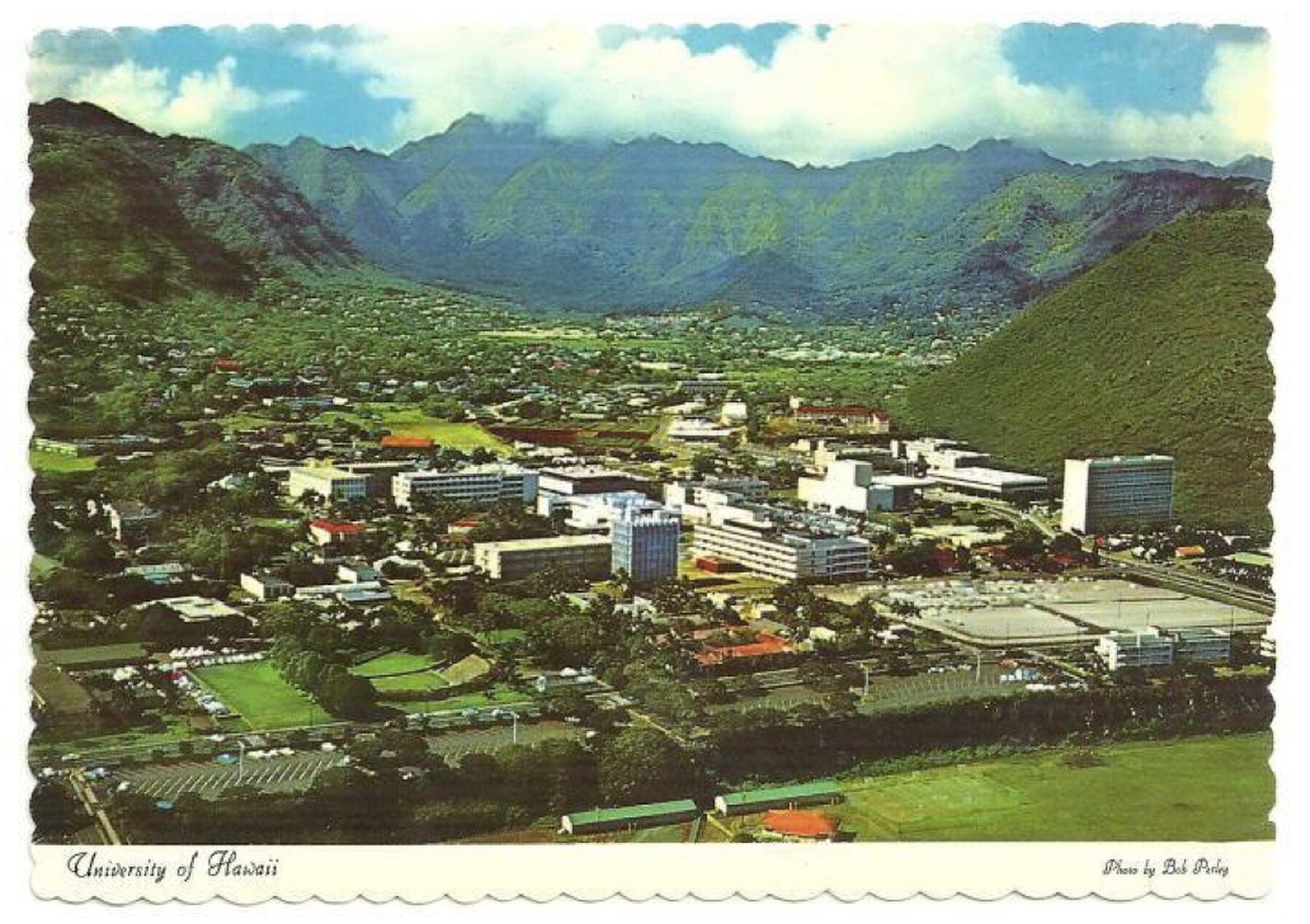
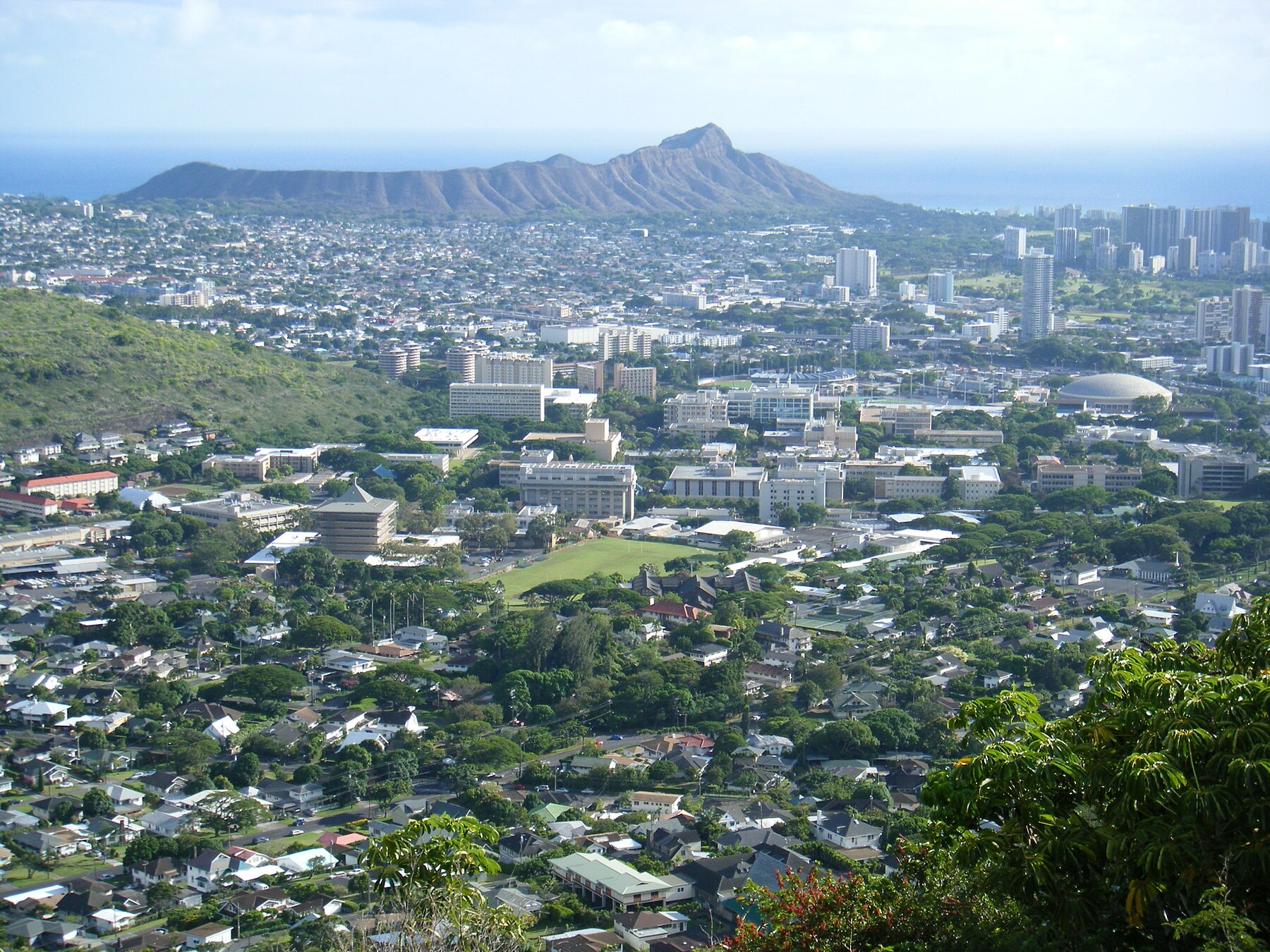
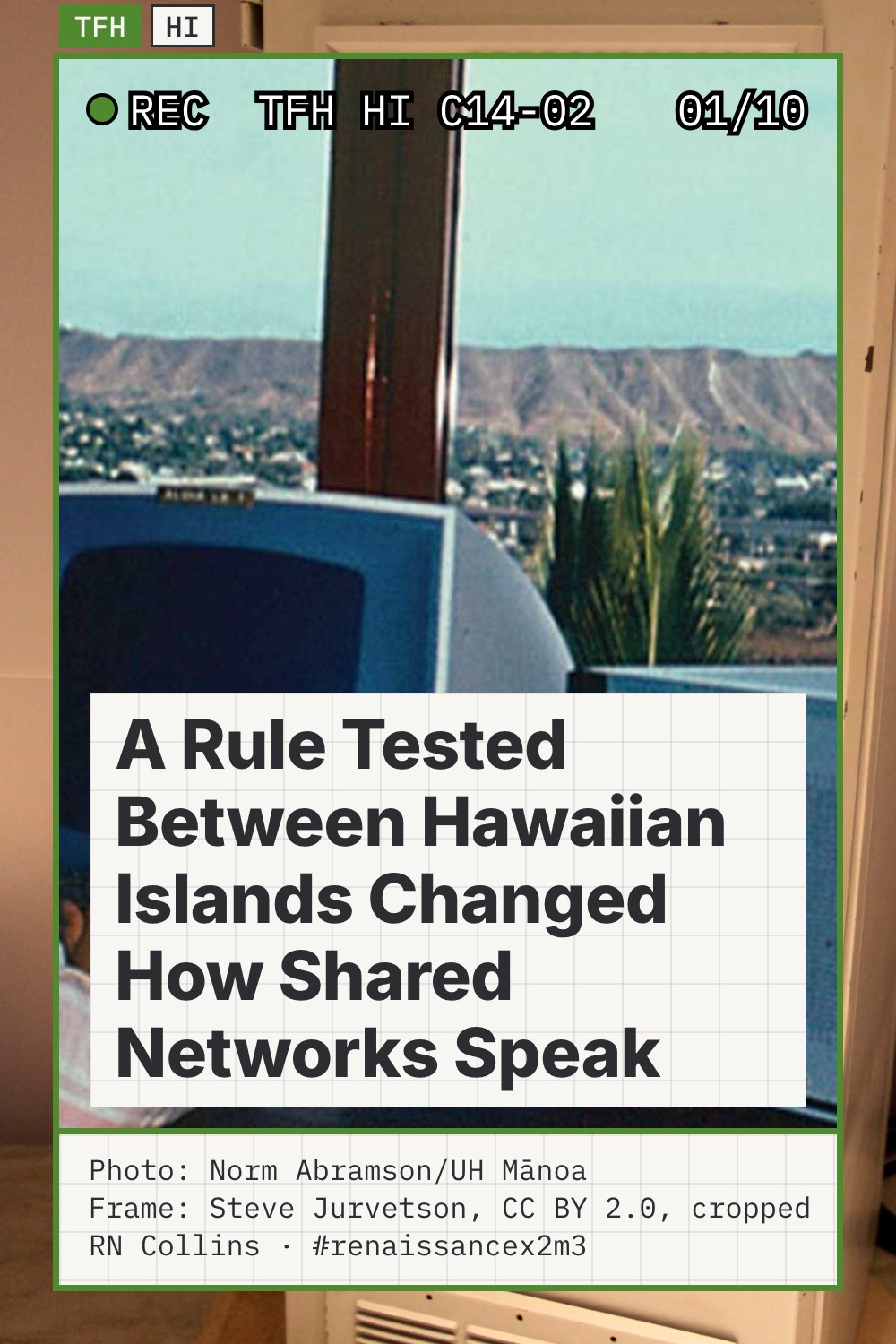
In September 1968, that question already had a geography problem attached to it. The University of Hawaiʻi's computing ran through a single IBM 360/65 mainframe in Mānoa Valley on Oahu. But the university itself was not centered anywhere: it ran a four-year college in Hilo, five two-year community colleges scattered across Oahu, Kauaʻi, Maui, and Hawaiʻi Island, and research institutes spread across a two-hundred-mile radius from Honolulu. Every one of those sites that wanted to reach the Mānoa mainframe had to go through a phone line.
Norman Abramson had not planned on Hawaiʻi at all; he had first seen the islands only because flights from San Francisco to a Tokyo conference then stopped in Honolulu, and, never having visited, he rented a surfboard for a few days before flying home. He came back in 1966 to join the University of Hawaiʻi's faculty full time, leaving positions at Stanford and Harvard behind, and called the move "a big gamble," trading the "intellectual stimulation" of two elite mainland institutions for a state school where he would have to find his own research money.
In a 1970 paper describing what he was building, Abramson laid out the case against wire communications in plain economic terms: leased lines came at "a premium cost," and "for communication links over large distances (say 100 miles) the cost of communication for an interactive user on an alphanumeric console can easily exceed the cost of computation." Interactive traffic was bursty, a user might occupy a leased line at "less than 1 percent of its capacity" while still paying for the whole thing, and whatever wire he used belonged to a phone company, not to him.
Abramson was not the only one wiring computers together that year. Roughly one state away, ARPA's own network was going up the conventional way: on October 29, 1969, researchers led by Leonard Kleinrock at UCLA sent the first host-to-host message over what became the ARPANET, to a second node at the Stanford Research Institute, over leased telephone lines and dedicated switching computers called IMPs. That approach assumed the two ends of a link were worth a dedicated wire. Hawaiʻi's problem was different in kind, not just in distance: no single leased line could reach a mainframe on Oahu from a community college on Kauaʻi, a research institute on Hawaiʻi Island, and a handful of other sites at once, at a price a state university could sustain. Radio, broadcast to everyone within range and sorted out afterward by the protocol rather than the wiring, was Abramson's answer to a problem ARPANET's own design did not have to solve.
Abramson recruited two new UH faculty colleagues, Wesley Peterson and Edward "Ned" Weldon, along with Franklin Kuo, Thomas Gaarder, and Shu Lin, and pitched a research program to the Department of Defense's Project THEMIS, a program built specifically to fund research at "second-tier" universities. The first contract -- Office of Aerospace Research, Contract F44620-69-C-0030 -- funded what Abramson named, straightforwardly, THE ALOHA SYSTEM. Later funding for the broader program came through ARPA's Information Processing Techniques Office, managed at the time by Bob Taylor and Larry Roberts.
One of Abramson's recruits was already famous in a narrower world. Wesley Peterson had joined UH two years earlier, in 1964, as the inventor of the cyclic redundancy check -- the CRC error-detection scheme that, decades later, still runs inside nearly every digital storage and communication system built. His 1961 book, Error-Correcting Codes, is credited with founding algebraic coding theory; he'd later win the 1999 Japan Prize for the work. When Abramson's packets needed protection from radio noise, Peterson supplied the CRC math to do it, and directed the time-sharing system, UHTSS/2, that the terminals would eventually reach. The rest of the recruits brought their own histories. Abramson himself held a physics degree from Harvard, a master's from UCLA, and a doctorate in electrical engineering from Stanford, with faculty stints at Stanford, Harvard, UC Berkeley, and MIT before Hawaiʻi. Franklin Kuo arrived by a different route: an electrical-engineering degree from the University of Illinois at Urbana-Champaign, then early-1960s research work at Bell Laboratories, before he joined UH Mānoa as a full professor in 1966.
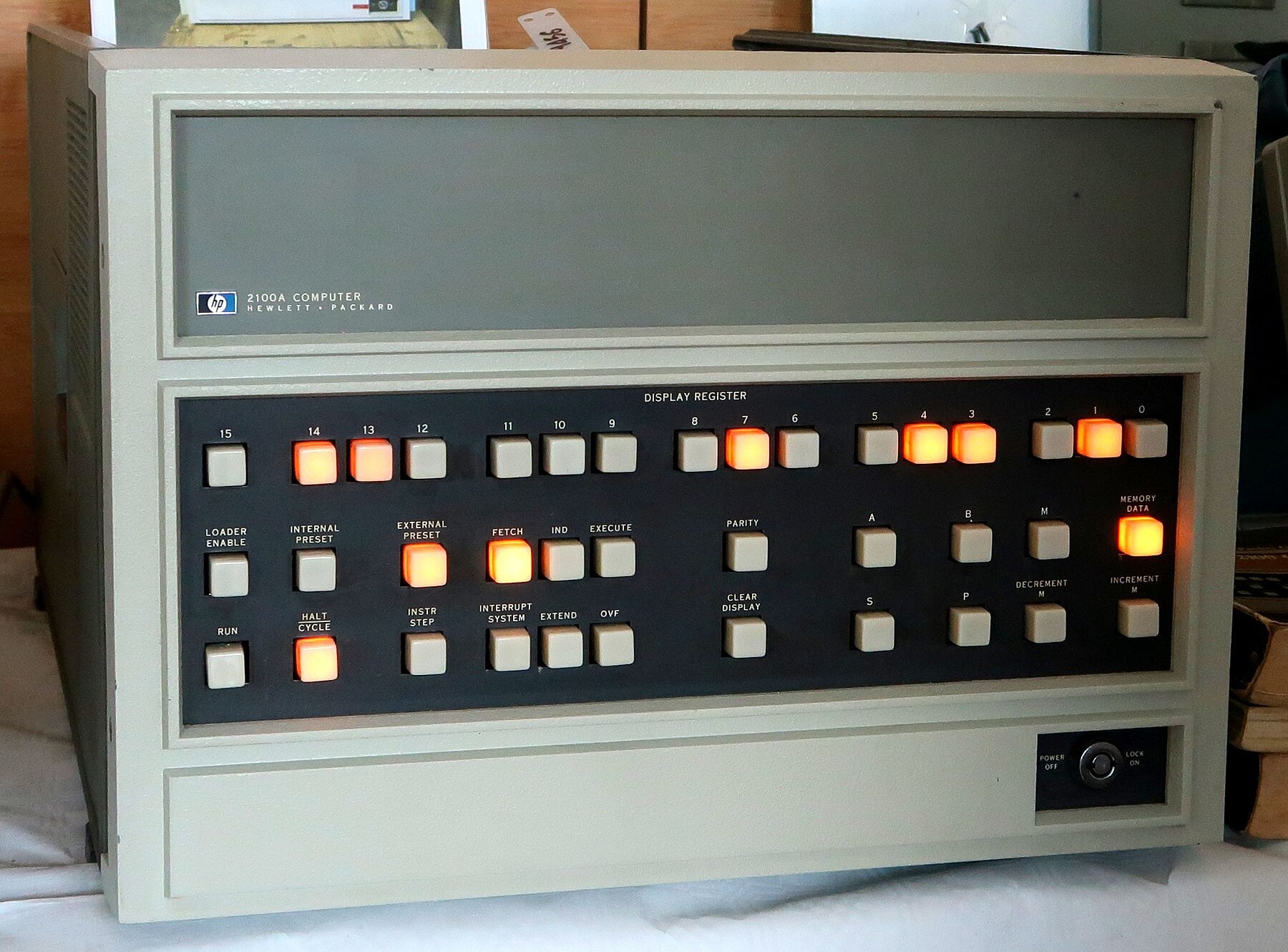
The system that resulted was, by later standards, small and specific. A Hawaiian Menehune -- legendary elf -- lent its name to the interface computer sitting between the mainframe and the airwaves: an HP 2115A, 16-bit words, 8K of core, doing for Hawaiʻi's radio network roughly what the Interface Message Processors were doing for the wired ARPANET. Two 100-kilohertz channels were carved out of the UHF band -- 407.350 megahertz from the Menehune to remote consoles, 413.475 megahertz back -- each running at 24,000 baud. A packet was 704 bits: 80 eight-bit characters, 32 identification and control bits, 32 parity bits, taking 29 milliseconds to transmit.
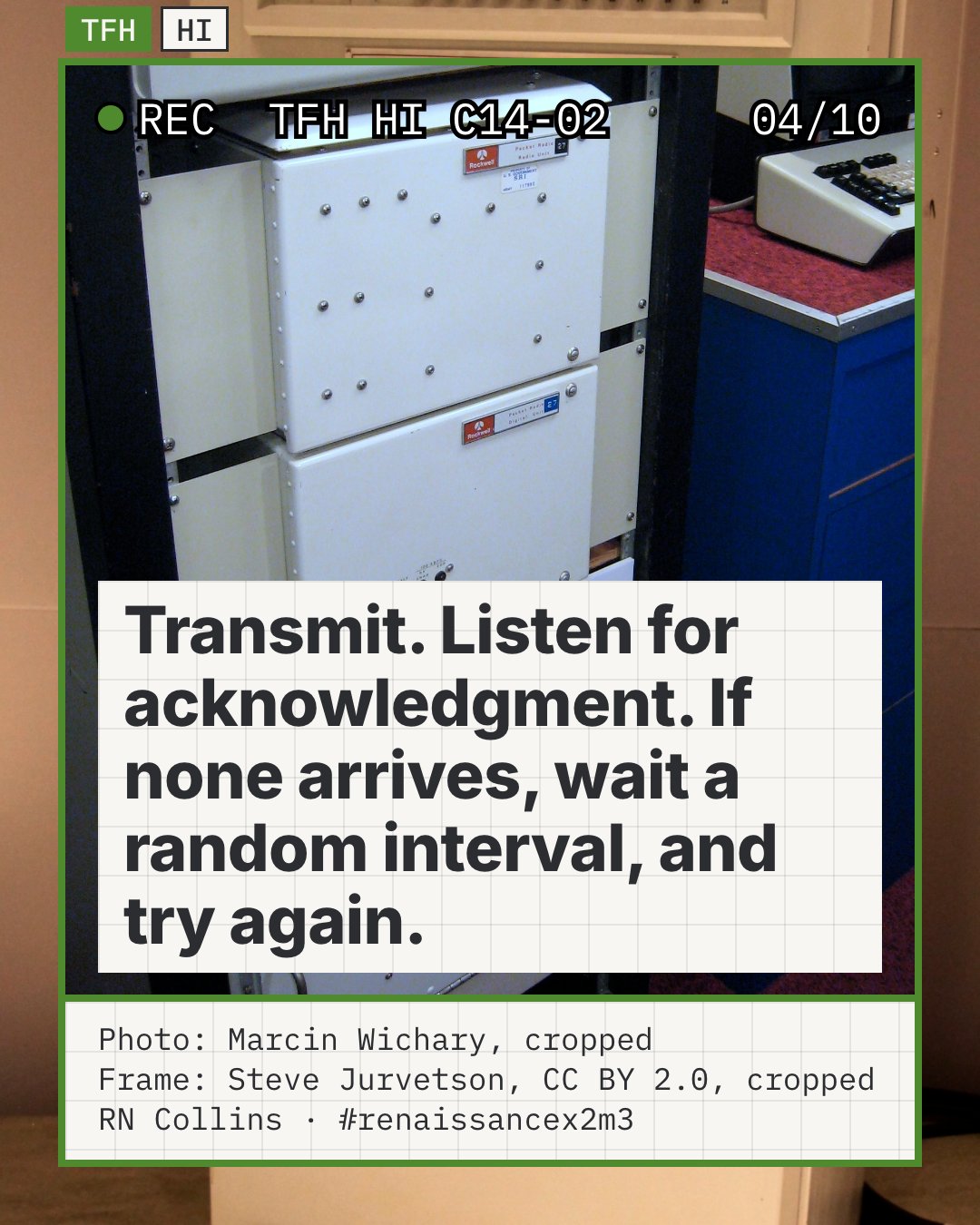
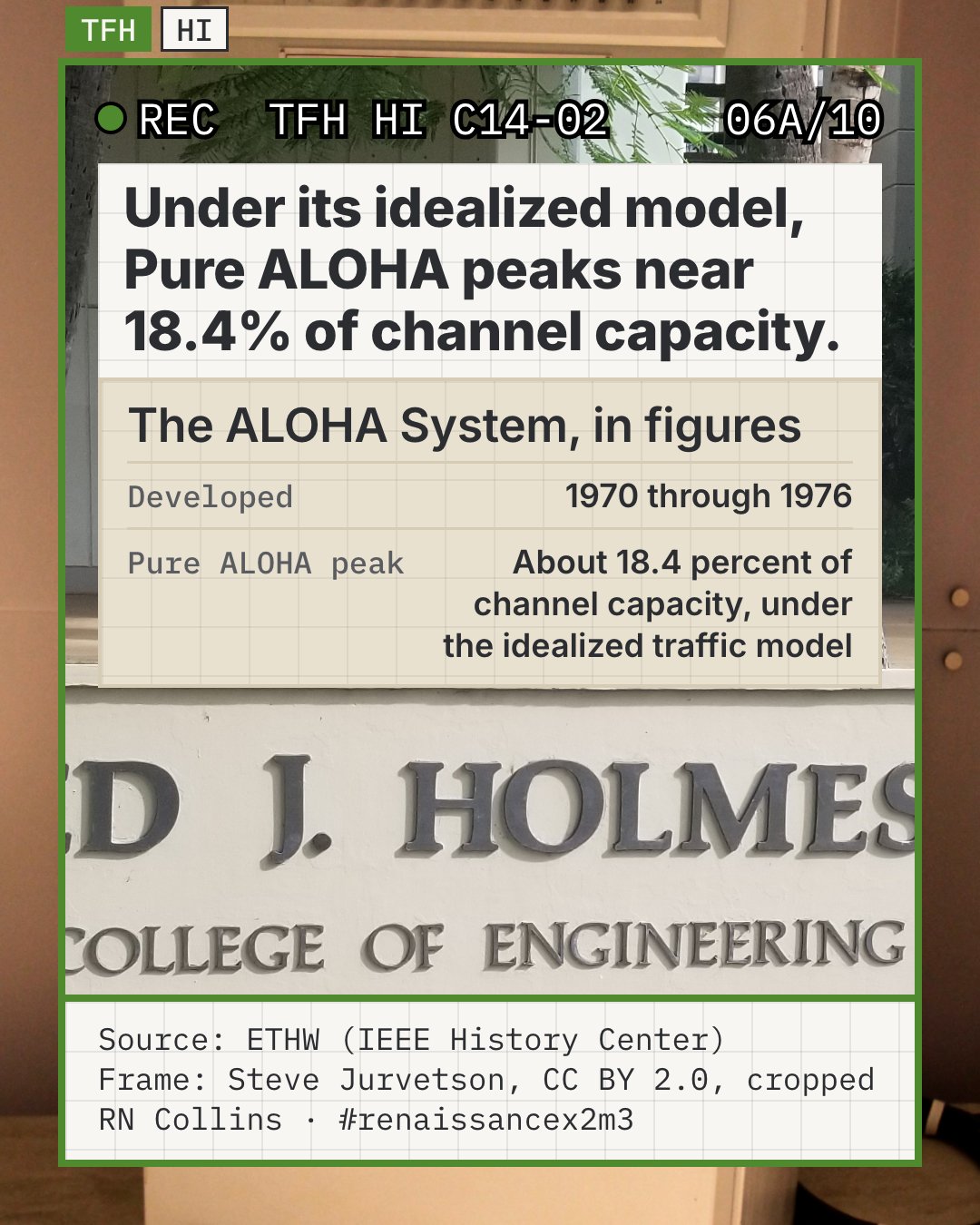
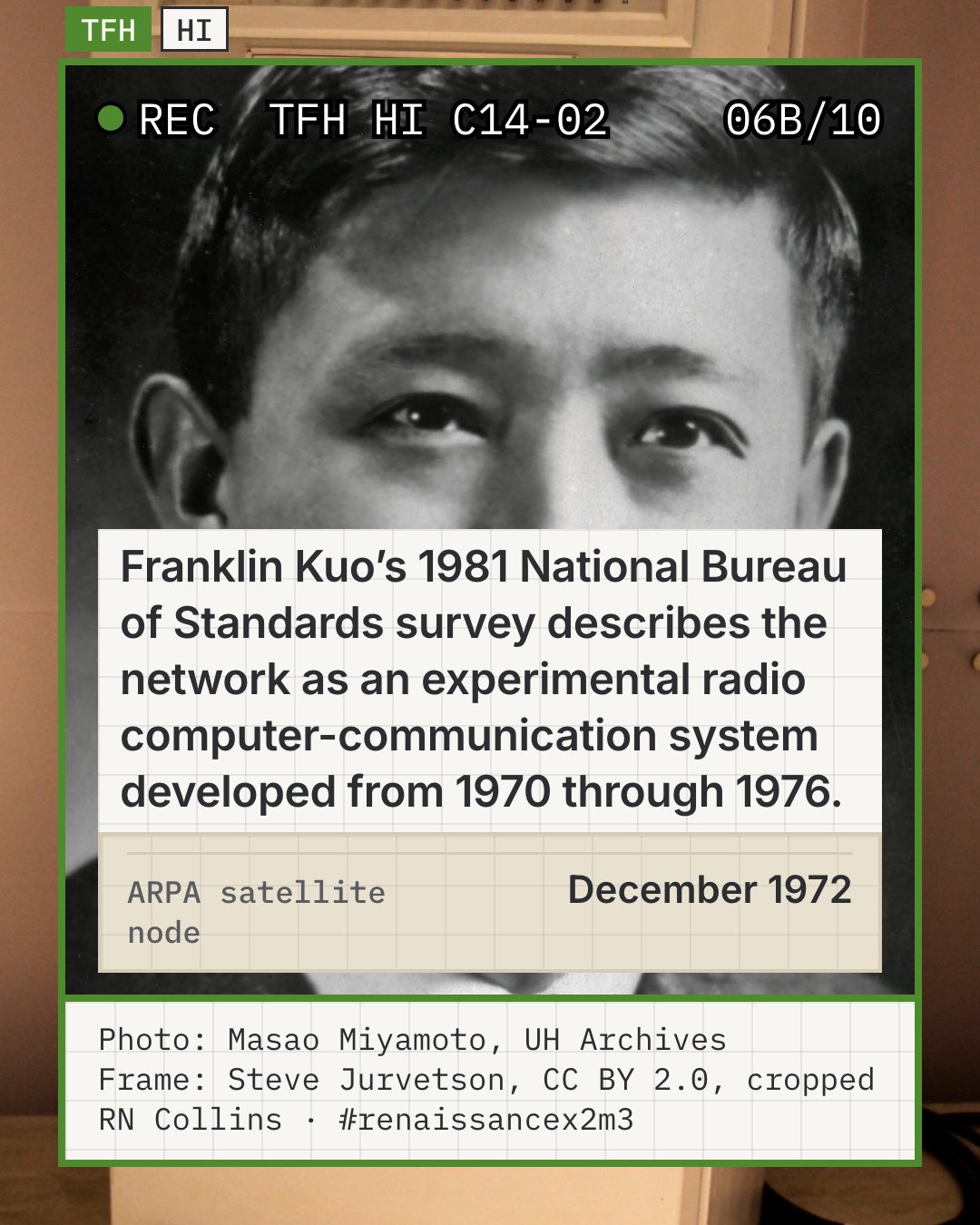
The protocol governing that channel was the real invention. A remote terminal did not reserve the channel or wait for permission. When it had a packet, it transmitted. If the central station received the packet correctly, it sent an acknowledgment. If the terminal did not receive that acknowledgment, it treated the packet as unsuccessful, waited a randomly selected interval, and tried again. Random delay reduced the chance of repeated lockstep collision without assigning every user a fixed turn. Franklin Kuo's 1981 National Bureau of Standards survey describes the network as an experimental radio computer-communication system developed from 1970 through 1976. Under the idealized traffic model used to analyze Pure ALOHA, its theoretical maximum throughput is about 18.4 percent of channel capacity.
The figure comes from a small piece of probability. A packet took 29 milliseconds to send, so any other packet that started within 29 milliseconds before or after it would overlap with it, a danger window of two packet-times. If packets arrive at random at an average of G per packet-time, a given packet escapes collision with probability e to the minus 2G, so useful throughput is G times that, a curve that peaks at G equal to one half, where it reaches one over two e, about 18.4 percent. Push more traffic onto the channel and the curve falls, because the busier the network, the more of its capacity goes to packets that must be sent again.
That ceiling was not the protocol's last word. In 1972, Lawrence Roberts, then running ARPA's Information Processing Techniques Office, proposed a simple fix: divide time into discrete slots and let terminals transmit only at the start of a slot, rather than the instant a packet was ready, cutting in half the window during which two transmissions could overlap. Published that June as an ARPANET system note, the change doubled the channel's theoretical maximum throughput, to 36.8 percent, for what became known as Slotted ALOHA. Roberts's 1972 note carried a second idea in its title, capture: when two transmissions overlap but one arrives much stronger than the other, the receiver can sometimes still decode the stronger one, so a collision is not always a total loss. Nothing about Hawaiʻi's radios changed; the improvement came entirely from a scheduling rule layered on top of the random-access principle Abramson had already built.
The protocol kept attracting theorists after that. Leonard Kleinrock, the UCLA engineer whose early-1960s doctoral work had first applied queueing theory to message-switched networks, spent much of the 1970s analyzing this exact kind of channel with his student Fouad Tobagi; their 1978 work on acknowledgment traffic's effect on packet-radio channel capacity treated Abramson's Hawaiʻi network as raw material for a broader mathematical theory of shared channels.
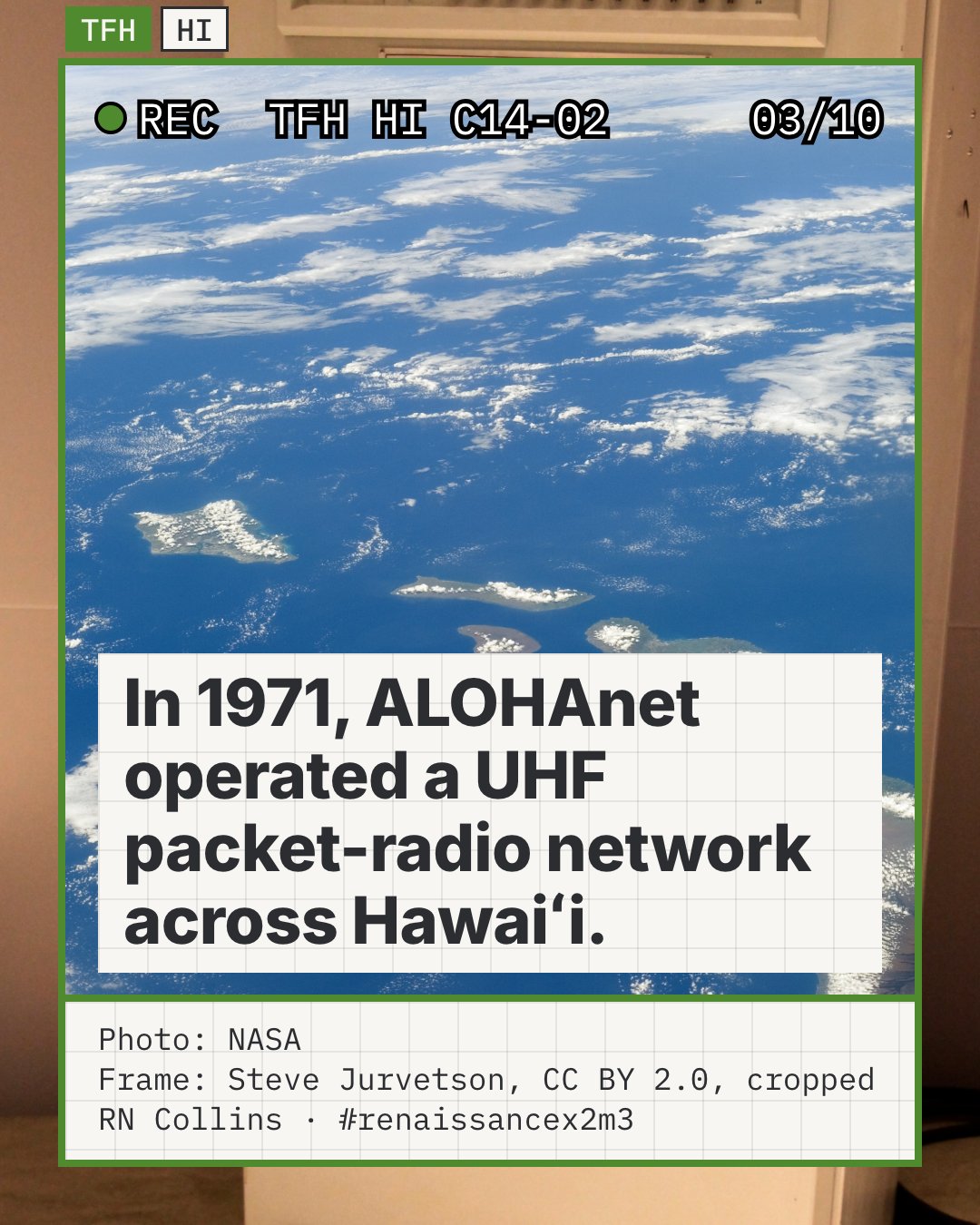
The network those radios actually carried stayed modest by design. By the end of its first year of operation, ALOHAnet ran four active terminals, linking Oahu and Kauaʻi; at its peak it supported roughly forty users across several sites on Oahu and Maui, each wired into a terminal connection unit over an ordinary RS-232 line at 9,600 bits per second before a single bit of its traffic ever reached the airwaves.
Hawaiʻi's geography fought back immediately. Kuo's own account is blunt about it: coverage was "severely limited by the diversity of terrain (mountains, high rise buildings, heavy foliage) that exists in Hawaii." The fix was two simple store-and-forward repeaters, which took advantage of the bursty, packet-based nature of the traffic to extend the Menehune's reach from Oahu out to the other islands in the chain -- the inter-island access the IEEE would later cite by name.
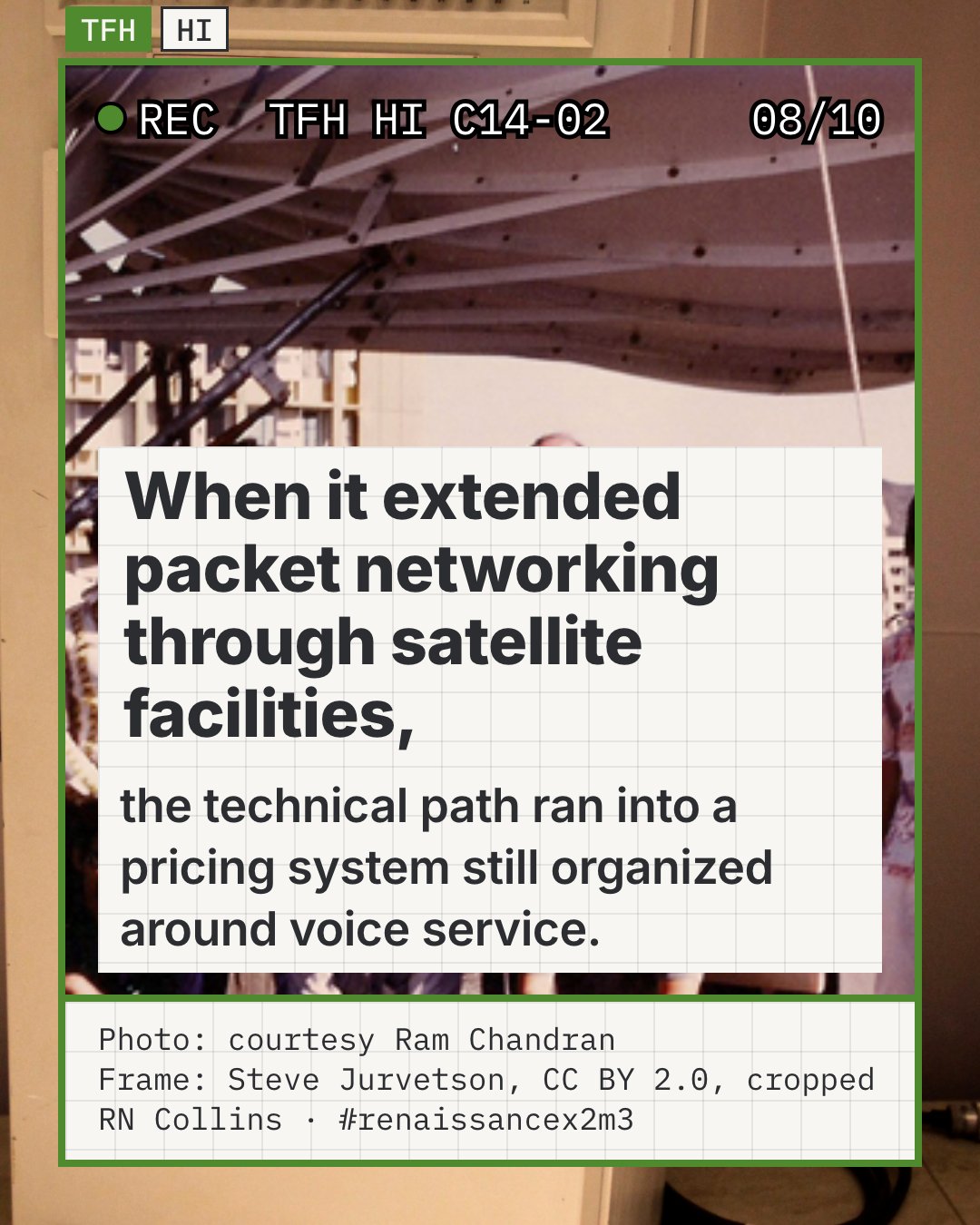
The network's most consequential extension went up, not sideways. In December 1972, the ALOHA System became the first operational satellite node on the ARPA network, riding the Pacific Ocean INTELSAT IV satellite through COMSAT's SPADE voice-channel system. The pricing here is usually described as an obstacle the project ran into. Kuo's own writing says the opposite. COMSAT billed the link "on the basis of a single voice channel, which is a remarkable savings over land-line rates" -- and because a satellite channel broadcasts rather than running point-to-point, that single voice-channel tariff let ALOHA carry two 50-kilobaud data channels in each direction, four data channels total, to every ground station in view of the satellite, at the price of one phone call. The team separately ran experiments on NASA's ATS-1 satellite with NASA Ames Research Center and the University of Alaska; where INTELSAT's standard earth stations were 97 feet across and cost "several million dollars," the ATS-1 ground stations used antennas "as small as ten feet," with total ground electronics under $5,000. That work grew into PACNET, generally described as the first packet-broadcasting satellite network, linking sites in Hawaiʻi, Alaska, California, Japan, and Australia by 1973.
The name itself was bureaucratic before it was Hawaiian: ALOHA was originally a backronym, Additive Links On-line Hawaii Area, retrofitted onto the ordinary Hawaiian greeting so the acronym would spell something everyone in the islands already said daily.
None of it lasted, in the direct sense. "When funding ran out from the various U.S. Government sponsors, the ALOHANET stopped operations in the fall of 1976," Kuo wrote five years later. But he wrote that sentence specifically to introduce what came next, because by 1981 he could already list three separate lineages descending from the Hawaiʻi network.
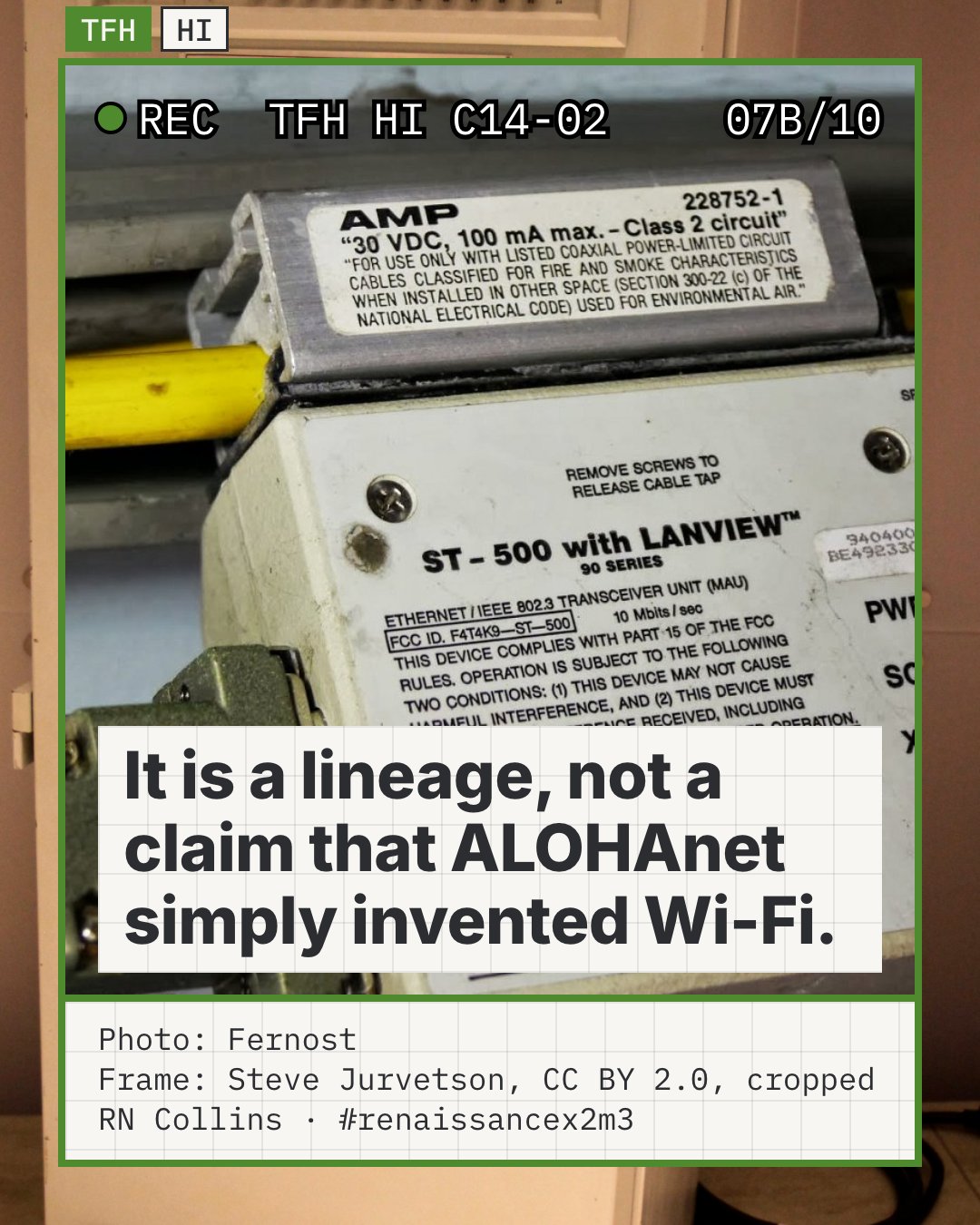
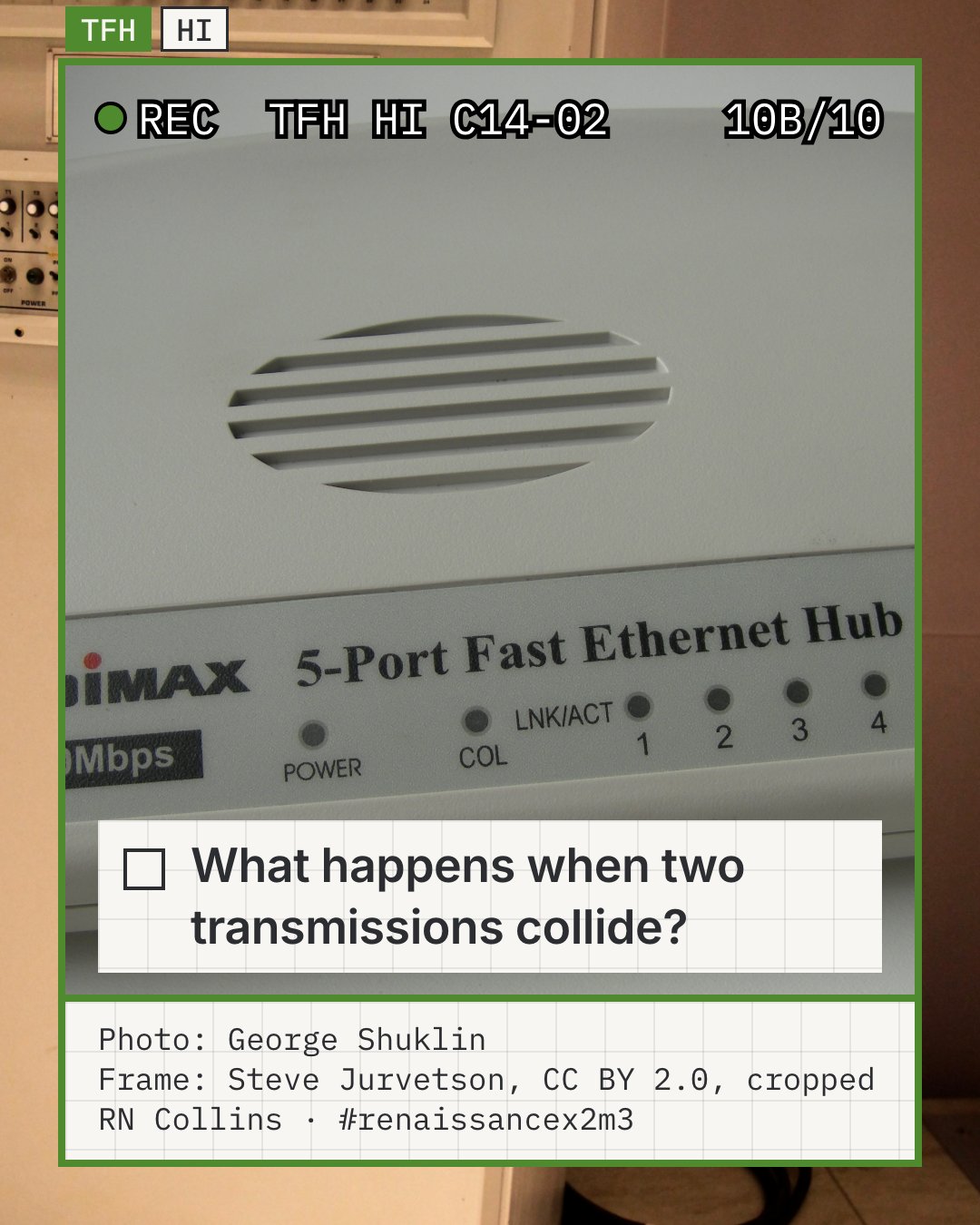
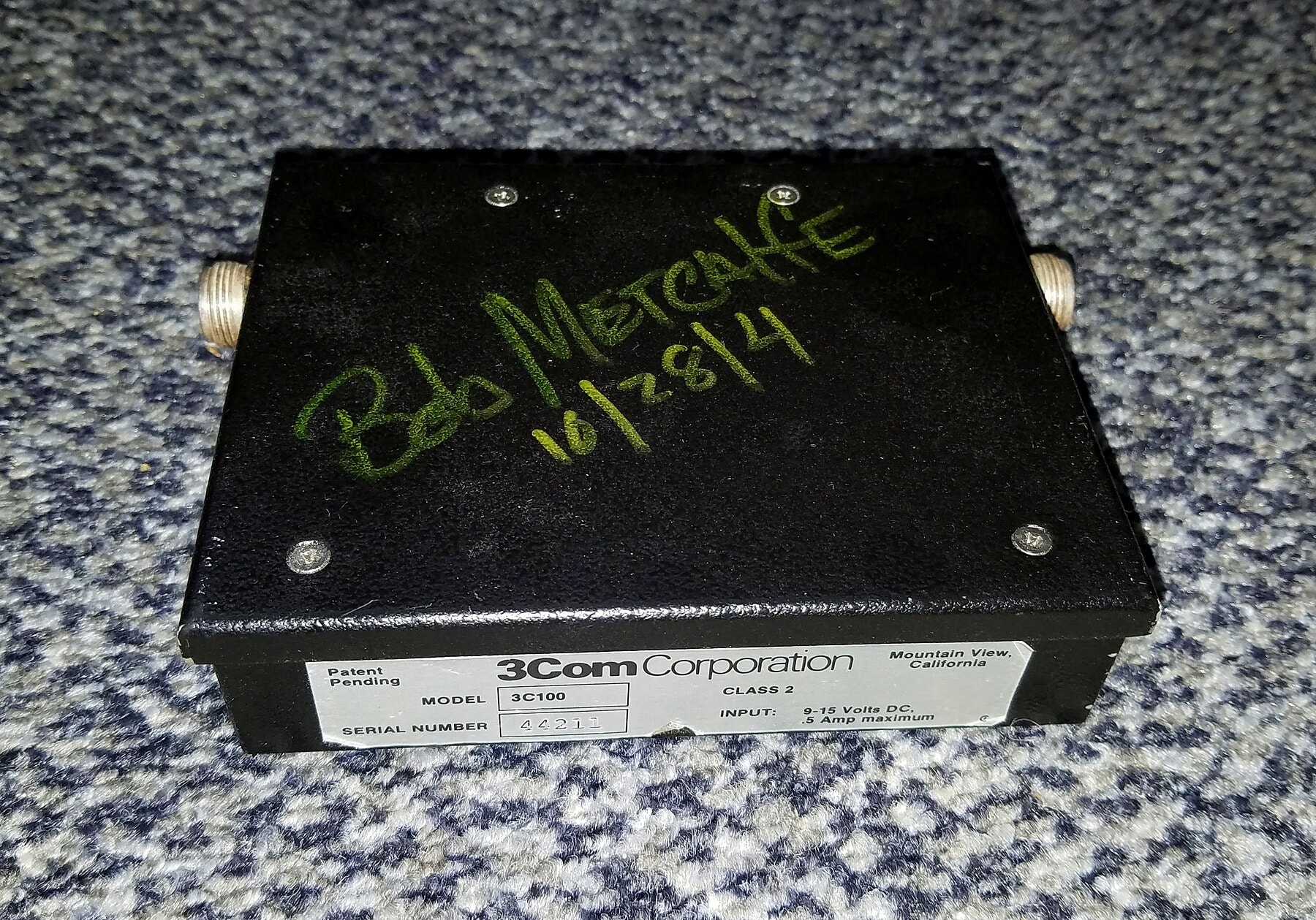
Ethernet, built by Robert Metcalfe and David Boggs at Xerox PARC between 1973 and 1975, took ALOHA's shared-channel idea and added carrier sense, listening before and while transmitting, on top of ALOHA's collision-and-retry logic. Xerox filed the patent application on March 31, 1975, naming Metcalfe, Boggs, Chuck Thacker, and Butler Lampson, and U.S. Patent 4,063,220, "Multipoint data communication system with collision detection," issued in December 1977; Metcalfe and Boggs had already published the design in Communications of the ACM in July 1976.
In that 1976 paper, Metcalfe and Boggs wrote that their design began with the basic idea of packet collision and retransmission developed in the Aloha Network. They described an experimental Ethernet running at 3 megabits per second over a kilometer of cable. The 1976 paper shows ALOHA’s collision-and-retry logic reappearing on a wired cable.
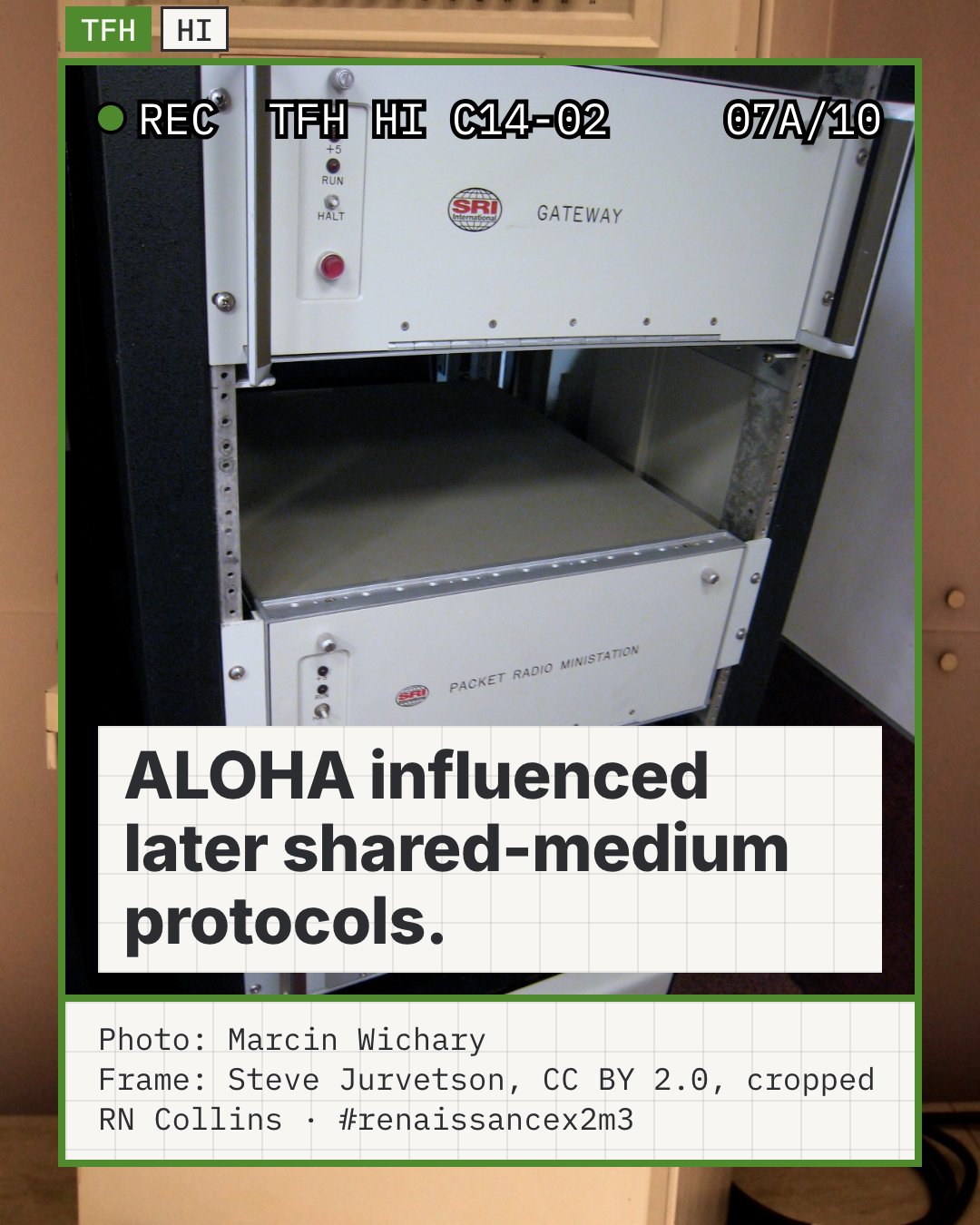
PRNET, DARPA's Packet Radio Network, was by 1981 running in prototype in the San Francisco Bay Area out of SRI International in Menlo Park, extending ALOHA's model from a single fixed hub to mobile, wide-area routing. SATNET, the Atlantic Packet Satellite System, ran a demand-assignment protocol over the Atlantic. Its contention mode for low-traffic stations was slotted ALOHA wrapped inside a scheme called CPODA, which Kuo counted among the most advanced packet communications systems of the 1980s.
The idea has outlived the networks it first served. Passive UHF RFID tags, the kind used in warehouse inventories and retail stock counts, are read under the EPC Gen2 standard, whose anti-collision procedure is a framed slotted ALOHA scheme: the reader opens a frame of time slots, each tag picks one at random, and the reader adjusts the frame size when too many tags answer at once.
The same logic runs through the standards that followed. Ethernet was standardized as IEEE 802.3 in 1983, and Wi-Fi's first IEEE 802.11 standard appeared in 1997, with Wi-Fi using collision avoidance rather than collision detection because a radio cannot reliably listen while it talks.
Metcalfe has told his own version of finding the paper. Staying at a colleague's house, he read Abramson's 1970 AFIPS conference paper describing the ALOHA network being built at Mānoa. He came away not impressed but irritated. Abramson's throughput model, in Metcalfe's retelling, assumed an "infinite number of users" when "the fact is they would be lucky to have ten users," and it assumed idle terminals kept transmitting blind rather than waiting for an acknowledgment. Metcalfe built a corrected model -- a fixed, finite population of real users who wait, then retry -- and added the piece Abramson's original design lacked: a back-off algorithm, in which "if a collision is detected, it should be taken as evidence that the channel is busier than anticipated," so the random retry window grows. The fix, folded into a revised dissertation, got him his Harvard PhD in 1973. He later described the theoretical gap this way: uncontrolled ALOHA throughput peaked around 17 percent, while Ethernet, with carrier sense and back-off added, could peak "at 99 percent plus" -- his own figure, not an independently audited one, but his account of why the fix mattered.
The people involved did not get much more time with each other. Abramson taught at UH Mānoa until 1996, then chaired the university's Information and Computer Sciences Department before retiring; he collected the IEEE Alexander Graham Bell Medal in 2007 and the NEC Computer and Communications Award in 2011, among other honors, and held eight patents. Kuo left for the Pentagon in the late 1970s as director of information systems in the Office of the Secretary of Defense, later worked at SRI International, and co-founded a wireless communications company in 1994.
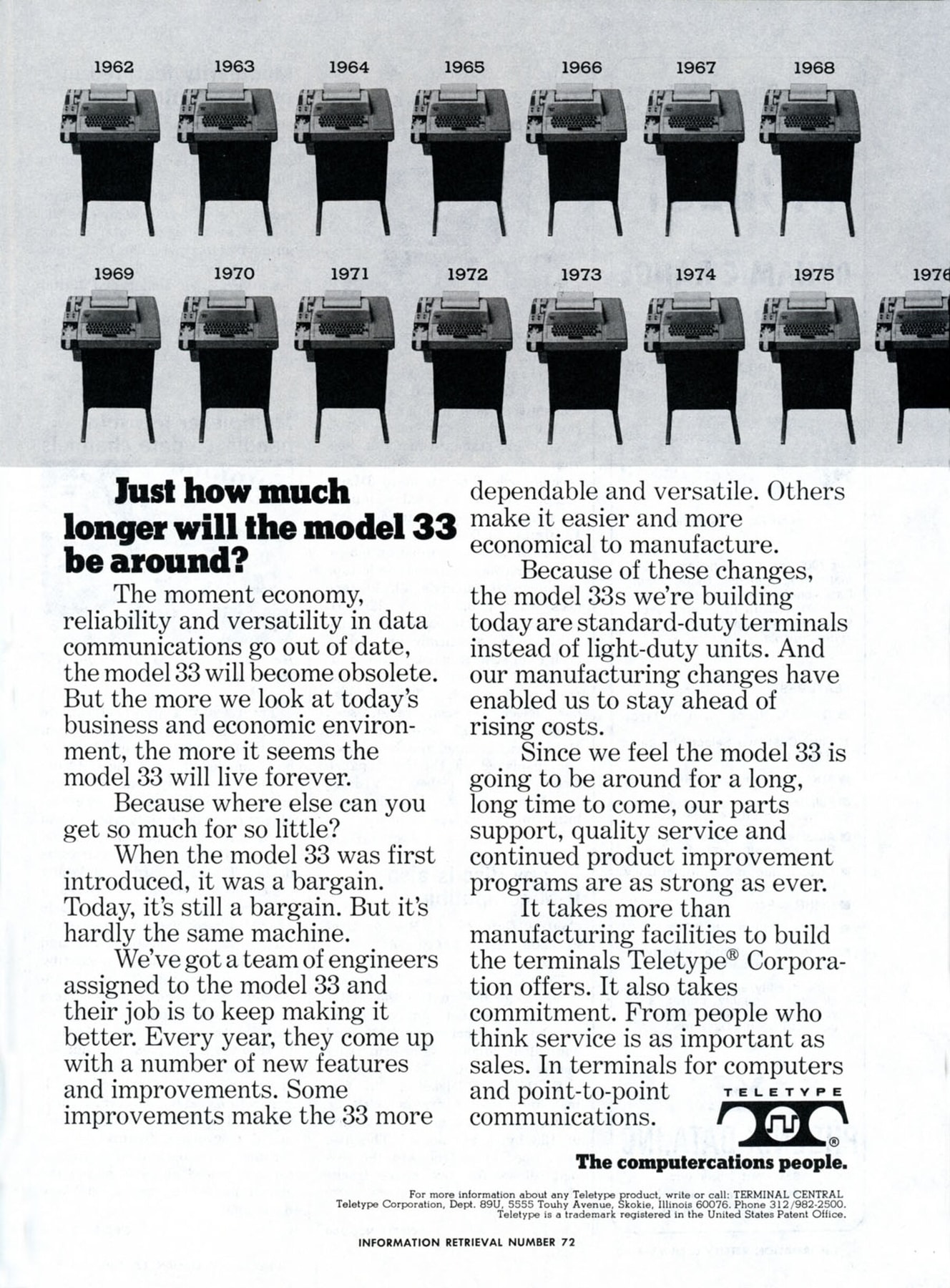
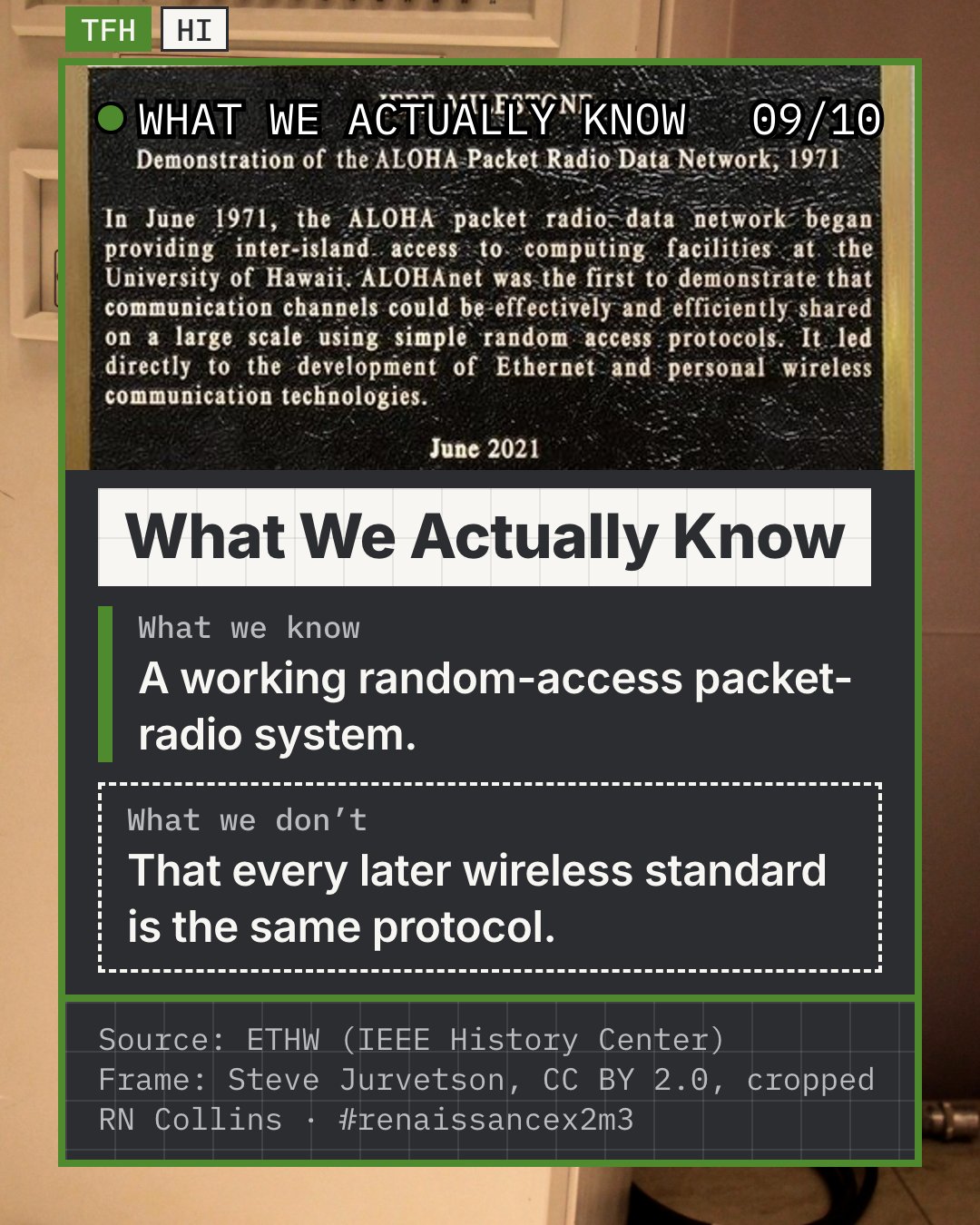
The IEEE did not get around to marking the site until October 13, 2020 -- Milestone #207, not 1974 as sometimes assumed, with plaques at Holmes Hall on the Mānoa campus and at the Computer History Museum in Mountain View. Its citation reads, in full: "In June 1971, the ALOHA packet radio data network began providing inter-island access to computing facilities at the University of Hawaii. ALOHAnet was the first to demonstrate that communication channels could be effectively and efficiently shared on a large scale using simple random access protocols. It led directly to the development of Ethernet and personal wireless communication technologies." Abramson appeared in a video for the dedication. He died less than two months later, on December 1, 2020, at 88. Kuo was recognized at the same ceremony and lived another five and a half years, dying April 14, 2026, at 91 -- the last of the ALOHA System's principal designers to go. The plaque is a commemoration written afterward, not a record of what the network did. What the network did was answer, for the first time, the question every shared channel eventually has to answer: not who goes first, but what happens when two people talk at once, and how quickly the system forgives it.
That question did not stay confined to 1970s satellite links. The same random-access principle, refined into carrier-sense multiple access, is the layer underneath ordinary Wi-Fi today: an 802.11 device listens for a quiet channel before it transmits, backs off and retries at a randomized interval if it senses a collision, and repeats the process by the millisecond, largely invisibly, every time a laptop or phone joins a shared network. Bluetooth and the low-power radios behind Zigbee-based smart-home devices descend from the same family of random-access ideas. The specific radios, satellites, and mainframes described above are gone. The question Abramson's team answered first, in a network built to link a handful of Hawaiian islands to one mainframe, is still being answered, slightly differently, by every device now reading this sentence over a wireless connection.
Abramson himself put it in more personal terms not long before he died: he liked to say that whenever someone picks up a telephone to make a call, the very first thing that happens is a packet leaves that phone, and the packet says “aloha,” which is as close to a signature as a protocol is likely to get.
It is worth noticing how modestly the idea first arrived. Abramson's 1970 paper was titled “The ALOHA System: Another Alternative for Computer Communications,” an alternative, not a replacement, offered to people who were still mostly buying leased lines. Its central move was an inversion of what shared channels had assumed. Reservation systems, which gave each user a scheduled turn, treated a collision as a failure to be prevented.
ALOHA treated it as an ordinary event to be repaired, and then made the repair cheap: an acknowledgment to confirm success, a random pause to break the deadlock, and a retry. The network never needed to know in advance who would speak next, only how to recover when two people spoke at once. That trade of coordination for recovery is why the rule travelled so far from Hawaiʻi.
It works anywhere the traffic is bursty, the users are many, and the cost of asking permission first would exceed the cost of occasionally being wrong, which describes a surprising share of the connected world. The cost of the trade is visible too: a random-access network is fast when it is quiet and slows sharply as it fills, which is why so much of the engineering that followed went into limiting how much traffic reached the channel at once.
That a rule for sharing a radio channel was worked out between islands, by a small team solving a local problem of distance, terrain, and the price of a phone line, is part of why the story belongs to Hawaiʻi at all. The archipelago did not supply the mathematics, which Abramson, Kuo, Peterson, and their colleagues brought with them, but it supplied the constraint that made the mathematics necessary. A campus spread across islands could not afford to give every user a wire or a reserved slot, so it learned to let them talk, and to forgive them when they collided.
Source added October 3, 2026 (checked on that date): Robert M. Metcalfe and David R. Boggs, Ethernet: Distributed Packet Switching for Local Computer Networks, Communications of the ACM, July 1976, cl.cam.ac.uk/teaching/0708/DigiCommI/metcalfe1976ethernet.pdf.


_and_Experimental_Packet_Radio_(EPR)_(2230480776).jpg)




.jpg)

.jpg)
