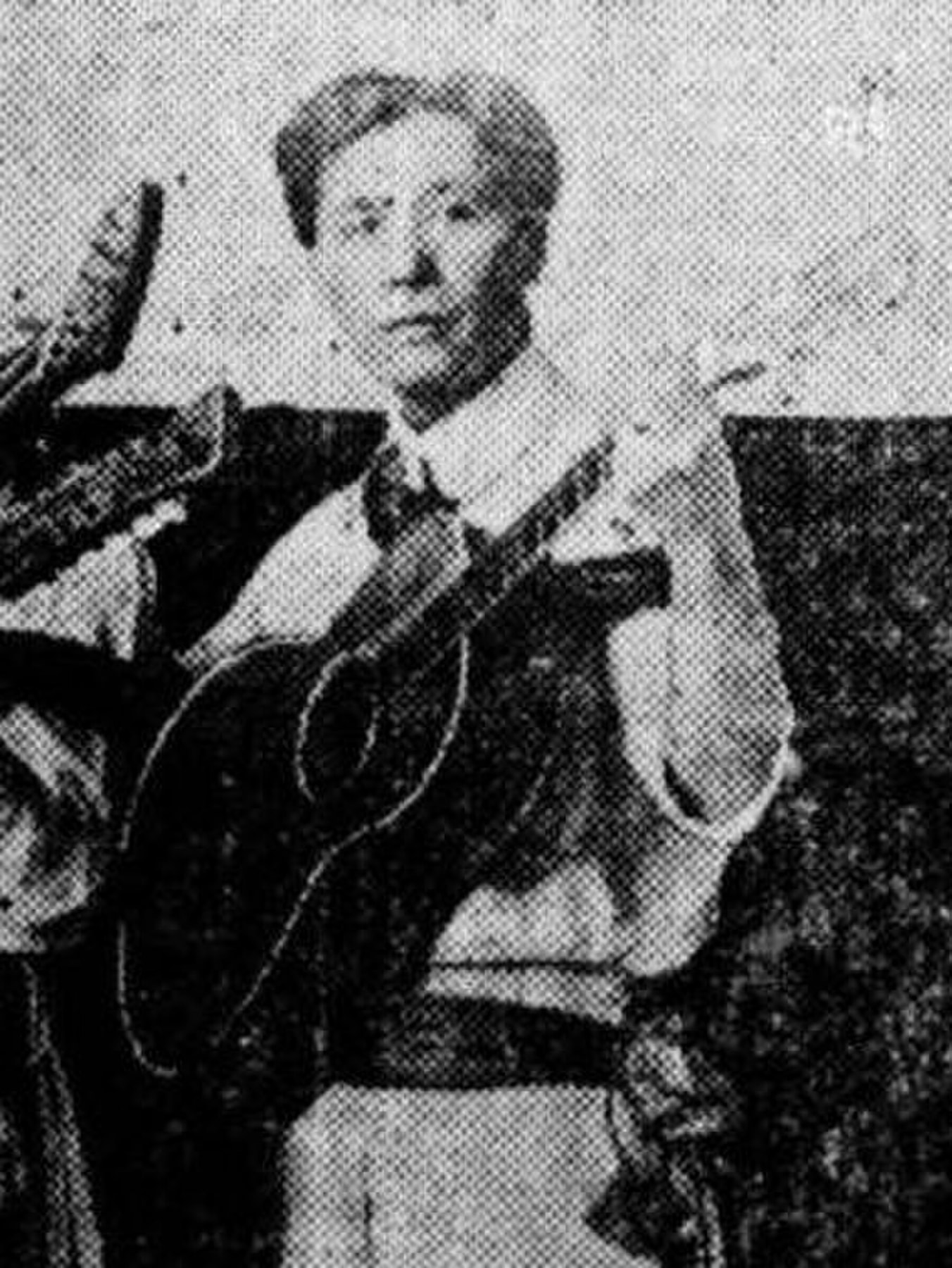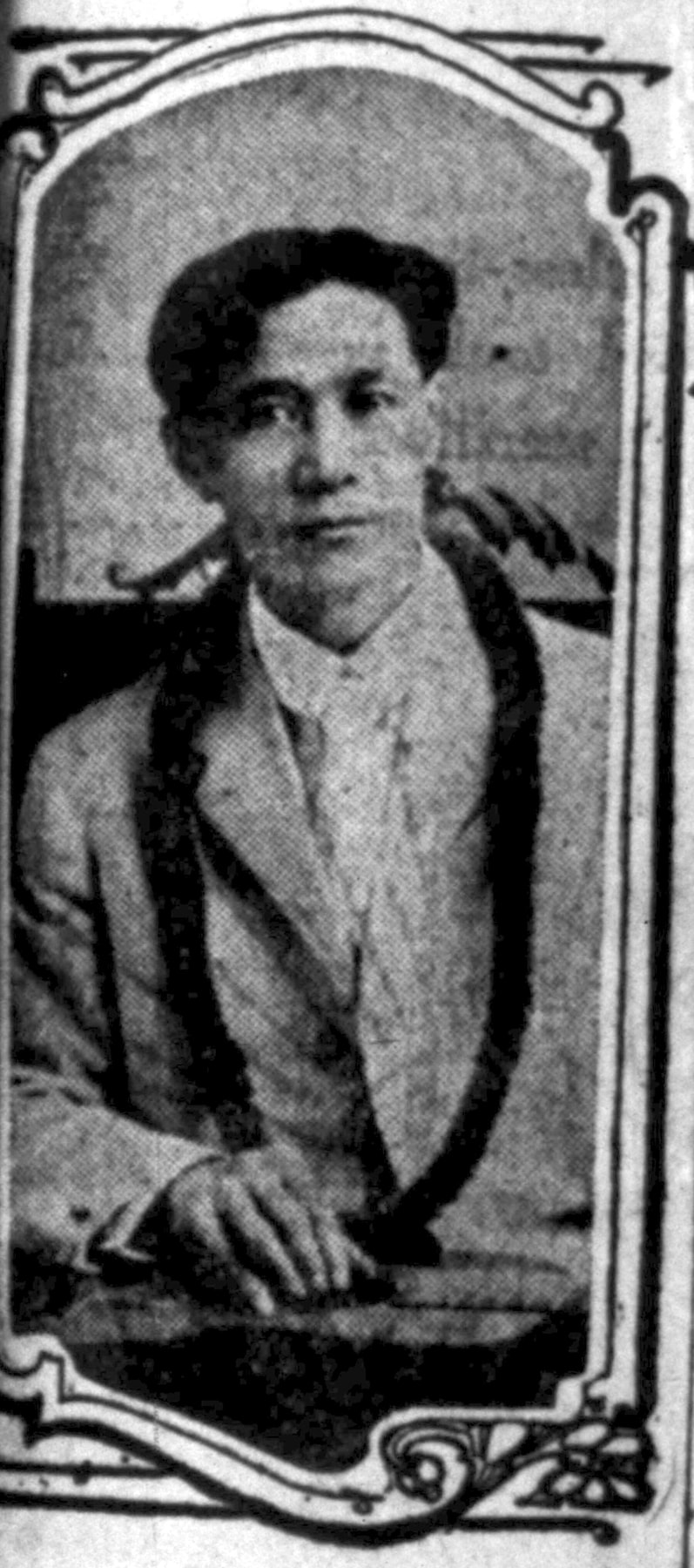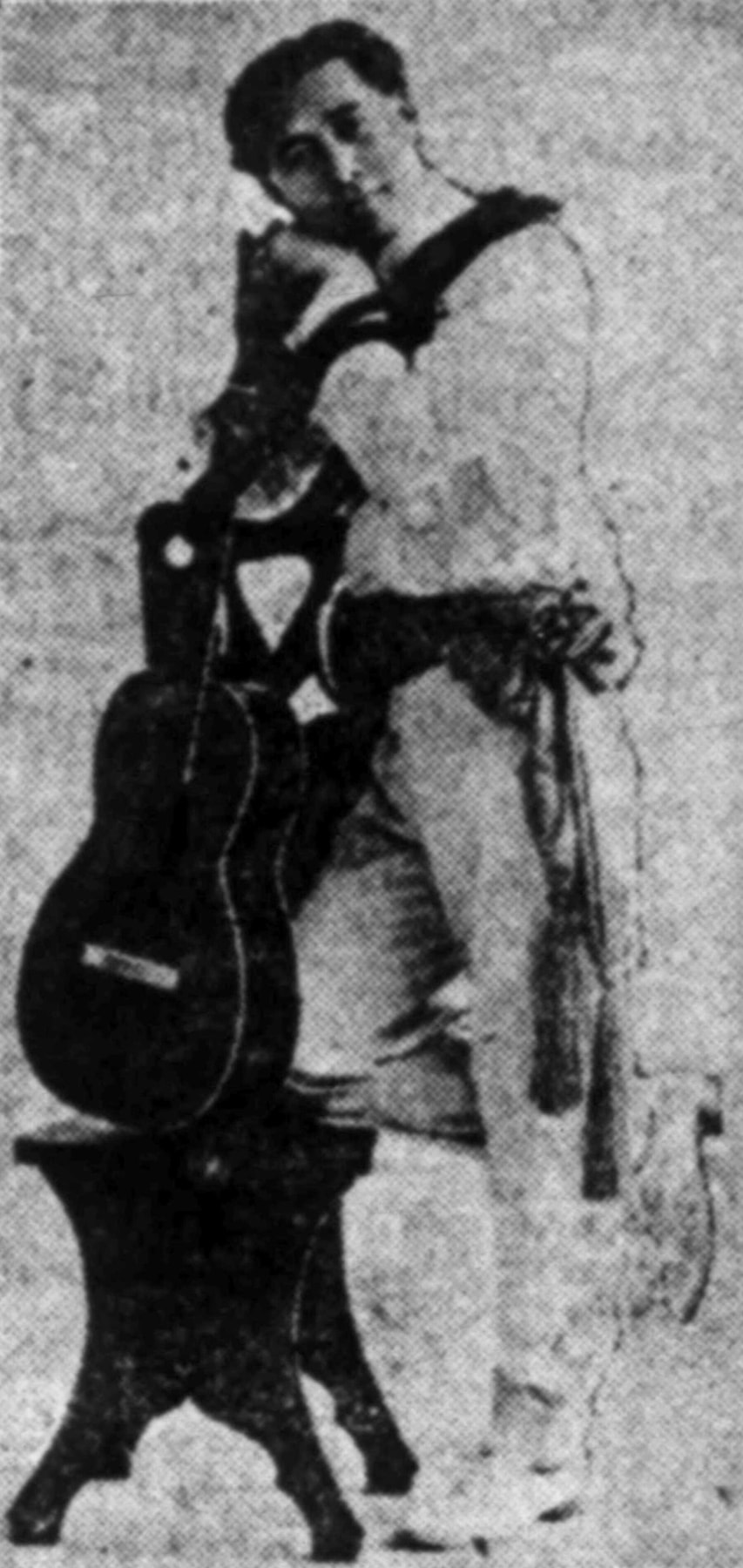
The story
Listen to a steel guitar bend toward a note and you may hear country music.
Joseph Kekuku is the person most closely associated with developing the technique, in 1889, as a teenager at the Kamehameha School for Boys on Oʻahu.
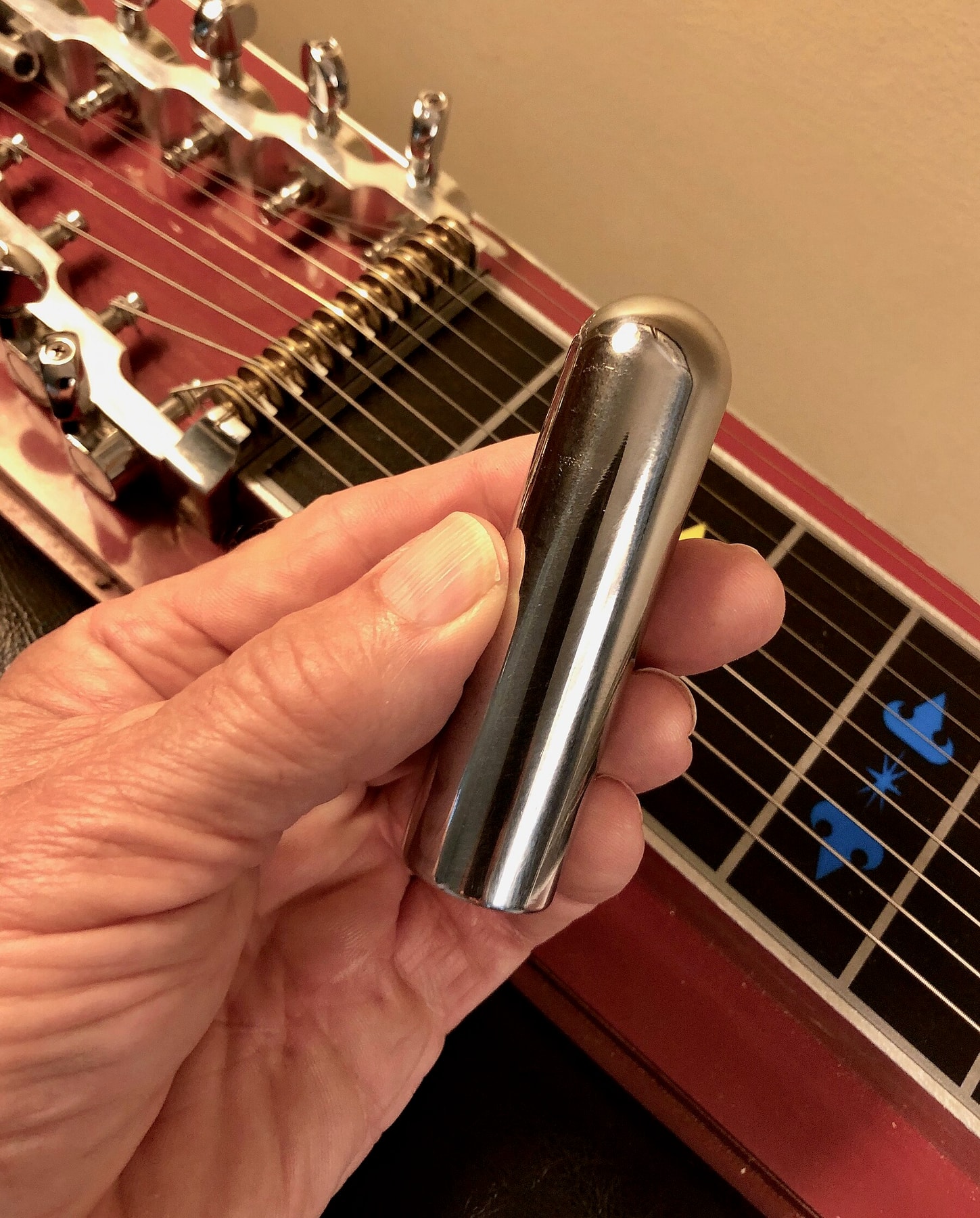
The accounts of exactly how (a dropped bolt, a comb, a knife back dragged across the strings) were recorded later, disagree with each other, and cannot securely recover a single first moment. The better story begins after the supposed accident: Kekuku spent years filing a steel bar smooth, raising the strings' action, and retuning them into an open chord so the bar alone could carry a melody. He did not merely discover a noise. He built a technique precise enough to teach.
By his own later account, the trigger was a rusty bolt he found on a railroad track as a boy and pressed idly against his guitar strings; other tellings credit a pocketknife or a comb. Kekuku never claimed the accident mattered as much as what came after it: he settled on open-A tuning, raised the strings above the frets on a bar of polished steel, and built the instrument that every steel guitarist since has inherited, whatever they call it. No Hawaiian word for the instrument existed before he built it; Hawaiians simply transliterated the English words themselves, calling it kīkā kila (guitar, steel) because the object needed a name before anyone outside Hawaiʻi had a claim to give it one.
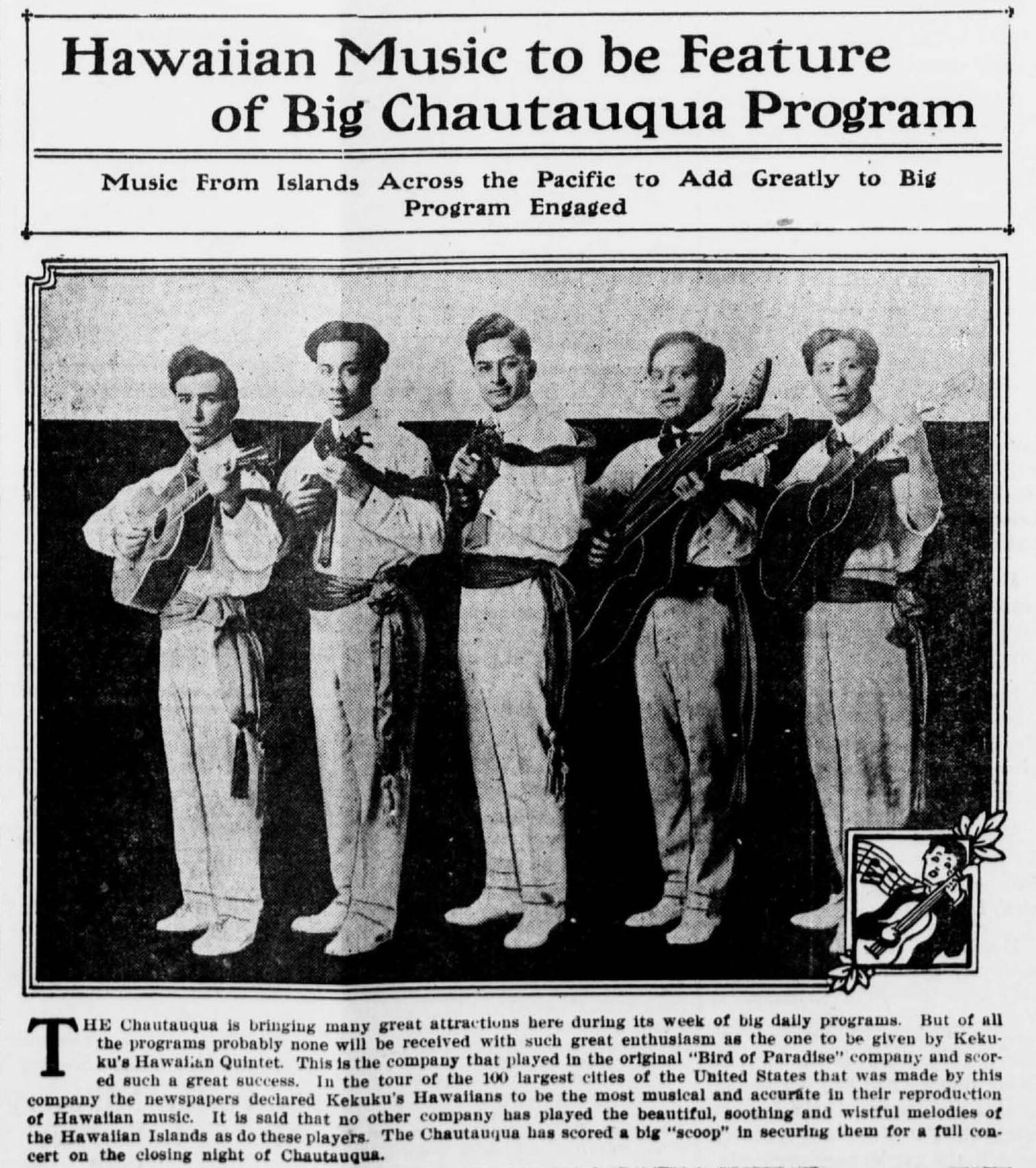
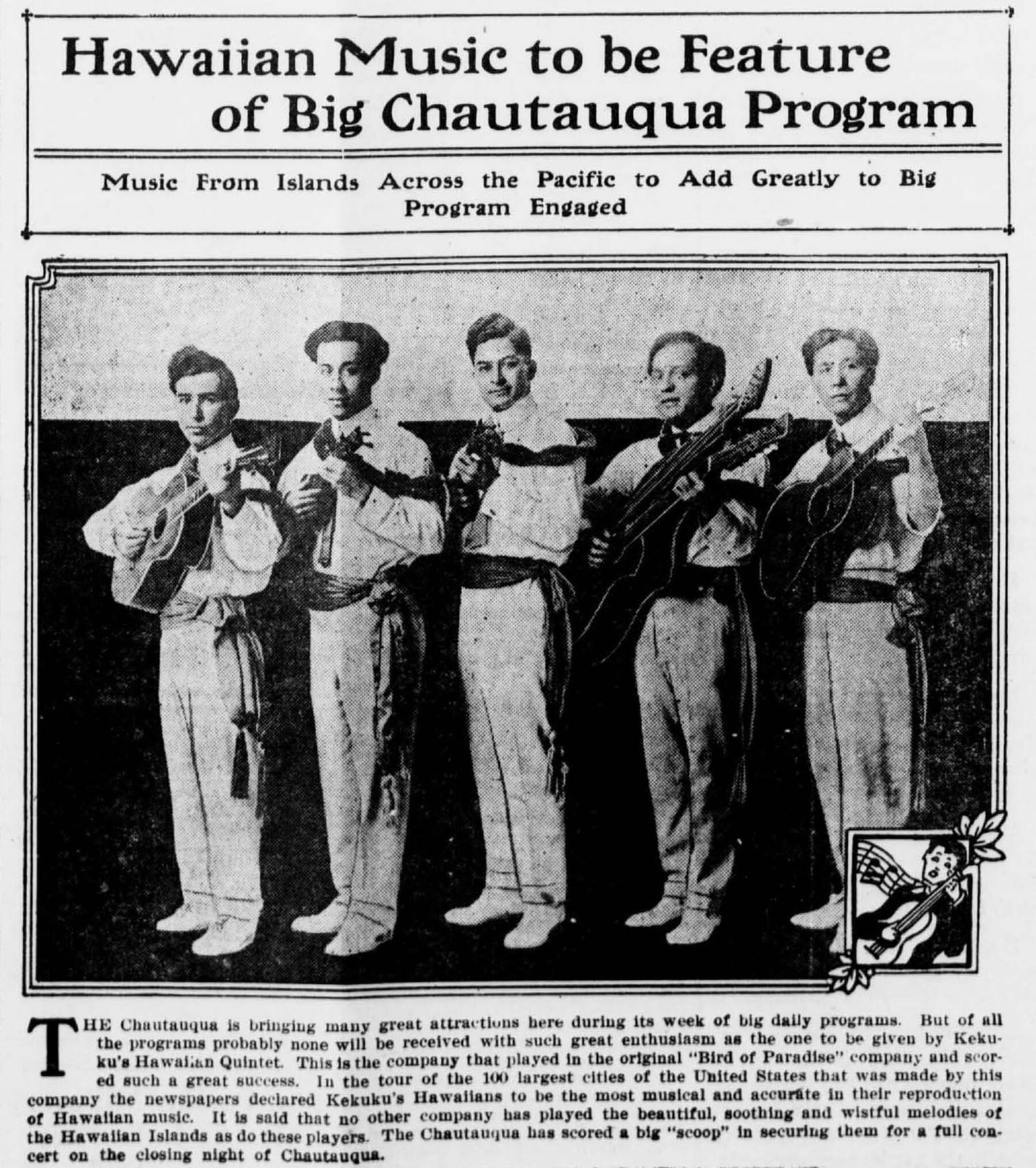
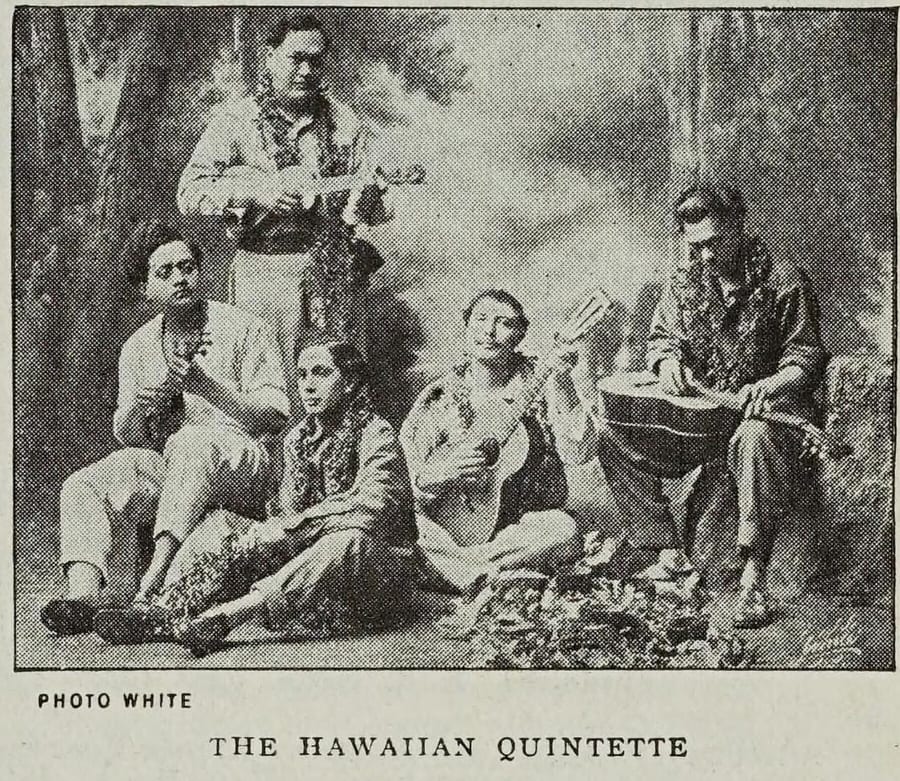
Other Hawaiian musicians adopted, changed, taught, and performed the technique, and it left the islands inside Kekuku himself: he sailed for the US mainland in 1904 and worked vaudeville circuits for over a decade. When the Broadway hit "The Bird of Paradise" (a sensation since its 1912 premiere, with steel guitarist Walter Kolomoku already in its original 1912 pit orchestra, part of the Hawaiian Quintette the producers had imported for the show) was reorganized for a European tour in 1919, Kekuku took the steel guitar chair and kept it for eight years, playing before royalty across the continent.
The ukulele descends from small Portuguese instruments such as the machete, and Wikipedia places its beginnings with Madeiran immigrants who arrived aboard the Ravenscrag in late August 1879. Manuel Nunes, José do Espírito Santo and Augusto Dias are generally credited as its first makers. At the 1915 Panama-Pacific International Exposition in San Francisco, the Hawaiian pavilion featured the Royal Hawaiian Quartet and the ukulele maker Jonah Kumalae, and one account says the fair escalated the Hawaiian sound into a national obsession.
Instructional books converted the embodied technique into diagrams, tunings, exercises, and standardized lessons for players who had never been near Hawaiʻi. By the 1916 recording-industry boom that followed, sheet-music publishers who had never heard of Kekuku were printing songs built around his invention.
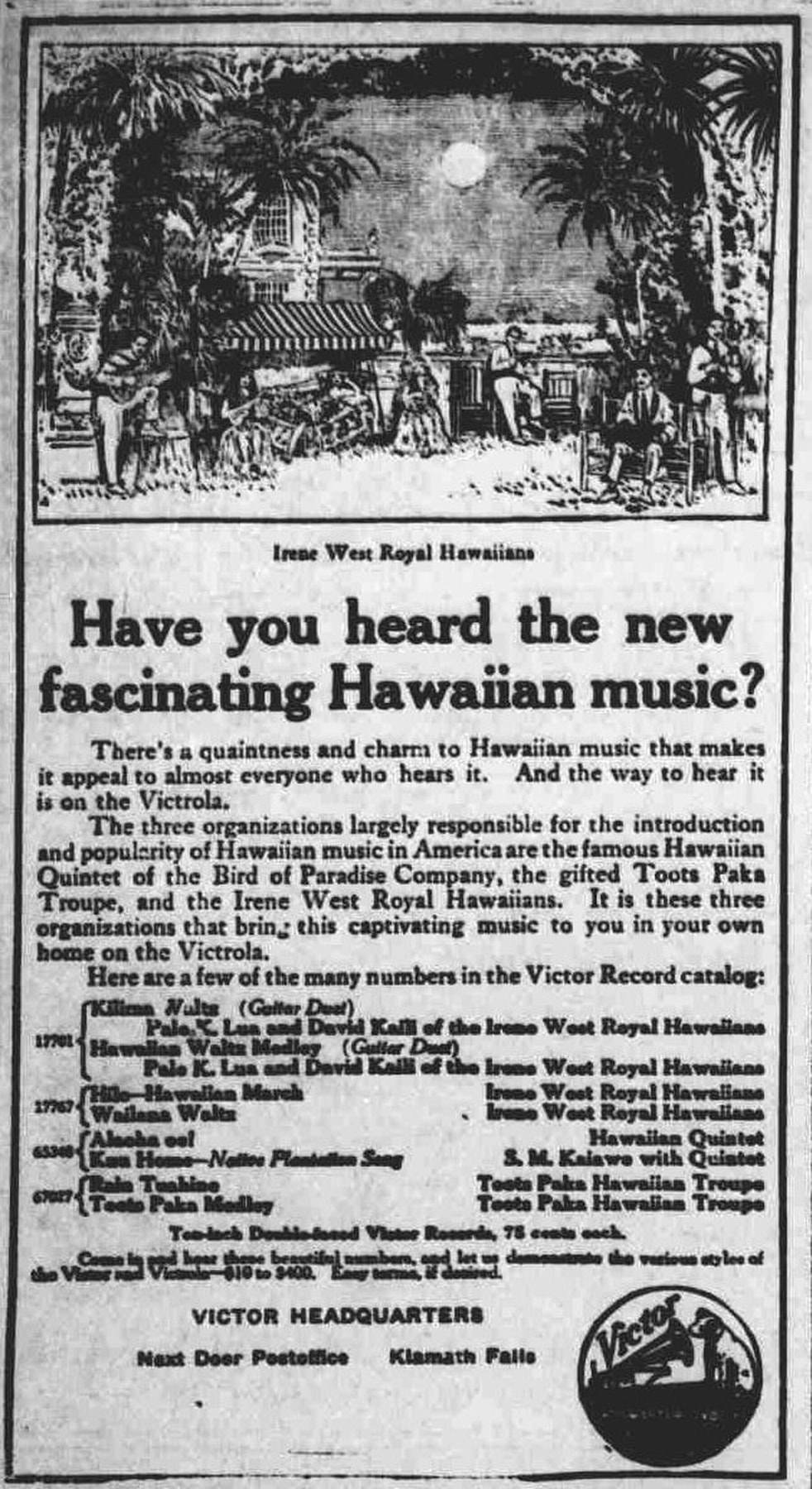
The 1915 Panama–Pacific International Exposition in San Francisco had done as much as any single event to spread the sound: its Hawai‘i Pavilion introduced the steel guitar to some of the roughly nineteen million visitors who passed through the fair over nine months. By 1916, recordings of Hawaiian steel guitar outsold every other genre of music in the United States, and Edison Phonograph Monthly told its trade readers that season’s biggest popular hits were, without exception, Hawaiian songs. Publishers coined a name for the resulting genre (hapa haole, “half white,” for English-language songs dressed in Hawaiian musical color) and companies like the Oahu Music Company built a business selling steel guitars, method books, and sheet music to mainland Americans who would mostly never hear a Hawaiian musician play a note of it.
A pickup converted the vibration of metal strings into an electrical signal that could be amplified.
George Beauchamp’s route to the Frying Pan ran through volume. A steel guitarist, he asked John Dopyera for a louder instrument, and in 1927 the two formed the National String Instrument Corporation to build resonator guitars that could compete with brass and reed instruments in dance orchestras. Resonator guitars are most often played as lap steels, which makes the pickup look like a second answer to a problem players already faced.
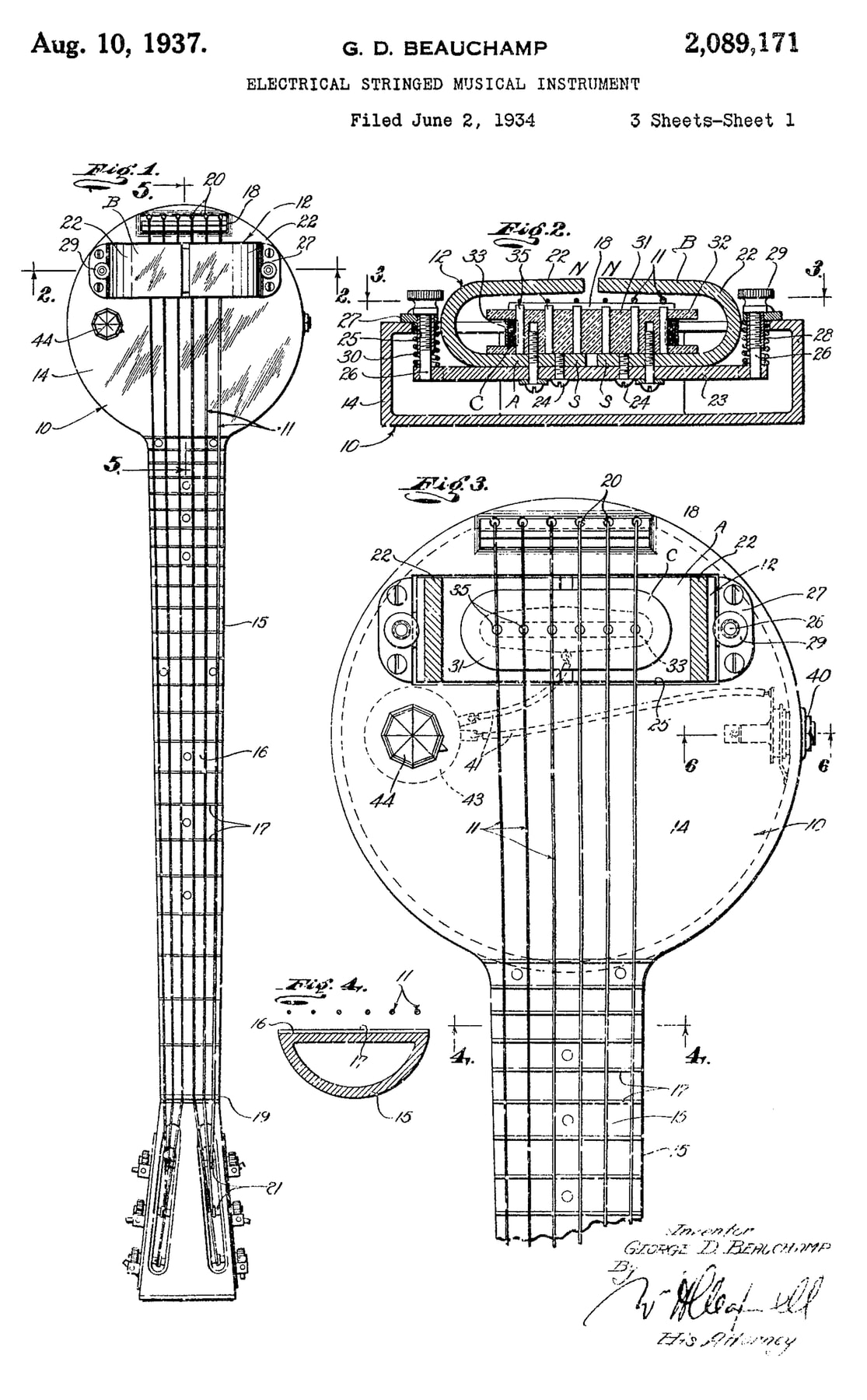
One of the earliest commercially successful electric-guitar forms was the cast-aluminum lap steel associated with George Beauchamp, Paul Barth, and Adolph Rickenbacker, sold from 1932 under their Ro-Pat-In company (ElectRo-Patent-Instruments) and nicknamed the "Frying Pan" for its round body. The company took the surname of co-founder Adolph Rickenbacker rather than Beauchamp’s, and not by coincidence: Adolph’s cousin was Eddie Rickenbacker, the country’s most famous World War I flying ace, and the instrument-makers judged his name easier to sell than their own. Beauchamp's patent, filed in 1934 and granted in 1937 as US Patent 2,089,171, described an electrical stringed instrument that did not depend on a conventional soundboard or resonance box, the same magnetic-pickup principle every solid-body electric guitar still uses. Kekuku did not live to hear it: he died in January 1932, the same year the instrument he made possible went electric.
Kekuku's own countrymen carried the technique south before the recordings did. Hawaiian troupes toured the American mainland through the nineteen-tens and twenties on vaudeville circuits, Broadway runs, and world's-fair stages, and their itineraries ran directly through the segregated South. Touring under Jim Crow, Hawaiian musicians lodged in the same boarding homes as the era's other itinerant performers (Mexican mariachis, Chinese acrobats, Black vaudeville acts) and by night, historian John W. Troutman has documented, they would all end up in boarding homes, hanging out, playing music. Iolai Kealoha Paka, Pali K. Lua, Walter Kolomoku, and Frank Ferera were among the Hawaiian musicians whose names appear on tour bills and early recordings from this period, each helping carry the technique into rooms it was never marketed toward.
Ferera is the sharpest case. Recording for Victor and then Columbia from 1915 onward, his 1916 duet “Drowsy Waters” sold more than 300,000 copies, and across his career, much of it in partnership with guitarist Anthony Franchini, he cut more than 3,500 recorded sides, by some measures making him the most recorded guitarist of the era, mainland or Hawaiian, working in any style. A career that size does not usually disappear from memory. His did, almost entirely, outside specialist discographies.
The technique had already reached the Mississippi Delta on its own, and blues history's own founding anecdote says so. In his 1941 memoir Father of the Blues, composer W. C. Handy described waiting for a train at Tutwiler, Mississippi, around 1903, when a guitarist beside him began playing with a knife pressed against the strings, a technique Handy himself described as used in a manner popularized by Hawaiian guitarists who used steel bars. The story that opens the standard history of the blues already names Hawaiʻi. It rarely stays named for long.
Sylvester Weaver made the first commercial blues slide-guitar recording in 1923; Blind Lemon Jefferson followed in 1926, cradling the instrument flat across his lap and fretting with a slide the way Kekuku and other Hawaiian steel guitarists did, rather than holding it upright and fretting conventionally. Delta blues patriarch Son House, asked decades later by researchers where he had first heard slide guitar, answered with a question of his own (Oh, you mean the Hawaiian way of playing?), then described the people who had first demonstrated it to him. The influence reached further than technique. Guitarist Casey Bill Weldon recorded and toured through the 1930s billed as The Hawaiian Guitar Wizard; B. B. King said he built his own signature finger vibrato specifically to imitate the Hawaiian steel sound, which he called one of the sweetest sounds this side of heaven. Bukka White, Huddie “Lead Belly” Ledbetter, Tampa Red, Elmore James, and Muddy Waters all worked the same lap-style slide technique into blues guitar at some point in their careers, learning it, like most of their listeners did, from records and radio rather than from a Hawaiian teacher standing in the room.
Country music's own origin story runs through the same erasure. The Country Music Hall of Fame calls Jimmie Rodgers the man who started it all, and Rodgers recorded with Hawaiian steel guitarists on several sessions, including one credited only as Joseph Kaipo, playing, in one instance, on a song about Hawaiʻi itself. Kaipo's name does not appear in the surviving liner notes. One Joseph became the man credited with starting country music. The other became an uncredited session player on a song about his own home.
One Hawaiian player crossed directly into that mainland jazz-and-swing world himself. Sol Hoʻopiʻi stowed away on a San Francisco-bound steamer as a teenager in 1919 and talked his way out of trouble by playing for the passengers; by the late 1920s he was recording with his own trio, the first Hawaiian steel guitarist to fold jazz improvisation into the style, and his phrasing shaped a generation of steel players who followed, including the electric steel pioneers of Western swing. He appeared alongside Bing Crosby in the 1937 film Waikiki Wedding, one of the biggest box-office hits of the year.
Western swing carried the same lineage into Texas. In late September 1936, in a Chicago recording session, Bob Wills's Texas Playboys cut “Steel Guitar Rag,” composed by their steel guitarist Leon McAuliffe, who adapted it from “Guitar Rag,” the 1923 blues recording by Sylvester Weaver, the same Weaver this essay has already met. McAuliffe later said the record played the leading role in making the steel guitar popular in American music, and it became country music's first steel guitar standard. An amplified steel had already been on record: in January 1935, Bob Dunn, steel guitarist with Milton Brown and His Musical Brownies, became one of the first musicians to record an electrically amplified instrument, influenced by Sol Hoʻopiʻi and playing in a blues-inflected style of his own.
The instrument kept evolving after Kekuku's death, and each step folded further from his name. Bandleader Alvino Rey worked with Gibson to build a pedal-operated steel guitar, released in 1940 as the Electraharp, the first steel guitar with a foot-pedal mechanism, though only forty-three were sold before wartime production halted it. Steel guitarist and toolmaker Paul Bigsby refined the idea after the war, building a rack-and-cable pedal mechanism for player Speedy West in 1948. In 1952, Bigsby built a double-neck pedal steel for a young player named Bud Isaacs. During a Nashville session in November 1953, producer Owen Bradley asked Isaacs to solo on Webb Pierce's Slowly, and Isaacs pushed his pedal while a note was still sounding, bending pitch into a chord in a way other steel players had until then considered un-Hawaiian. Slowly spent seventeen weeks at No. 1 on Billboard's country chart in 1954. Steel guitarist Lloyd Green later said Isaacs had thrown a new tool into musical thinking about the steel that still reverberates to this day. The pedal steel guitar is now one of the most recognizable instruments in American country music. Few of the players chasing Isaacs' sound that year were chasing Kekuku's name.
The same 1912 Bird of Paradise show that first put Kolomoku in a Broadway pit was successful enough to become a 1932 film adaptation, released the same year Kekuku died and the instrument he built went electric.
The split was not an accident of taste. Music executives marketed country music to white audiences and blues as race records to Black audiences, historian Troutman has argued, and the two segregated marketing categories buried a shared root under two separate, racially coded origin stories. Blues historiography has long credited the diddley bow (a single-stringed instrument of West African origin) as the source of slide-guitar technique, with little room left in that account for the Hawaiian musicians whose recordings, tours, and boarding-house sessions ran alongside the blues's own early years. Country music's story runs through Jimmie Rodgers and the Nashville sound with even less room for Kaipo, or Kekuku, or the dozens of touring Hawaiian musicians whose names filled tour bills but not liner notes.
That correction is now, slowly, an institutional project rather than an argument made from outside. John W. Troutman, whose research runs through this piece, is curator of music and musical instruments at the Smithsonian's National Museum of American History, where he oversees the collections documenting blues, country, rock and roll, and Hawaiian music together rather than as separate, unrelated holdings. His book on the subject went on to win the Organization of American Historians' prize for best book in American cultural history: recognition, from inside the same institutions that helped erase the story, that the story was wrong.
Kekuku himself kept teaching. He opened a successful steel-guitar school in Chicago in the 1920s before settling in Dover, New Jersey, and in 1993, more than sixty years after his death, the Steel Guitar Hall of Fame inducted him as the technique’s originator, a formal recognition that arrived decades after the instrument he built had already circled the globe under other names. Jerry Byrd, a mainland steel guitarist who learned the style from records rather than from Kekuku directly, had already become the Hall's first-ever inductee in 1978; Sol Hoʻopiʻi followed in 1979. Kekuku himself had to wait fourteen years longer than the players he had made possible.
The circling went further than the American South and Nashville. Hawaiian guitarist Tau Moe first performed in India in the late 1920s and later settled in Calcutta from 1941 to 1947, where he taught Hawaiian music and built and sold steel guitars. Indian composers folded its sound into Bollywood soundtracks through the 1950s and 60s (O. P. Nayyar, among others, wove it into scores alongside Punjabi folk rhythms and Latin percussion) and Indian musicians eventually adapted the instrument further still, modifying archtop guitars with sympathetic drone strings to play ragas, producing what is now recognized as a legitimate voice in Hindustani classical music. In Argentina, bandleader Francisco Canaro recorded more than a dozen tangos featuring the instrument between 1928 and 1930, and the duo Les Loups was promoted by Victor Records as “extraordinary players of the Hawaiian guitar” on a tango called “Hawayanita”: a little Hawaiian girl, sung about in Buenos Aires, on an instrument built on Oʻahu.
The tradition has not vanished, but it has thinned. Hawaiian steel guitar festivals that once drew hundreds of players now draw a fraction of that, and in 2009 musician Alan Akaka opened a school on Oʻahu, Ke Kula Mele Hawaiʻi, built around the values of hoʻihi, kuleana, mālama, and aloha and still the only music school in the islands offering dedicated instruction in the Hawaiian lap steel guitar, for the specific purpose of teaching the technique to players young enough to carry it past his own generation. In 2025, a new stage production, "Joseph Kekuku and the Voice of the Steel Guitar," brought his story to Honolulu audiences for the first time in a dedicated theatrical work.
The lineage is easy to hear and strangely easy to forget. Kekuku built it. Kolomoku, Ferera, Kaipo, and Hoʻopiʻi carried it. Moe, and Canaro's Argentine collaborators scattered it further still. Almost none of those names will be familiar to the people who hear the sound every day.
Put Hawaiʻi back into the sequence and the map changes.
Who is remembered as an inventor? Who is reduced to an entertainer? Which parts of a technology receive patents, museum labels, royalties, or institutional prestige? Which creators become atmosphere around somebody else’s origin story?
The next time a steel guitar bends a note through country, gospel, blues, rock, or another musical tradition, do not hear Hawaiʻi as decoration added to someone else’s music.
Source Desk
Joseph Kekuku's development of the steel-guitar technique, mainland career, and death: Wikipedia, "Joseph Kekuku."
The Frying Pan's design, the Ro-Pat-In/Electro/Rickenbacker company history, and US Patent 2,089,171: Wikipedia, "Frying Pan (guitar)" and "Ro-Pat-In Corporation."
The 1912 "Bird of Paradise" production and the spread of Hawaiian guitar instruction and sheet music on the mainland: Acoustic Guitar magazine, "Island Style: How Hawaiian Music Helped Make the Guitar America's Instrument."
The definitive scholarly history of the instrument and its global influence: John W. Troutman, "Kīkā Kila: How the Hawaiian Steel Guitar Changed the Sound of Modern Music" (University of North Carolina Press, 2016); Troutman is curator of music and musical instruments at the Smithsonian's National Museum of American History.
W. C. Handy's 1903 Tutwiler, Mississippi account and its explicit Hawaiian attribution: the Mississippi Blues Trail, "W. C. Handy Encounters the Blues," quoting Handy's 1941 memoir Father of the Blues.
Hawaiian musicians touring the segregated South and the industry segregated marketing categories for country and blues, per Smithsonian Magazine and Fretboard Journal.
Named blues guitarists who adopted the Hawaiian steel technique, including Sylvester Weaver’s 1923 recording, Son House, and Casey Bill Weldon’s stage billing: Steel Trappings, a publication of the Hawaii Institute for Music Enrichment and Learning Experiences, “Hawaiian Steel Guitar and the Blues.”
Jimmie Rodgers, credited by the Country Music Hall of Fame as “the man who started it all,” recorded with Hawaiian steel guitarists including one credited only as Joseph Kaipo: Wikipedia, “Joseph Kekuku,” and Steel Trappings, “Hawaiian Steel Guitar and the Blues.”
The Electraharp, Alvino Rey, and Paul Bigsby’s pedal mechanism: Wikipedia, “Pedal steel guitar.”
Bud Isaacs, the November 1953 “Slowly” session, and its impact on Nashville steel playing: Wikipedia, “Bud Isaacs,” and Fretboard Journal, “Wire and Hinges: How Pedal Steel Guitar Legend Bud Isaacs Changed the Course of Country Music.”
Walter Kolomoku and the 1912 Bird of Paradise orchestra, and Frank Ferera's recordings with Anthony Franchini - Steel Trappings and Wikipedia, Frank Ferera.
Sol Hoopii's stowaway arrival, recording career, and film appearances - Wikipedia, Sol Hoopii, and HistoryLink.org.
Tau Moe's years in Calcutta and the adoption of steel guitar into Bollywood soundtracks and Hindustani classical music - Premier Guitar, The Secret World of Hindustani Slide, and Wikipedia, Tau Moe.
Francisco Canaro's recordings and the duo Les Loups in Argentine tango - Tango Stories: Musical Secrets, The Hawaiian guitar in tango.
John W. Troutman's role as curator of music and musical instruments at the Smithsonian's National Museum of American History and his book's awards - Smithsonian Institution staff profile, John W. Troutman.
The 1915 Panama-Pacific International Exposition, the hapa haole genre name, and the Oahu Music Company - Wikipedia, Hapa haole music and Oahu Music Company.
Jerry Byrd's and Sol Hoopii's earlier induction dates relative to Kekuku's own 1993 induction - Wikipedia, Steel Guitar Hall of Fame.
Leon McAuliffe's Steel Guitar Rag, its September 1936 recording by Bob Wills and His Texas Playboys, its derivation from Sylvester Weaver's Guitar Rag, and Bob Dunn's January 1935 amplified steel recording with Milton Brown and His Musical Brownies - Wikipedia, Steel Guitar Rag, and Wikipedia, Bob Dunn (musician).
Sources added October 3, 2026 (each checked on that date): Wikipedia, Ukulele, en.wikipedia.org/wiki/Ukulele, and Resonator guitar, en.wikipedia.org/wiki/Resonator_guitar (secondary sources; the 1927 National String Instrument Corporation link rests on the resonator guitar page alone). The Hawaiian Invasion, The Appendix, theappendix.net/issues/2014/10/the-hawaiian-invasion.