The story
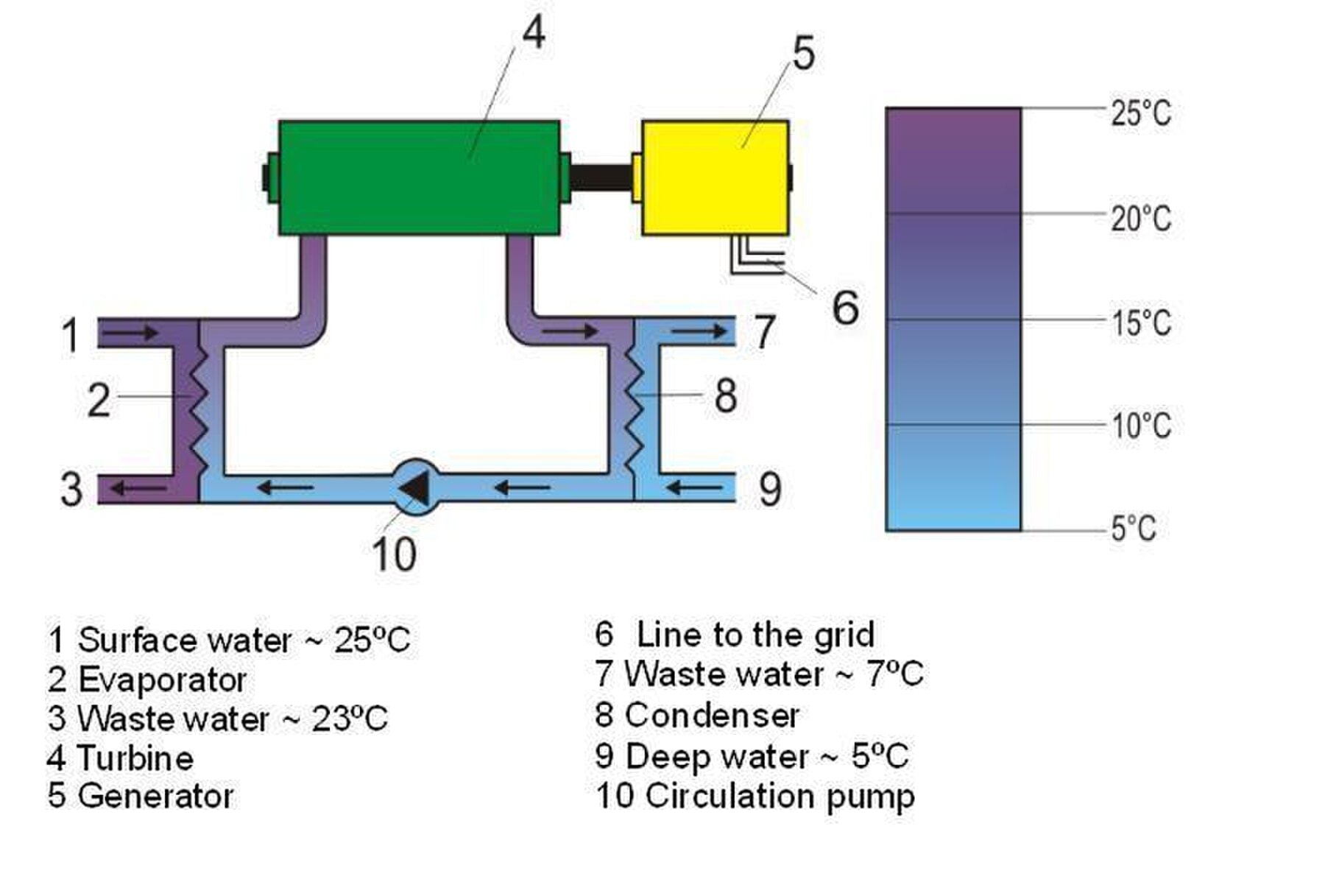
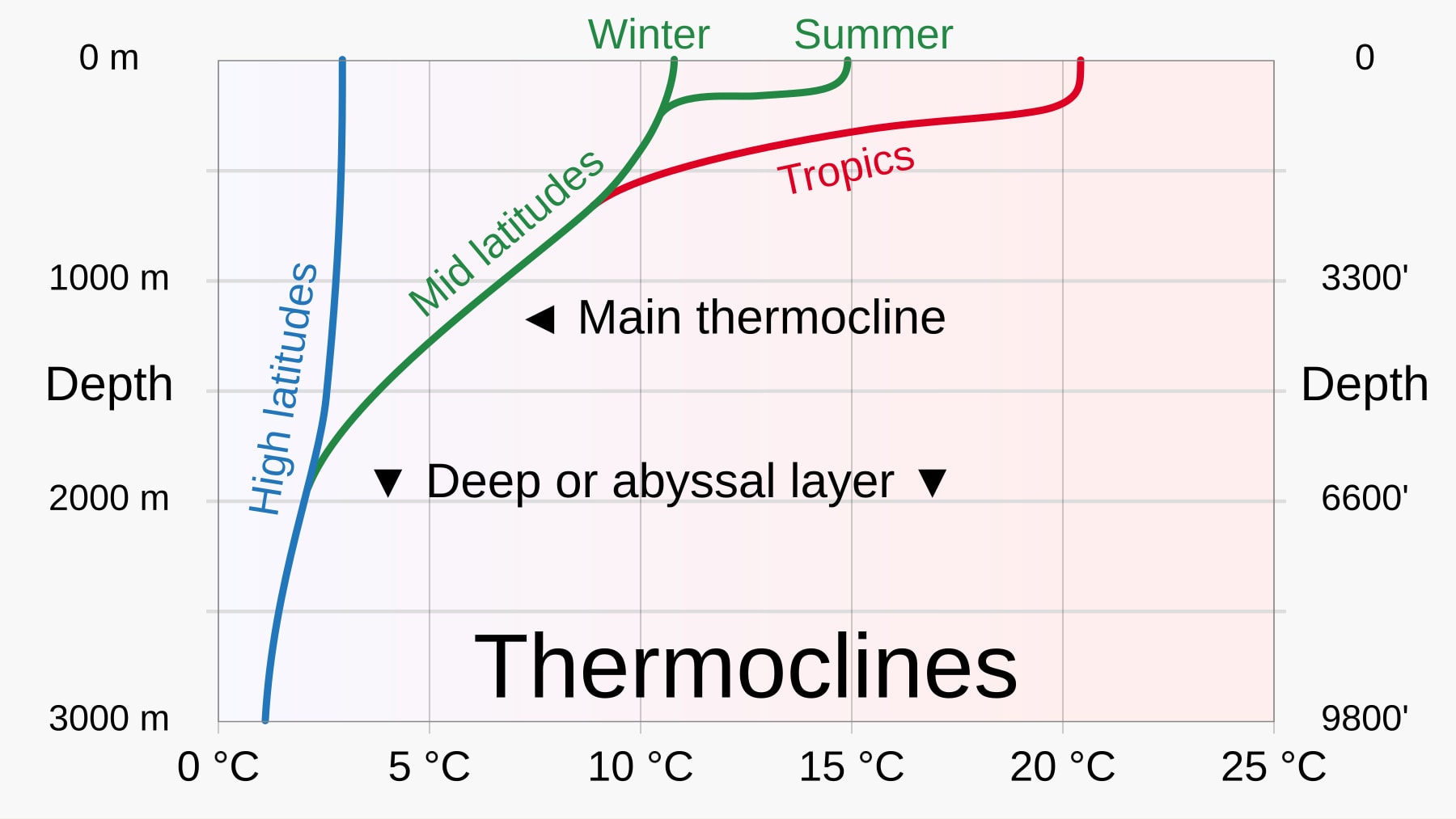
On August 2, 1979, a barge floating off Keāhole Point on Hawaiʻi Island's Kona Coast generated electricity from a resource that surrounds the islands in layers. The barge, floating about 2.2 kilometers offshore, was called Mini-OTEC, and it used the temperature difference between warm surface water and cold deep water to run a power cycle. Warm surface seawater passes through a heat exchanger and boils a working fluid with a lower boiling point, in Mini-OTEC's closed cycle, ammonia. The ammonia vapor spins a turbine, then a second heat exchanger cooled by deep seawater condenses it back to liquid so the cycle can repeat. Pumps keep immense volumes of warm and cold water moving through the system. Hawaiʻi eventually tested both closed- and open-cycle OTEC, but Mini-OTEC's world-first claim belongs to the closed-cycle design: it was the first OTEC system anywhere to put more power onto a load than it took to run itself.
The idea behind Mini-OTEC predates it by nearly a century. Marine engineer Luis Vega, who later ran an open-cycle plant at Keāhole, traces the first documented reference to making electricity from ocean temperature differences to Jules Verne's Twenty Thousand Leagues Under the Sea, published in 1870. Eleven years later d'Arsonval proposed warming pressurized ammonia with tropical surface water between 24 and 30 degrees Celsius, then condensing it with water brought up from depths of 800 to 1,000 meters. Mini-OTEC ran that closed ammonia loop in 1979.
The first builder was Georges Claude, who chose a different cycle: seawater itself, boiled in a vacuum. According to a history compiled by Brown, Gauthier and Meurville, he picked Matanzas Bay in Cuba partly because its currents stayed under half a knot. The pipe was the hard part. A rough sea took hundreds of meters of the first one. The second ran aground on a sandbar and sank in 500 meters of water. When his partners' budget ran out, Claude paid for a third pipe himself, 1.6 meters wide, rolled and welded on the spot from steel sheet. In September 1930 a small turbine reached 22 kilowatts on water at 27 and 13 degrees. Vega writes that the plant never reached net power and blames a poor site and mismatched power and seawater systems, and a second history says claims of net power cannot be verified.
Claude's second attempt put the plant on a ship. According to an account compiled by Michel Gauthier, he bought the vessel in 1933 and refitted it as La Tunisie, about 10,000 tons gross, carrying a 2.2-megawatt plant built around eight turbines of 275 kilowatts each. Vega says the design aimed at up to 2,000 tons of ice for Rio de Janeiro. The ship sat in 600 meters of water off Brazil. Assembly of the cold-water pipe began on February 8, 1935. After the fourth segment went on, the spherical float at the top began to shake violently, and when the fifth segment was bolted on, the plates joining the bottom of the pipe to the chains of the anchoring container were wrenched off. Claude could no longer pay for the flotilla standing by or the eighty-person workforce. He gave up, and Gauthier's account says he had the float destroyed with dynamite so that he would not be tempted to try again.
Vega attributes the failure to the missing offshore industry and ocean engineering skills of the 1930s and calls installing the pipe at sea Claude's biggest technological challenge. Mini-OTEC answered it in 1979 with a polyethylene pipe about 0.6 meters wide that also served as the barge's mooring line.
Hawaiʻi had a strong reason to try. The state's Department of Business, Economic Development and Tourism reports that before 1980 Hawaiʻi's primary energy consumption was almost entirely dependent on imported petroleum, with petroleum at 99.5 percent of primary energy in 1979. By 1989 the share had fallen to 90.4 percent, mostly because the islands burned more wood and waste. Petroleum's share of what Hawaiʻi spent on energy rose from 74.3 percent in 1970 to 86.6 percent in 1980.
The dependence outlasted the experiments. A 2008 U.S. Department of Energy assessment found that nearly 90 percent of the state's energy still came from oil as of 2006, that oil generated 83 percent of its electricity, and that Hawaiʻi paid 18.7 cents per kilowatt-hour against a national average of 8.8 cents. In January 2008 the state and the Department of Energy signed the memorandum that created the Hawaii Clean Energy Initiative, with a goal of 70 percent of primary energy from clean sources by 2030. Act 97, approved June 8, 2015, then amended section 269-92 of the Hawaii Revised Statutes to require 100 percent renewable net electricity sales by December 31, 2045, with 30 percent by 2020, 40 percent by 2030 and 70 percent by 2040. The Act names no technology, ocean thermal included.
The temperature difference driving Mini-OTEC was only about 21 degrees Celsius, averaged over the run. That gave the system little thermodynamic margin to waste. Small inefficiencies in pumps, heat transfer, pipe friction, turbine performance, and auxiliary equipment could consume a large share of the output. Water moving through hundreds of meters of pipe experiences resistance. Pumps require electricity to move it. Heat-exchanger surfaces must transfer energy efficiently while exposed to saltwater, corrosion, and biological growth. Technical reporting (W. L. Owens and L. C. Trimble, both of Lockheed Ocean Systems in Sunnyvale, writing up the results in the Journal of Solar Energy Engineering two years later) describes roughly 50 kilowatts of gross generation. Contemporary and participant accounts indicate that pumps and other equipment consumed roughly 35 to 40 kilowatts, leaving something like 10 to 15 kilowatts net depending on operating conditions; other summaries of the same run put net output as high as 18 kilowatts. The spread across sources is itself a small lesson in how "net power" gets rounded differently by different tellers of the same four months.
The gap between gross and net output reflects physics and engineering. The U.S. Energy Information Administration says an OTEC system needs a temperature difference of at least 20 degrees Celsius, or 36 degrees Fahrenheit, between warm surface water and cold deep water. Luis Vega wrote in 2002 that an actual plant achieves an energy conversion of 3 to 4 percent, and that designers try to hold seawater pumping losses to about 20 to 30 percent of gross power. Mini-OTEC’s pumps used 35 to 40 of its roughly 50 kilowatts, a far larger share, which is a reasonable reading of why its net figure stayed small.
Owens and Trimble report that Mini-OTEC produced first power on August 2 and that the program concluded November 18, 1979, a run of about three and a half months, with its longest unbroken stretch of operation lasting ten days. Those dates keep three different claims separate: first net generation, sustained operation, and commercial service. Mini-OTEC demonstrated the first two at experimental scale; it never approached the third, and nothing about the demonstration was built to. The difference between gross and net output is the real story of why. Scaling the loop means building, deploying, and maintaining enormous seawater pipes and heat exchangers in a corrosive marine environment while controlling biological fouling, protecting marine systems, and financing infrastructure whose energy density is low. Gross output is what the generator produces. Net output is what remains after the plant supplies its own pumps, controls, and auxiliaries.
Financing for Mini-OTEC is easier to characterize than to itemize precisely. Environment Hawaiʻi, the nonprofit journal that has tracked the state's OTEC spending for decades, described Mini-OTEC's budget as running on "a little bit of private funds, a little bit of state support, and an in-kind contribution from the federal government", the loaned Navy barge itself standing in for a cash appropriation. No federal line-item budget document naming a dollar figure specifically for Mini-OTEC turned up in this research. That smallness was structural, not incidental: Mini-OTEC ran on private industry money, a modest state contribution, and borrowed federal hardware, which is part of why it could exist as a four-month experiment on a $50,000-scale power output rather than a fully financed utility project. It sits in sharp contrast to the federal government's much larger commitment to OTEC nationally. After the 1973 Arab oil embargo, Congress and the Carter administration set a statutory goal of 10,000 megawatts of OTEC capacity by 1999 and put on the order of $250 to $260 million into OTEC research and development over the life of the federal program, figures that describe the whole national OTEC push across multiple projects and years, not a Mini-OTEC line item. Most of that federal money went to larger, later demonstrations, including OTEC-1, a Department of Energy-sponsored test of a megawatt-class heat exchanger aboard a converted tanker off Hawaiʻi in the early 1980s, a project that came after Mini-OTEC and dwarfed it in budget while never itself becoming a commercial plant either.
Federal money produced a second Hawaiʻi OTEC machine. OTEC-1 was the Department of Energy's test platform: the Chepachet, a 1943 oil tanker that had sat in dry dock since 1972, refitted by Global Marine Development of Portland, Oregon, at a cost Environment Hawaii puts at $45 million, to a design from Argonne National Laboratory. It reached Honolulu in July 1980 with its hold full of ammonia and three cold-water pipes to install, each 2,200 feet long and four feet wide, and by December it was anchored 18 miles off Keāhole Point.
Its purpose was to test heat exchangers: the 1983 final report lists assessing developing heat exchanger technology as the primary objective, with power system data and biofouling countermeasures secondary. Environment Hawaii reports that by April 1, four months and $50 million after OTEC-1 started operation, the Department of Energy called a halt to the project.
Politics moved on the same schedule. On April 10, 1981, the General Accounting Office reported that the administration had revised its fiscal 1982 request to include no funds for the program, on the argument that OTEC had matured enough to be left to private industry, and it warned that alternatives still in research were unlikely to win private support. Robert Cohen, the department's first OTEC manager, later said the Reagan administration had pulled the rug on its funding. The tanker was eventually sold, in 1986 or 1987, for $587,000.
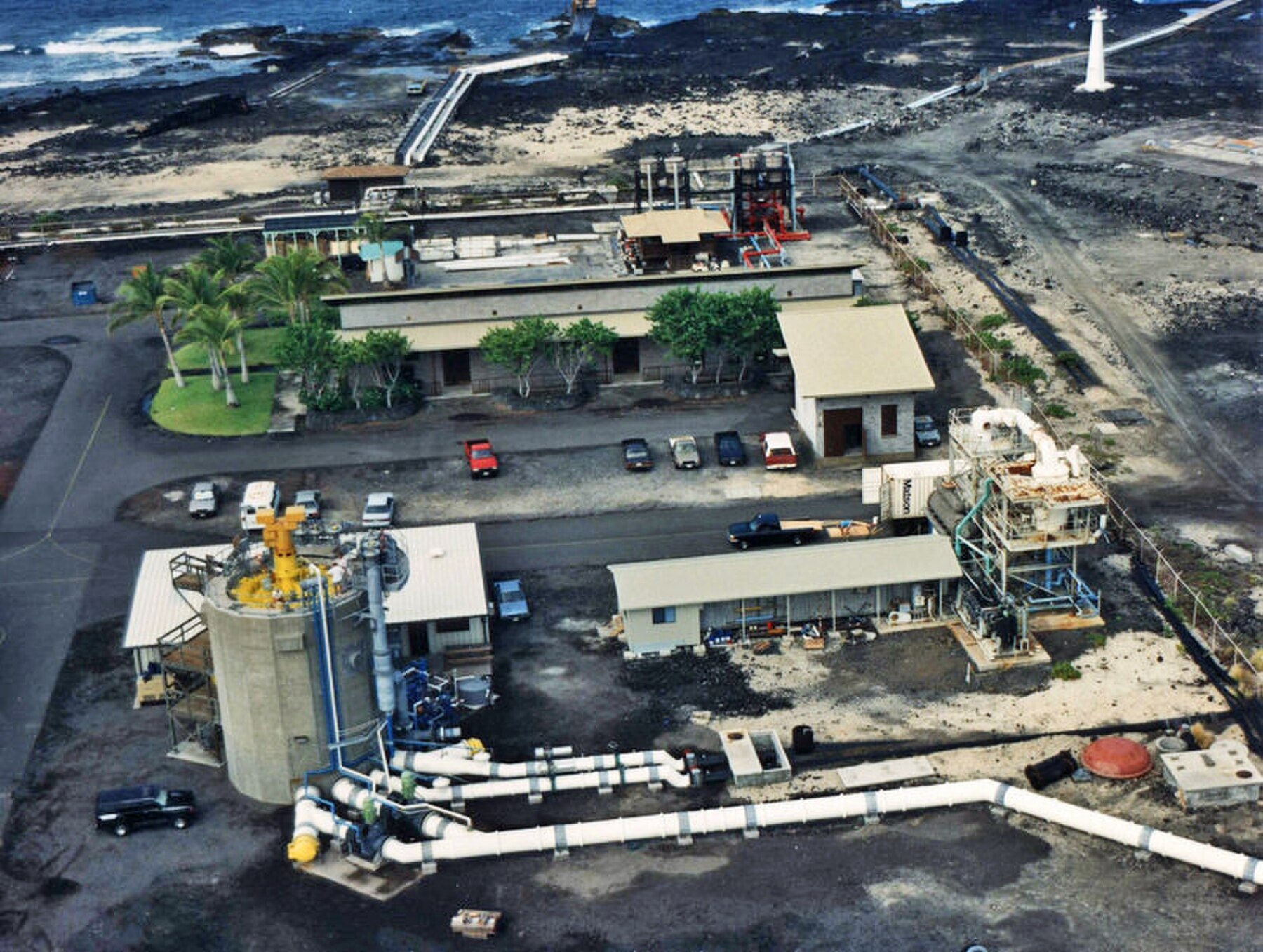
Mini-OTEC's cold-water intake descended roughly 2,000 feet. Makai Ocean Engineering, a project participant, says its polyethylene pipe also served as part of the barge's mooring design: the pipe was part of the experiment's structure, not a delivery tube bolted on after the power plant was finished. Owens and Trimble describe a pipe about 0.61 meters (two feet) in diameter reaching approximately 670 meters, or about 2,200 feet, into deep water. Their abstract says it formed part of a single-point tension-leg mooring system. Makai's own history says the company designed and oversaw construction of the cold-water pipe, mooring, and platform; NELHA's profile of Makai says the firm later designed four more deep-water pipelines for the site: a 12-inch line in 1980 reaching 500 feet, an 18-inch line in 1987 reaching 2,100 feet, a 40-inch line also in 1987 reaching 2,200 feet, and a 55-inch line in 2001 reaching 3,000 feet. That is a documented, organizational thread from Mini-OTEC directly into NELHA's modern seawater infrastructure, even without a named individual who is confirmed to have carried it personally from one project to the next.
On the environmental record, the honest answer is that no dedicated review of Mini-OTEC has surfaced, in either direction. No environmental impact statement specific to the 1979 barge test turned up in NOAA, DOE, or state archives searched for this piece. The first federal OTEC environmental review came later and covered different ground: NOAA issued draft and final Environmental Impact Statements in 1981 for commercial OTEC licensing, required under the OTEC Act of 1980, two years after Mini-OTEC's program had already ended, and aimed at future full-scale plants rather than the four-month demonstration. NELHA's own water-quality monitoring, which ran from 1993 to 2007 and compared surface and bottom nutrient concentrations near its shore-based deep-seawater discharge, found no conclusive evidence of a substantial difference between the two, but that program began more than a decade after Mini-OTEC ended, and it monitored NELHA's onshore pipeline discharge, not a floating barge 2.2 kilometers out. The absence of a cited controversy about Mini-OTEC is not evidence that it caused no ecological harm, and the existence of a seawater intake is not evidence that it did. Neither claim is supported by anything found in this research, so neither is made here.
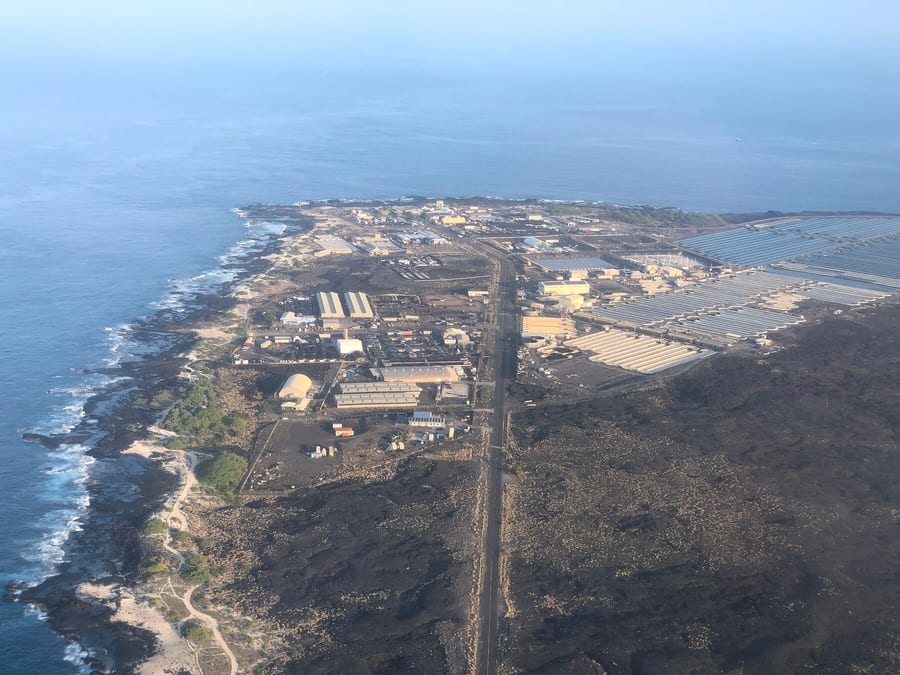
The surface supplied warm water while the steep offshore bathymetry off Keāhole Point placed cold deep water within reach of pipes and a moored experiment, a coincidence of geology that is why this stretch of the Kona Coast, rather than somewhere else in Hawaiʻi, became the site for OTEC testing in the first place, and why NELHA had already been founded there in 1974, five years before Mini-OTEC arrived. An OTEC design that works at Keāhole does not automatically work at a coast where deep water sits far offshore, the surface runs cooler, the seabed complicates installation, storms differ, or grid and financing conditions change.
NELHA's own history gives the founding details. On June 14, 1974, the state legislature approved Act 236, creating the Natural Energy Laboratory of Hawaii at Keāhole Point as an independent non-profit corporation, with start-up money of $50,000 from the State and $50,000 from Hawaiʻi County and the Research Corporation of the University of Hawaiʻi supplying the corporate structure. In April 1976 the legislature appropriated $750,000 for capital improvements and the land was rezoned for urban use. The laboratory's history says Mini-OTEC was sponsored by the State of Hawaiʻi in cooperation with Dillingham Corporation, Lockheed Ocean Systems and other private companies, and Makai lists the funders as the State, Lockheed, Dillingham and Alfa Laval. Makai also says that in 1980 the National Society of Professional Engineers named Mini-OTEC one of the ten outstanding engineering achievements in the country that year, a recognition worth attributing to the company that reports it.
Whether the Mini-OTEC barge itself was scrapped, mothballed, or returned to the Navy after the program concluded (November 18, 1979, according to Owens and Trimble) could not be confirmed from the sources available for this piece, a specific, narrow gap rather than a broad one. What is documented is organizational continuity, not the fate of the hull. Makai Ocean Engineering, the same firm that built Mini-OTEC's pipe and mooring, kept building at the same site for the next four decades. NELHA, already five years old when Mini-OTEC ran, grew into an 870-acre Hawaiʻi Ocean Science and Technology Park with deep-seawater pipelines reaching as far as 3,000 feet, supporting energy tests and commercial tenants that use cold deep water for purposes, deep-seawater bottling chief among them, the barge was never built to serve. And decades later, Lockheed Martin, corporate descendant of the Lockheed Missiles and Space Company that put up part of Mini-OTEC's funding and engineering in 1978, returned to OTEC, announcing plans around 2009 to 2012 to build pilot and demonstration plants and continuing to work with Makai at the Keahole site. None of these later ventures are descendants of Mini-OTEC in a strict causal sense (each had to justify itself on its own economics) but the same two organizational names, Lockheed and Makai, appear at both ends of a story that spans more than thirty years.
Two years after Mini-OTEC, Japan switched on a land-based plant on the Pacific island of Nauru. Tokyo Electric Power Company and the Japanese government ran a 100-kilowatt pilot there, and a Japanese trade journal dates operation to October 1981. The reported numbers disagree. One account has the plant producing about 120 kilowatts, with 90 consumed on site and the rest powering a school and other buildings. A 2011 Honolulu Star-Advertiser article gives 31.5 kilowatts of continuous net power. Luis Vega calls it a 100-kilowatt gross plant that ran for a few months and was too small to scale.
Japan offers a comparison for how deep seawater gets used. The Japan International Cooperation Agency notes that Okinawa Prefecture has run a 100-kilowatt OTEC demonstration on Kumejima since 2013, and that deep seawater there suits prawns, sea grapes, oysters, drinking water and cosmetics.
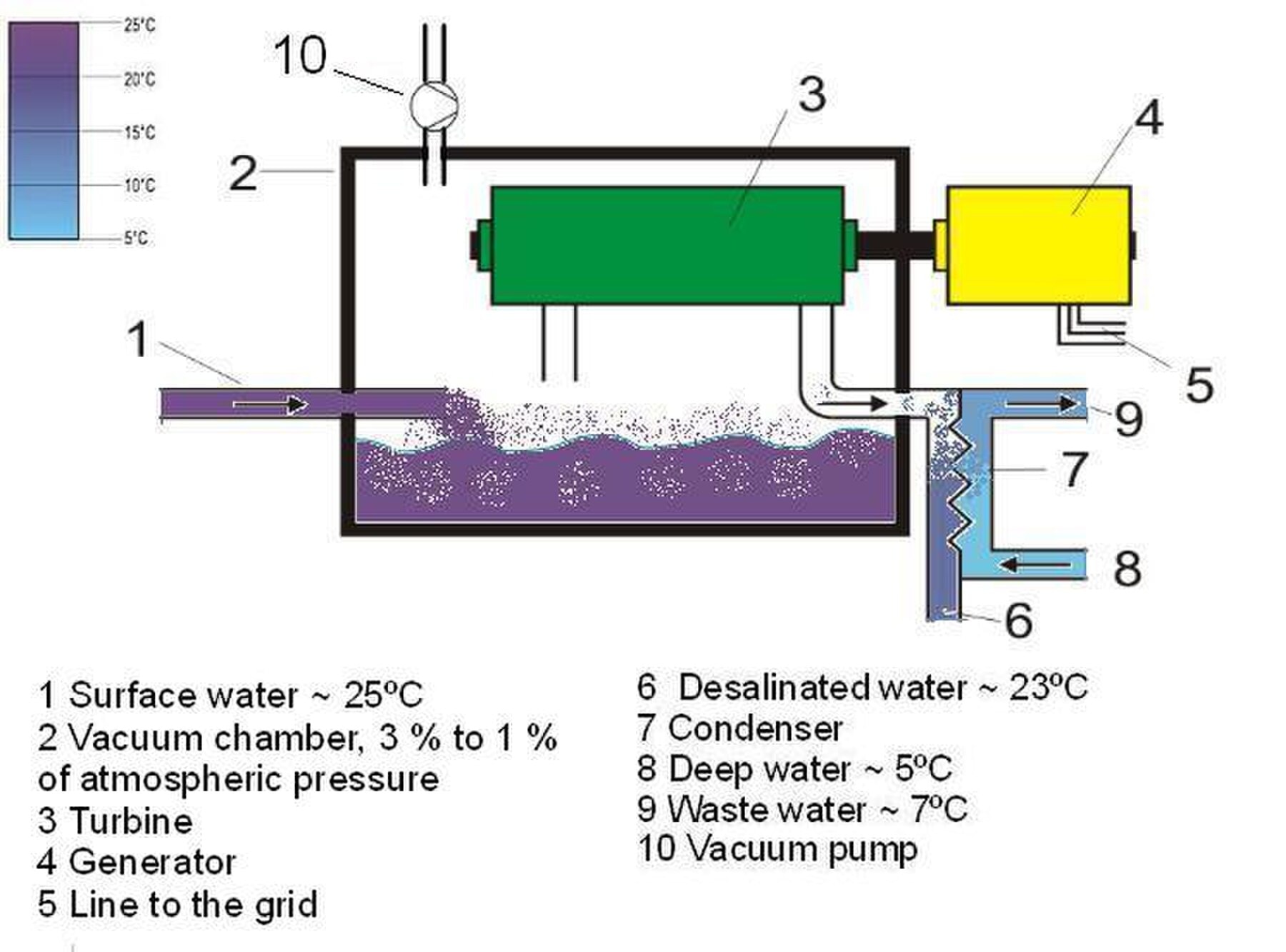
Keāhole's biggest net-power result came from a plant that used seawater itself as the working fluid. In an open-cycle plant, warm surface water is flashed to low-pressure steam in a vacuum chamber, the steam spins a turbine, and cold deep water condenses it, which can leave fresh water as a by-product. A 1990 design by the Solar Energy Research Institute and its partners projected 213 kilowatts gross and 84 net, warned that worse-than-expected performance could leave about 50 net, and put the cost at $15 million over three fiscal years.
Luis Vega, whose team ran the plant, reports that it operated from 1993 to 1998 and reached 255 kilowatts gross and 103 kilowatts net, with 0.4 liters per second of desalinated water, which he calls world records for OTEC. Other sources give different numbers: a 2011 newspaper article says the plant produced a net 50 kilowatts, and the Energy Information Administration describes a 250-kilowatt demonstration plant that ran for six years.
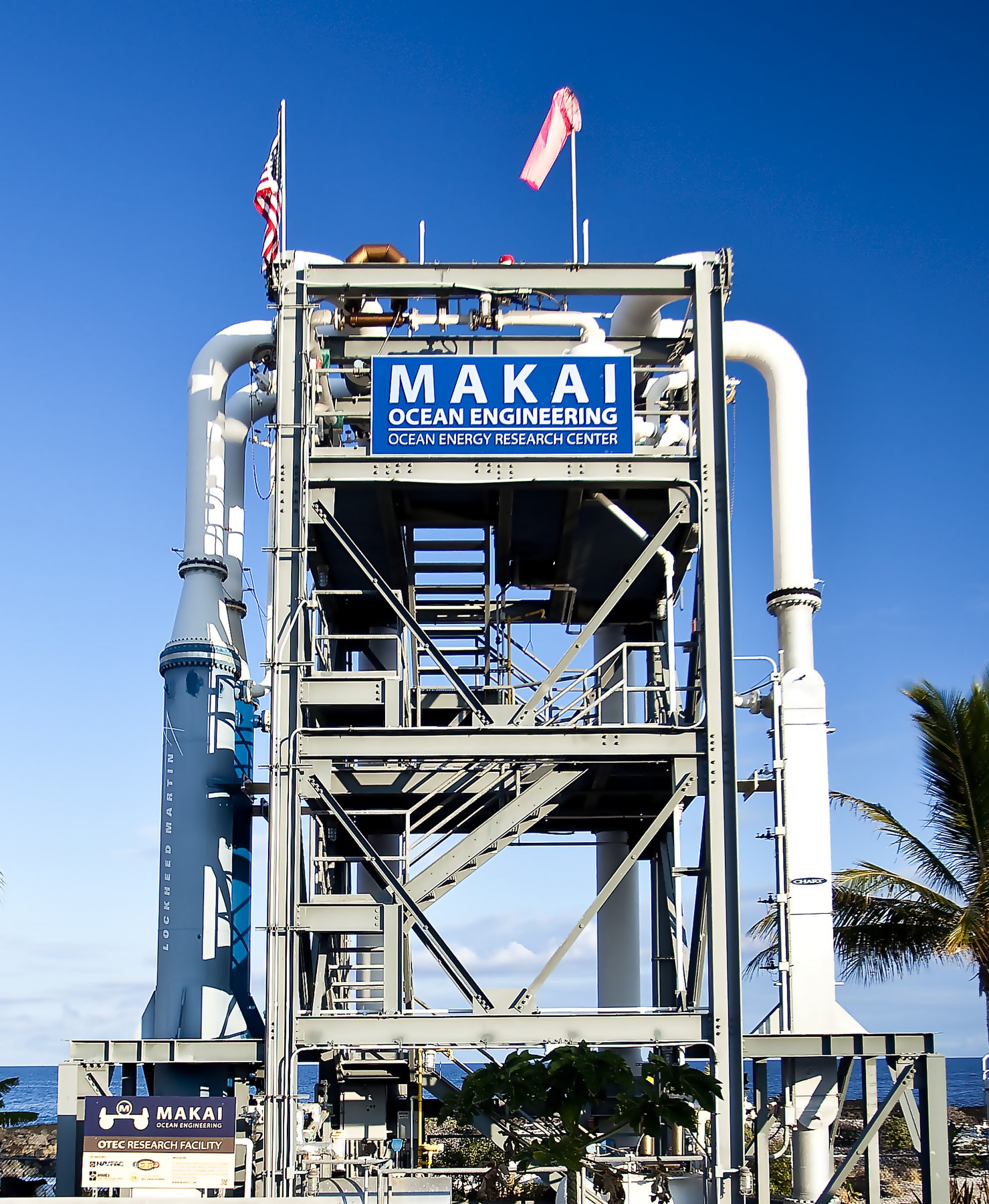
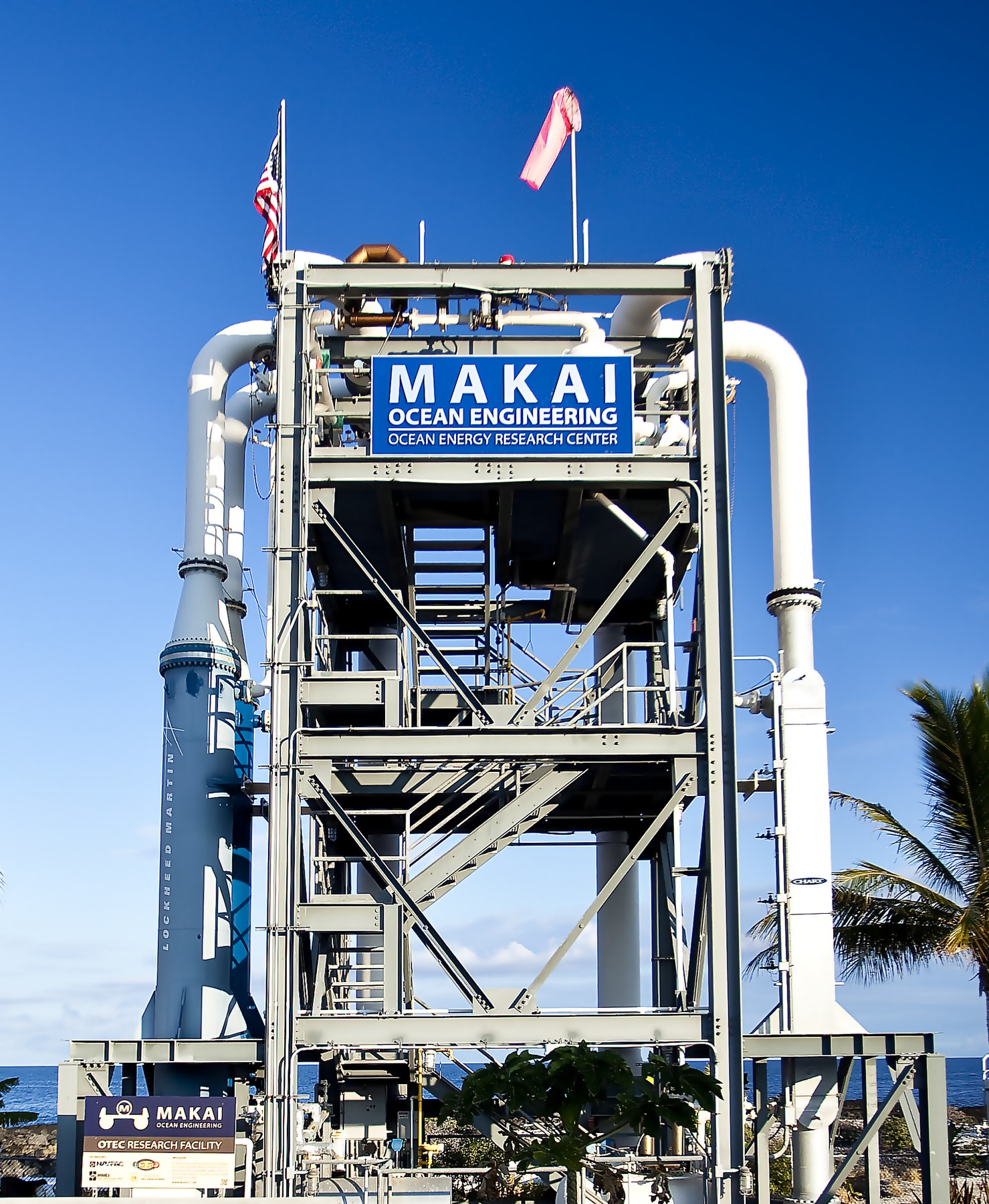
Makai Ocean Engineering, which engineered parts of Mini-OTEC in 1979, built the plant that closes the loop. Its 105-kilowatt closed-cycle unit at NELHA was dedicated in August 2015, and Makai describes it as the first closed-cycle OTEC electricity delivered to a U.S. utility. Governor David Ige called it the world's largest operational ocean thermal power plant, and Bloomberg, as relayed by Phys.org, put the build cost at about $5 million. The Office of Naval Research funded the research through the Hawaiʻi Natural Energy Institute, and the Naval Facilities Engineering Command paid for infrastructure. Makai's Duke Hartman called the plant dispatchable, meaning that its power can be ramped up or down to cover swings from solar and wind farms.
A prototype can succeed technically and still reveal why an industry does not yet exist. Mini-OTEC proved that a barge could put net power onto a load using nothing but a 21-degree temperature difference in the ocean. It did not prove, and was never asked to prove, that the same numbers would hold at commercial scale, on someone else's coastline, financed by a different mix of public and private partners splitting the bill for four months. The pump load, the missing commercial fleet that never followed, the later pipelines at the same site, and the businesses now using cold deep water for purposes the barge was never built to serve are all part of what that gap between gross and net power turned out to mean.
Sources added October 3, 2026 (each checked on that date): U.S. Energy Information Administration, Ocean thermal energy conversion, eia.gov/energyexplained/hydropower/ocean-thermal-energy-conversion.php. Luis Vega, 2002, as hosted at offinf.com/MTS_OTEC_Published.pdf. Japan International Cooperation Agency, November 17, 2023, jica.go.jp/english/information/topics/2023/20231117_01.html. The November 18, 1979 end date rests on one secondary source, Owens and Trimble, and no second source for it was found.