The story
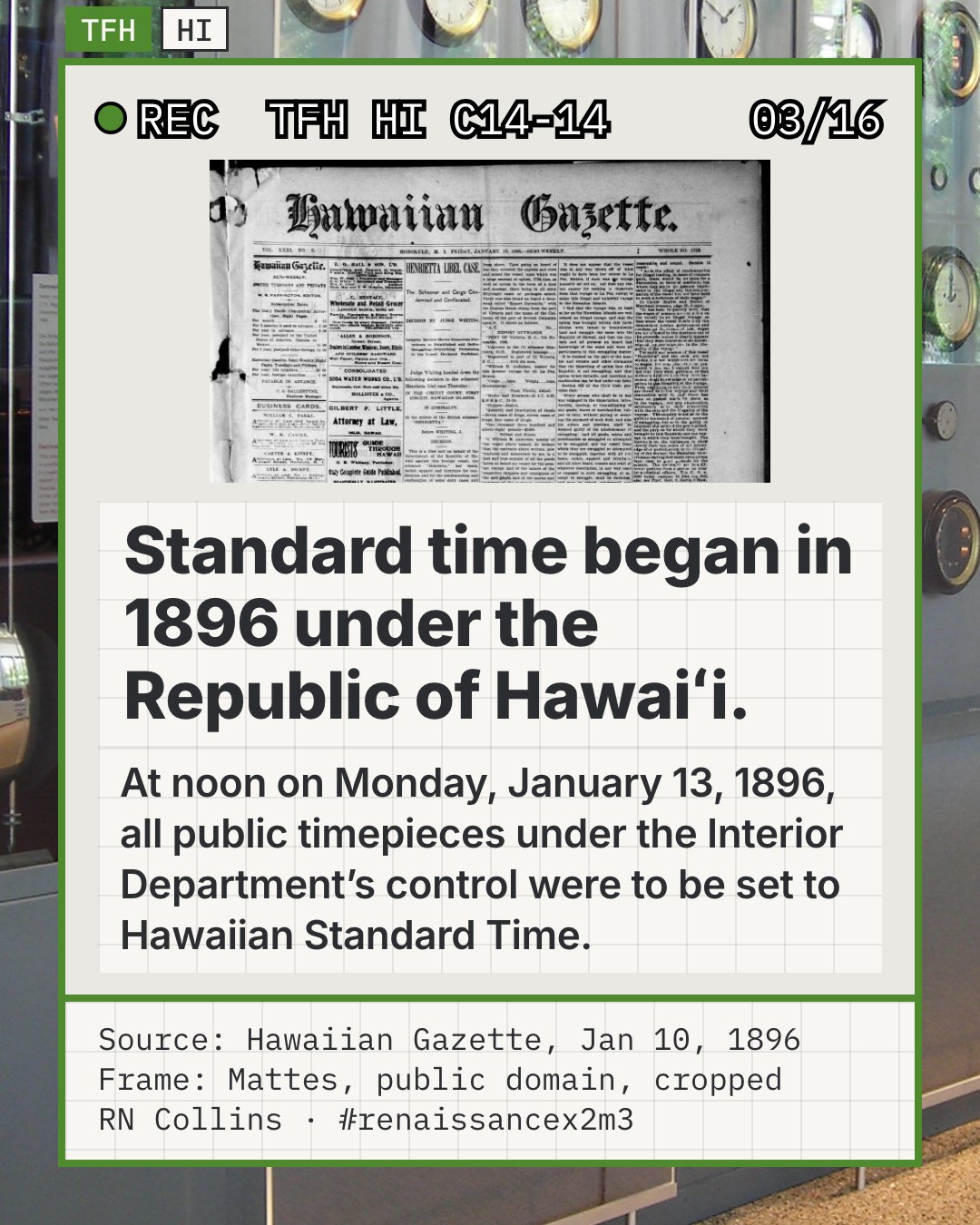
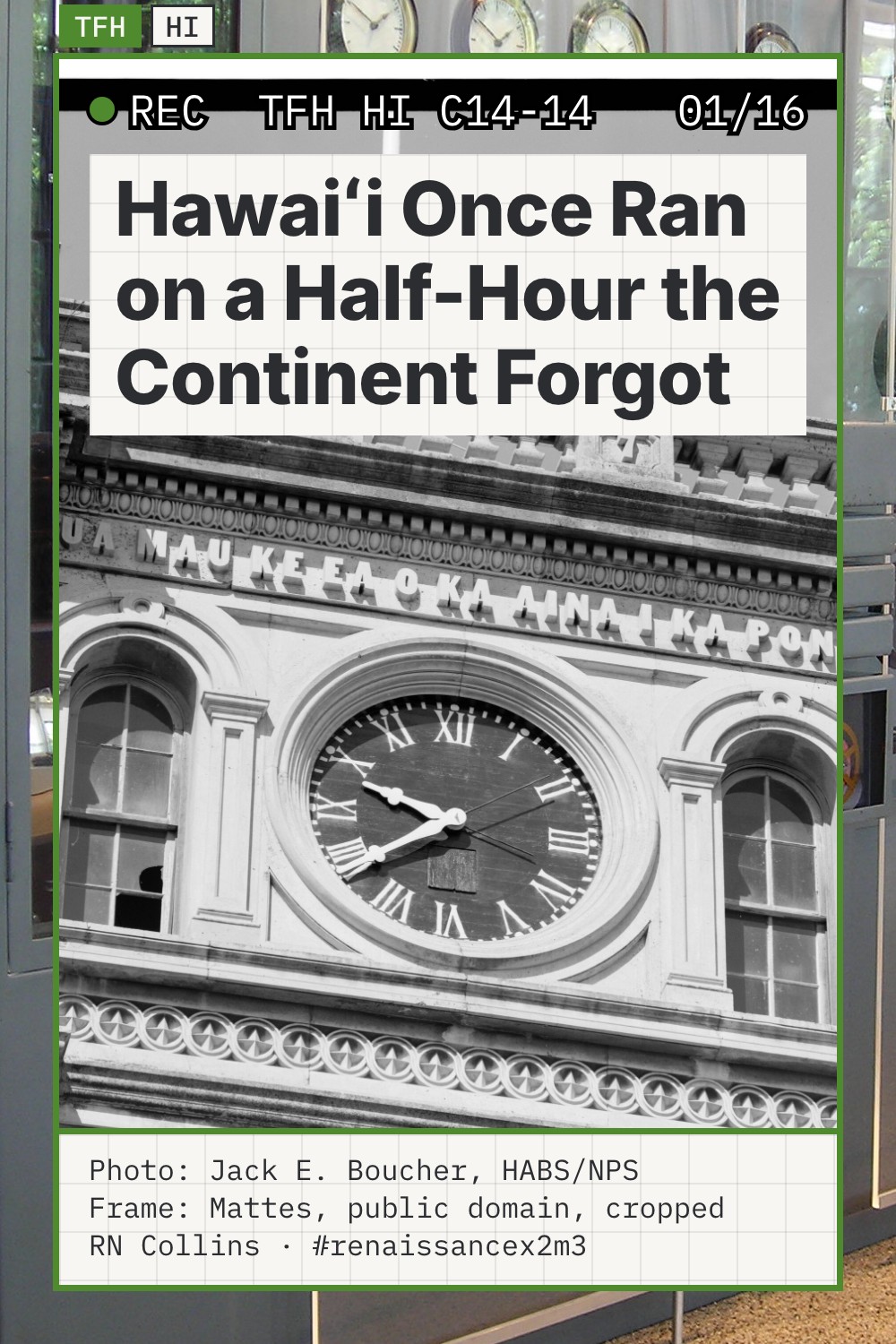
At noon on January 13, 1896, public clocks across Hawaiʻi were supposed to agree.
Schedules, messages, public offices, schools and businesses work differently when the same printed hour means the same civil time across the islands.
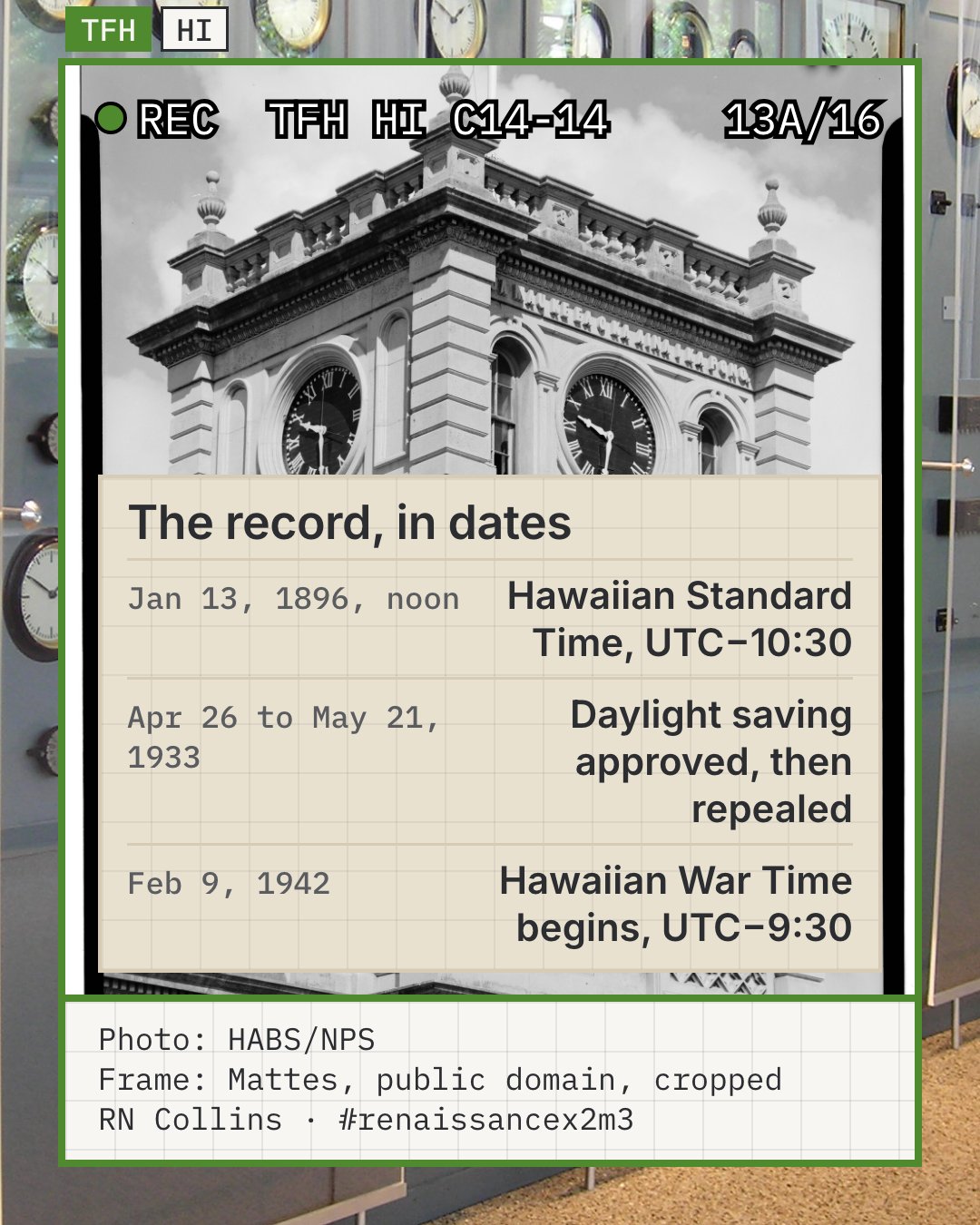
So the Republic of Hawaiʻi adopted Hawaiian Standard Time: ten and one-half hours behind Greenwich mean time.
For more than fifty years, Hawaiʻi occupied a temporal position that would look strange on most American phones today: the equivalent of UTC−10:30.
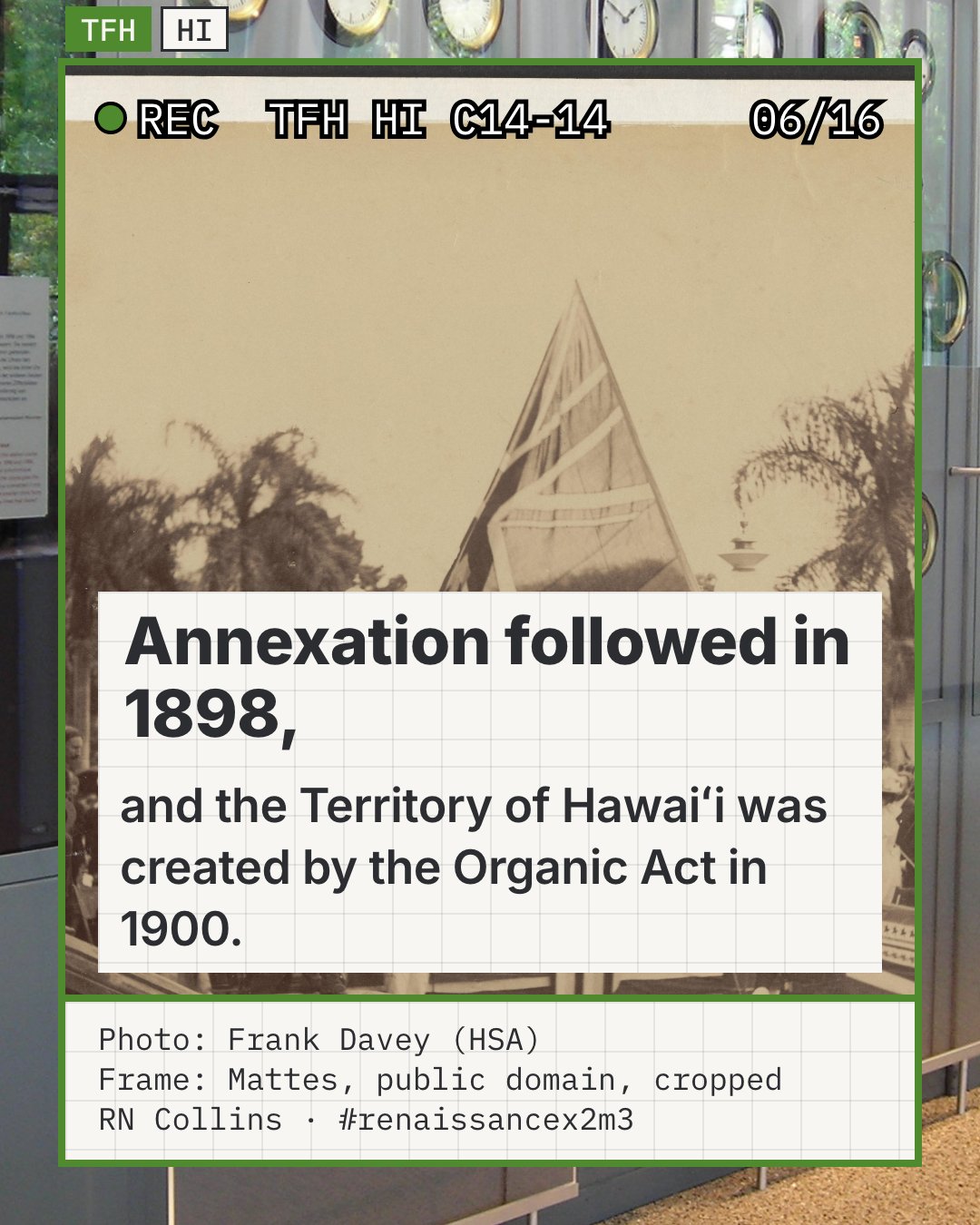
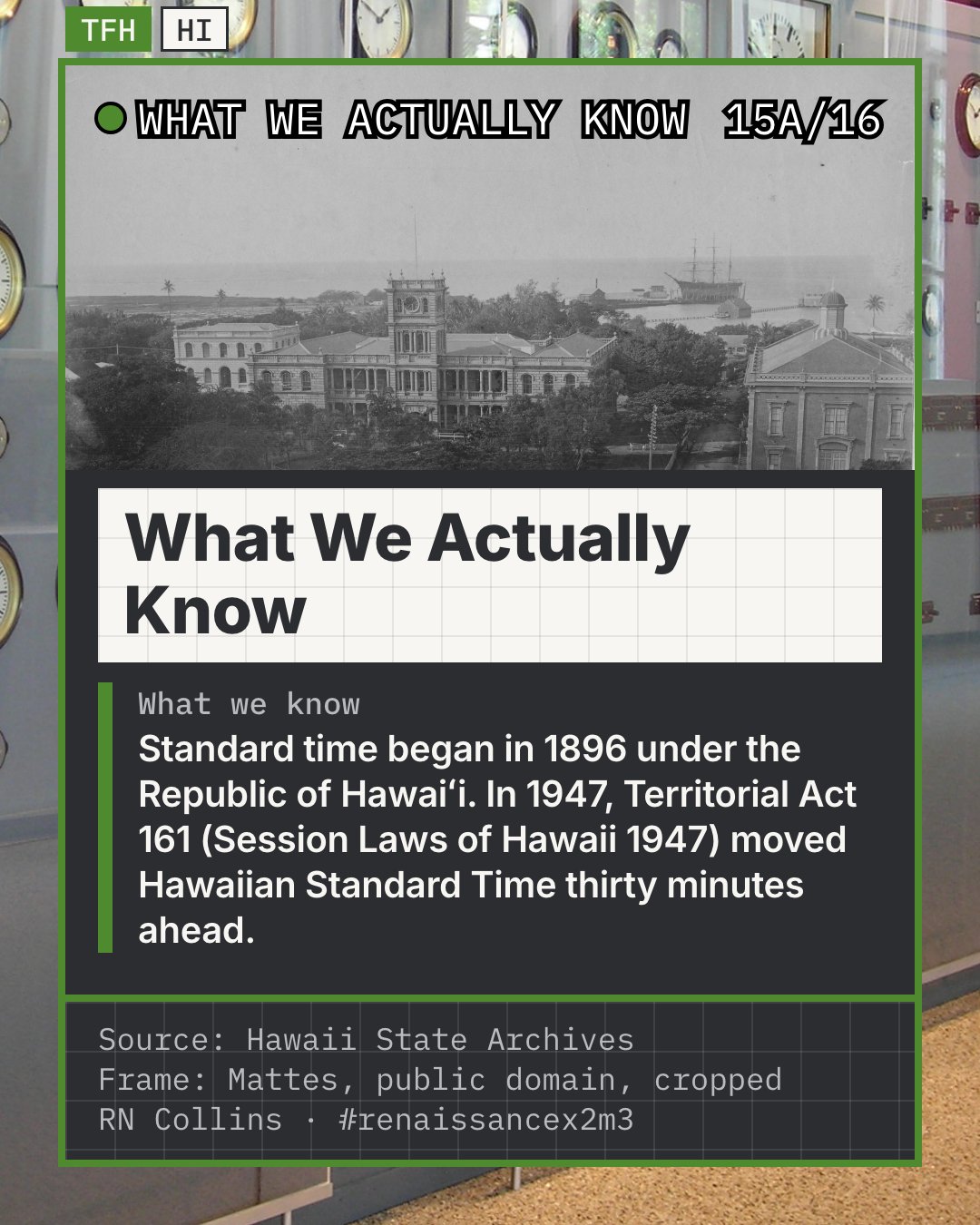
Standard time began in 1896 under that successor government.
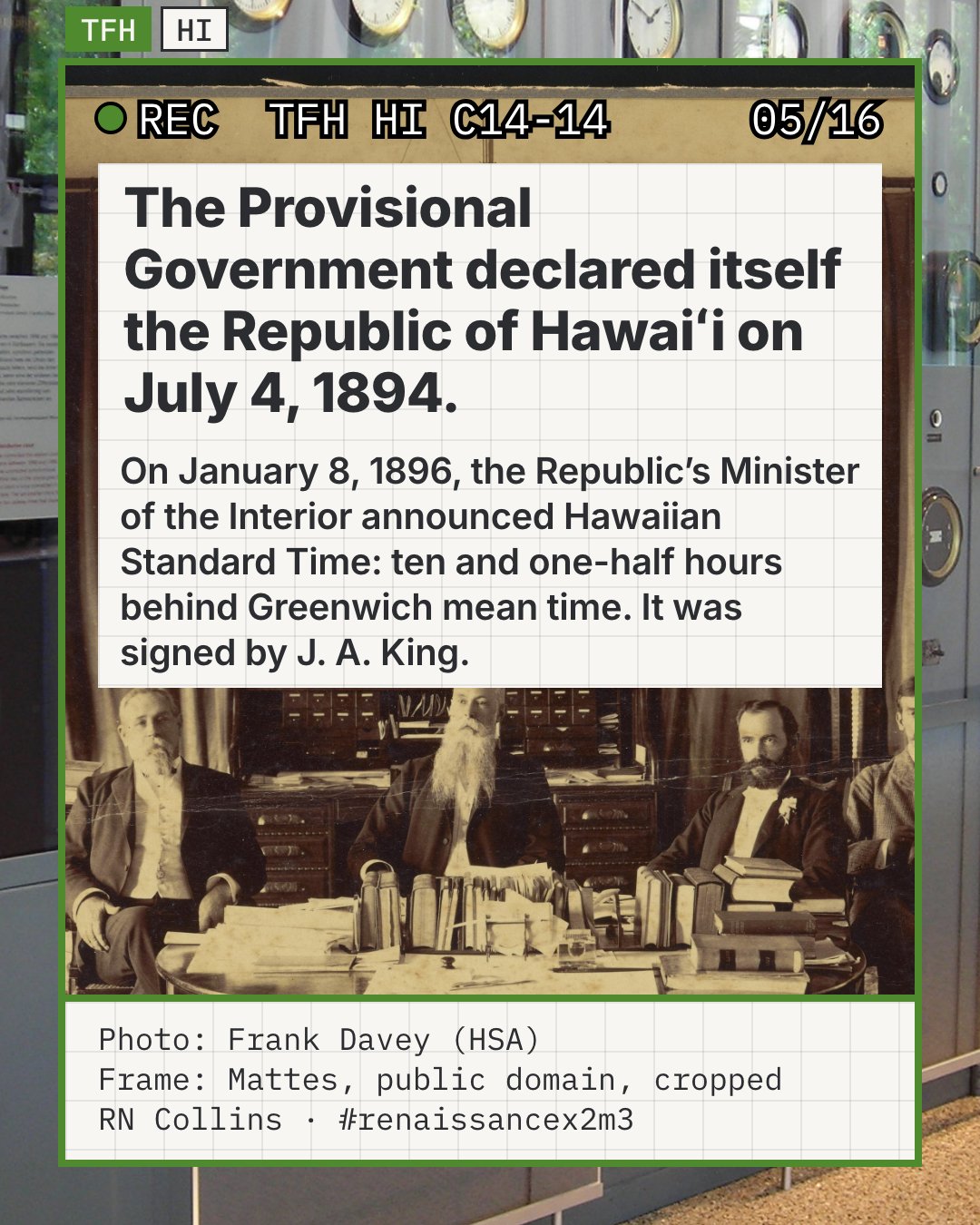
The 1896 order carried a name. A notice dated January 8, 1896, and signed by J. A. King, Minister of the Interior of the Republic of Hawaiʻi, set the changeover: "On and after MONDAY NOON, January 13, 1896, all public timepieces under control of this Department, shall be set in accordance with Hawaiian Standard Time... the object of the change being to secure a uniform and convenient time system for the Hawaiian Group." Before that order, Hawaiʻi kept local solar time that varied town to town: Hilo ran eleven minutes twenty seconds ahead of Honolulu, Waimea lagged Honolulu by seven minutes thirty-six seconds. Twelve years earlier, Hawaiʻi had already sent representatives into the international conversation that produced the Greenwich standard: W. D. Alexander, the Kingdom's Surveyor-General, and Luther Aholo, a Privy Councillor, attended the International Meridian Conference in Washington, D.C. in October 1884 and joined the majority approving a prime meridian through Greenwich and a universal day beginning at midnight.
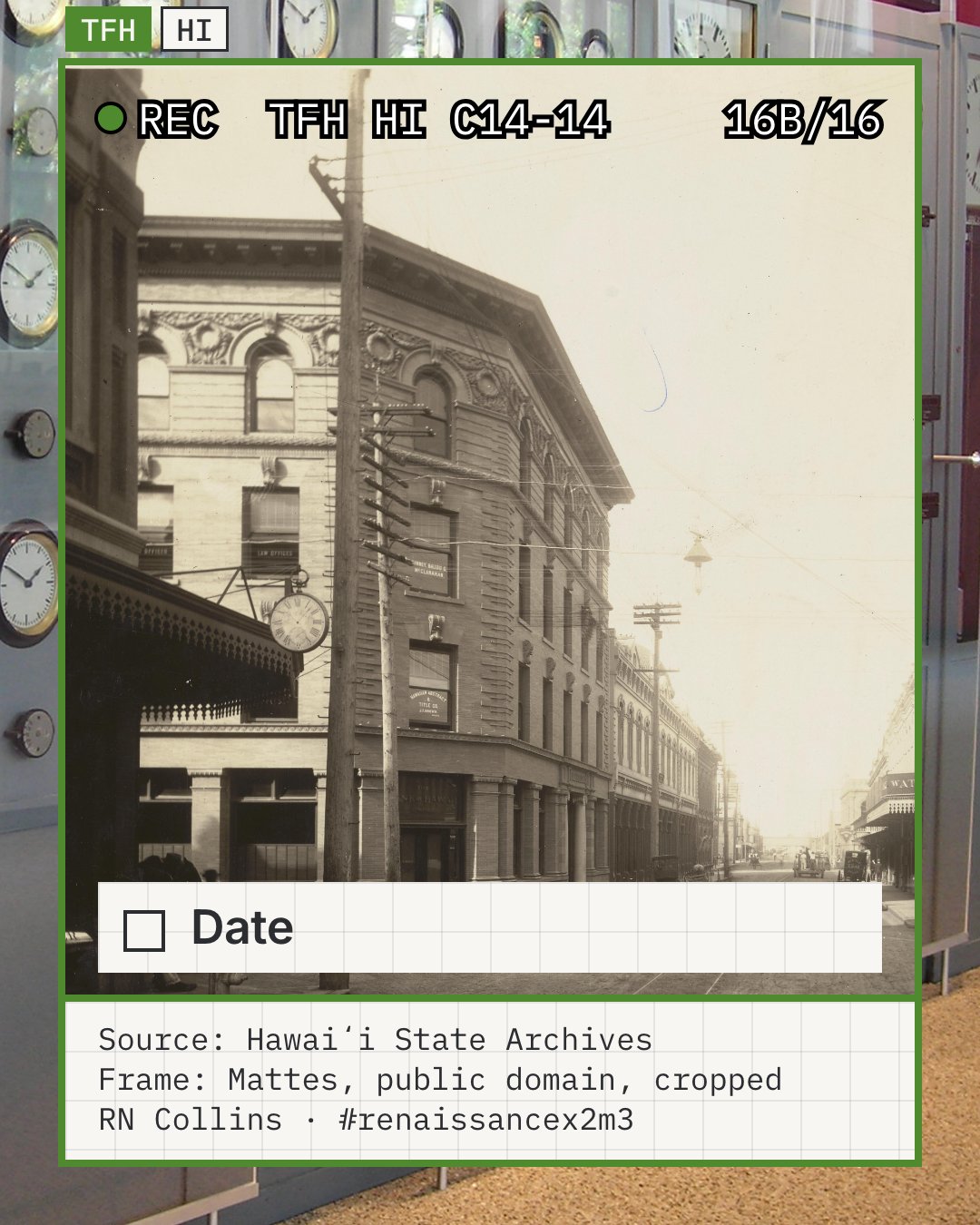
Before the notice of 1896, the town's clocks were already a negotiated arrangement between a government office and the businesses that could afford a tall pole. According to Robert Schmitt and Doak Cox's history of Hawaiian time, the Hawaiian Government Survey had by 1882 “taken charge of the Government time for the town,” working from a theodolite and a chronometer. In January 1883 the Advertiser reported that J. W. Robertson and Company would drop a time ball from their signal pole every day at noon, on a signal from the Survey Department.
By 1889 the Lucas Planing Mill whistle also sounded Greenwich noon, which fell at 1:28:33 in the afternoon Honolulu time, and the paper added that chronometers would no longer be rated at the Survey Office. Ships, in other words, were setting their instruments to a steam whistle. The Advertiser's editorial the week of the 1896 notice called the change slight in itself and said it had been adopted by the advice of the Government Survey.
The size of the slight can be checked. The tz database puts Honolulu's local mean time at 10 hours 31 minutes 26 seconds behind Greenwich, so moving to a flat ten and a half hours advanced the town's clocks by about a minute and a half. A new tower later took over the job. In 1926 Aloha Tower dropped a four-foot time ball at noon and sounded a siren at 7:00, 11:59 and 4:00, until residents complained it into silence.
The instruments behind these signals were old by then. The Survey bought an 1846 astronomical clock and transit, first imported by E. H. Boardman to regulate chronometers principally for the whaling fleet, in 1886, and according to Schmitt and Cox the 1846 clock now stands in the State Survey Division office at 1151 Punchbowl Street.
The legal notice of 1896 did not reach the cane fields. On the plantations, according to the geophysicist Doak Cox, who grew up on one, managers went on setting their own clocks, mostly to move work earlier into the daylight. A plantation might run 11 minutes ahead of standard time or 14 minutes behind it, and the manager could change the difference every few weeks. Anyone planning an event that drew people from several plantations used a neutral name, Honolulu time or Hilo time, or on Kauaʻi's south and west side, Port Allen time, after the harbor all the sugar went through.
Cox remembered that his family, at ʻEleʻele, lived on McBryde time while the next plantation west ran on Makaweli time. Around 1930 the two managers happened to change their clocks on the same day to the same offset from Port Allen time, and both then changed again the next day, because it was a matter of principle that neighboring plantations should not share a clock. Cox and his coauthor wrote that no published source on the subject exists and that the section rests on his own memory, so it is best read as testimony. It still shows that standard time arrived as one more layer in a place where an employer already decided what hour it was, and that the layers lasted into the early 1940s.
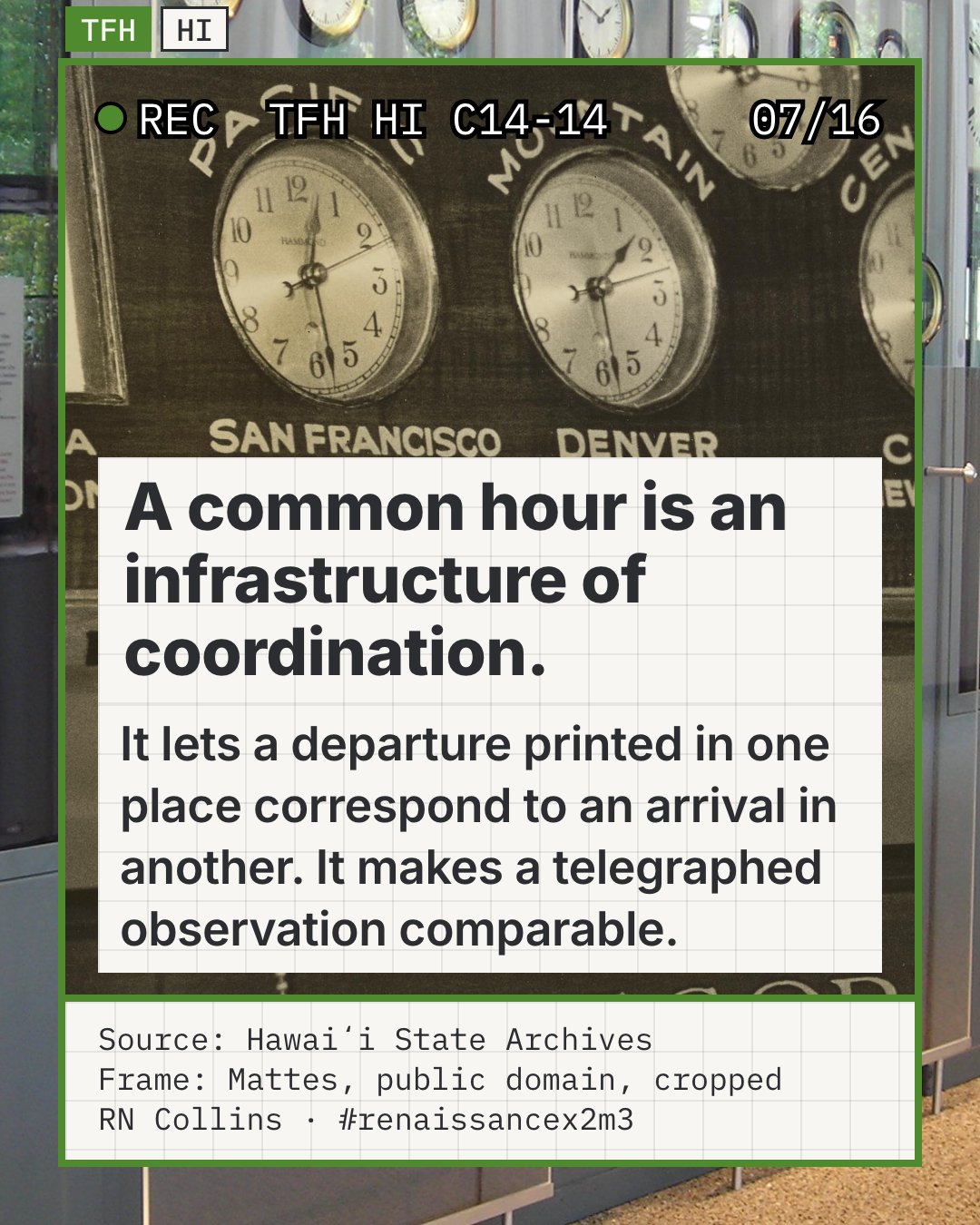
A common hour is an infrastructure of coordination. It lets a departure printed in one place correspond to an arrival in another. It makes a telegraphed observation comparable. It lets wages, hearings, broadcasts, school bells, and deadlines be administered. It turns astronomical measurement into institutional obedience.
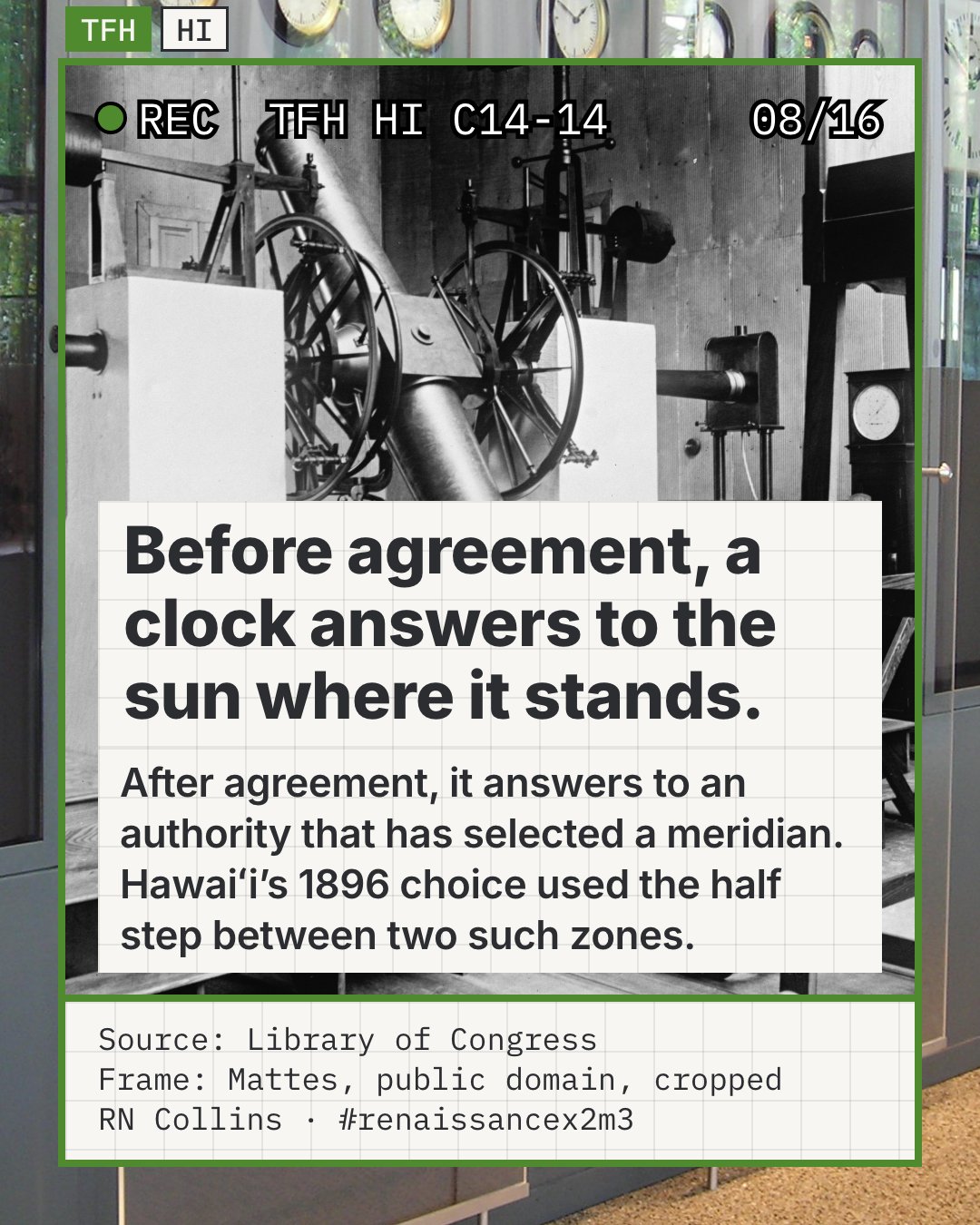
Before agreement, a clock answers to the sun where it stands. After agreement, it answers to an authority that has selected a meridian.
The distinction between apparent solar time, local mean time, and standard time is the mechanism underneath the story. Standard time takes the mean time of one reference meridian and applies it across a larger territory.
Hawaiʻi’s 1896 choice used the half step between two such zones.
A government chose which mismatch was acceptable, which territory should share a clock, and when the new reading would become official. The instrument on the wall displayed the settlement. Law and administration made it binding.
Hawaiʻi’s half-hour shows that this selection is a design decision. The world’s time zones were never simply discovered. They were negotiated around geography, commerce, state power, and convenience. Straight lines on modern maps conceal arguments about whose morning should begin when.
Hawaiʻi was not the only place that kept an odd offset and then tidied it. St. John's carried Newfoundland on 3 hours 30 minutes 52 seconds behind Greenwich, the local mean time of the capital, until March 30, 1935, when the Dominion's Commission of Government settled on an exact three and a half hours. India's story ran through argument. According to the maintainers of the tz database, citing the Indian Year Book, railways and telegraphs adopted +5:30 on January 1, 1906, replacing Madras time at 5:21:10, while some municipalities kept their own clocks and Calcutta's hour depended on whether you were standing in a railway station or a government office.
In both places a single authority replaced a patchwork of local clocks with one offset. Hawaiʻi's path differs in its last step, because it later left the clean half hour for the whole-hour meridian that its state law still names.
Time also traveled by newer channels. According to Schmitt and Cox, the first commercial radio stations in the islands began broadcasting in 1922 and time announcements, not always scrupulously accurate, quickly became a feature of station breaks, and in 1935 the Mutual Telephone Company introduced an automatic time announcement that customers could dial. Radio veteran Ron Jacobs recalled that local station announcements in the 1940s and 1950s were frequently in error by as much as several minutes, though Ed Sheehan disagreed, so even the common hour carried an argument about who could be trusted to say it.
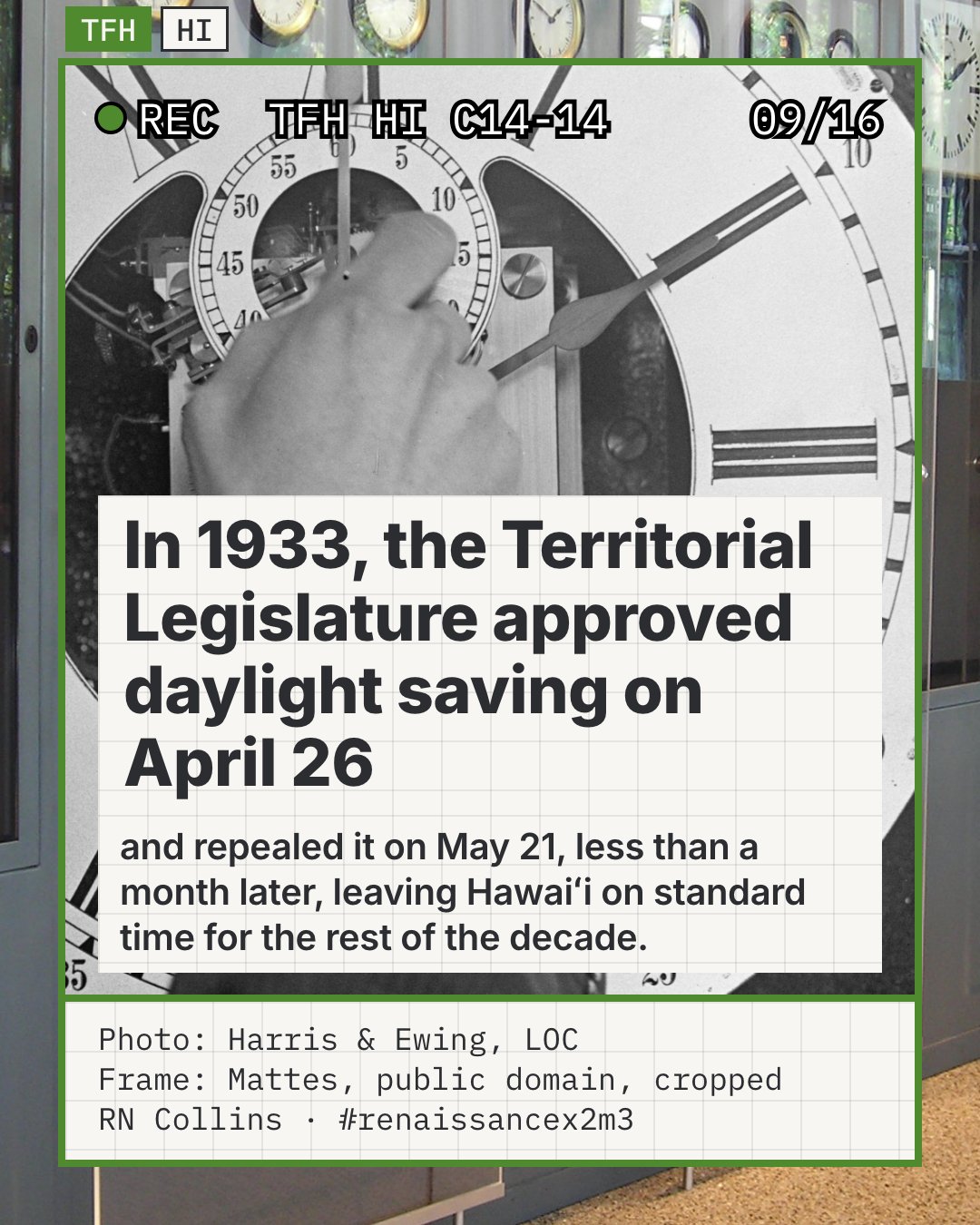
In 1933, the Territorial Legislature approved daylight saving on April 26.
The wartime shift lasted until September 30, 1945.
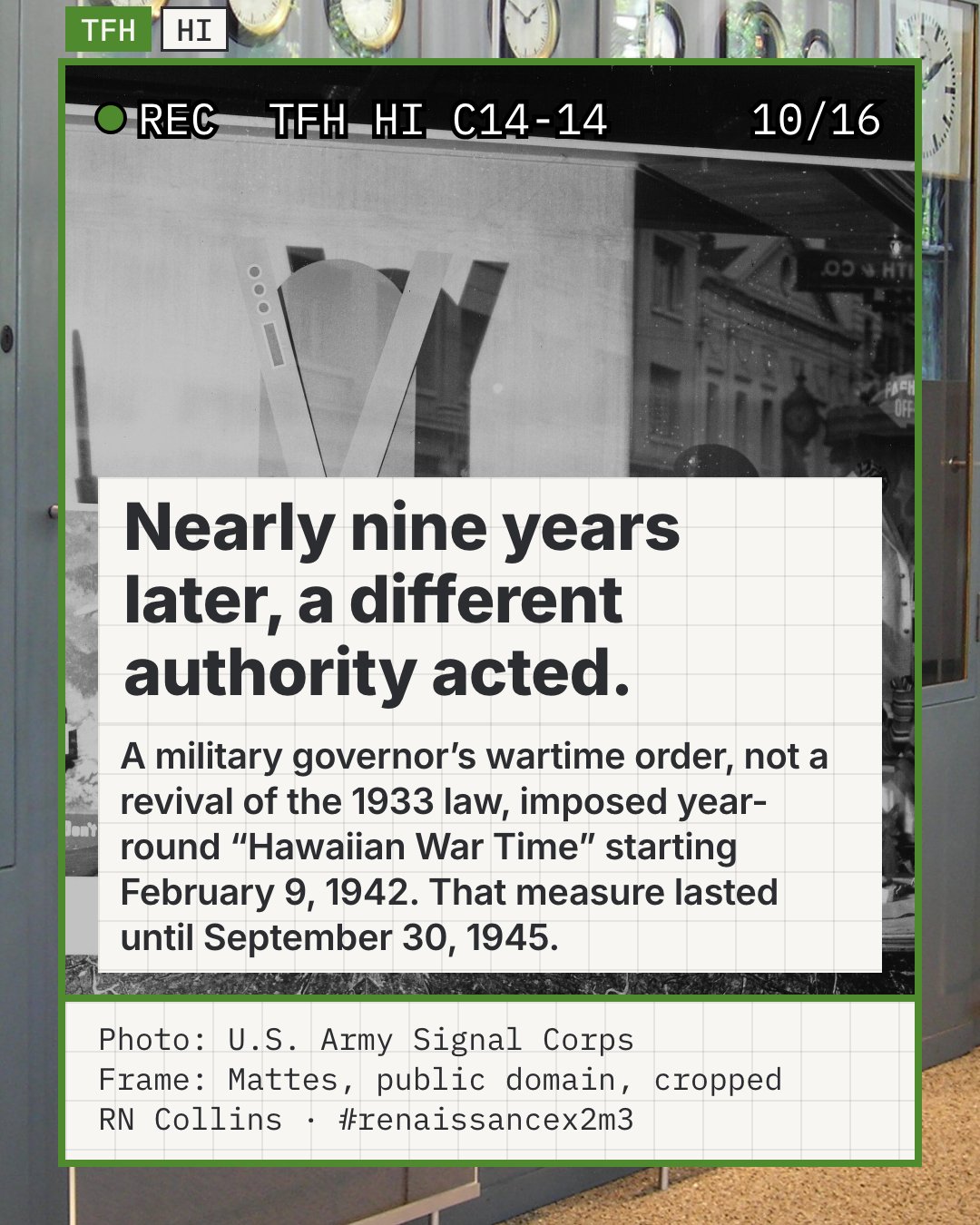
War produced the most disruptive version of the clock fights. On February 9, 1942, the military governor's General Order No. 66 put the Territory on year-round daylight time, one hour ahead of Hawaiian Standard Time, and the new hour was known as Hawaiian War Time. The national law of January 20 that year took effect on the twentieth day after enactment, which is also February 9, though neither source says the two dates were linked.
A 1942 entry in the Journal of Nursing, quoted on Peter T. Young's Images of Old Hawaiʻi site, shows what the extra hour meant on the ground: daylight saving, it says, “has given us another hour before the nightly blackout,” which began at 7:30 at night and lasted until 7:00 in the morning, and the pedestrian curfew moved from 6:00 to 9:00 p.m. while cars stayed off the streets after 7:30. The Territory had tried this kind of change before. In 1918, according to Thrum's annual as quoted by Schmitt and Cox, the navy set its clocks forward an hour on orders from Washington, but it did not last long. In 1933 the Legislature approved daylight time on April 26 and repealed it on May 21, three weeks later. The clock, in each case, answered to whoever held authority that season.
The same physical action, moving hands forward, can therefore carry very different constitutional meanings. A legislature can prescribe seasonal time. A military government can impose a wartime standard. Congress can establish a national framework. A state can later invoke a statutory exemption. The clock does not reveal which authority acted; the legal chain does.
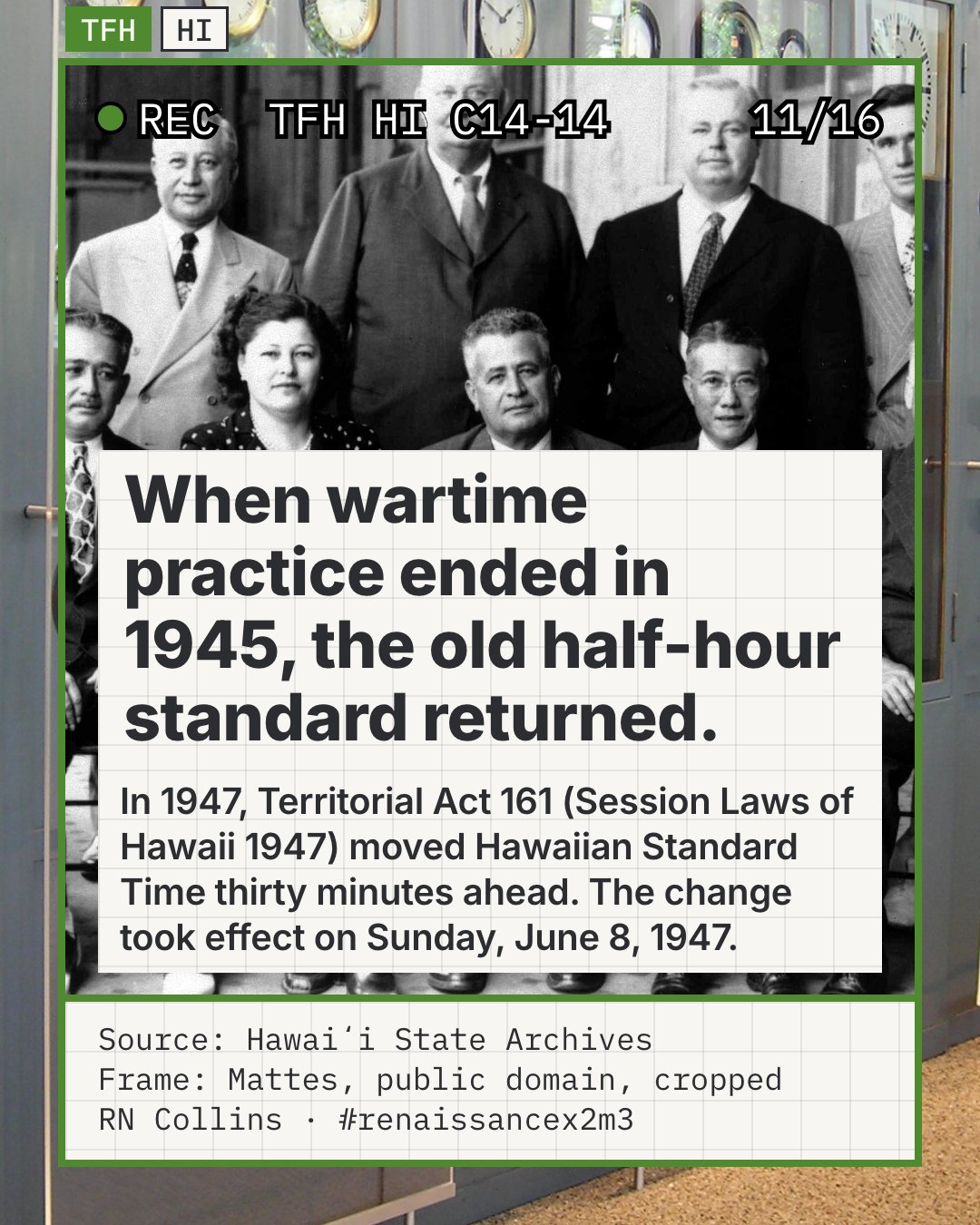
When wartime practice ended in 1945, the old half-hour standard returned.
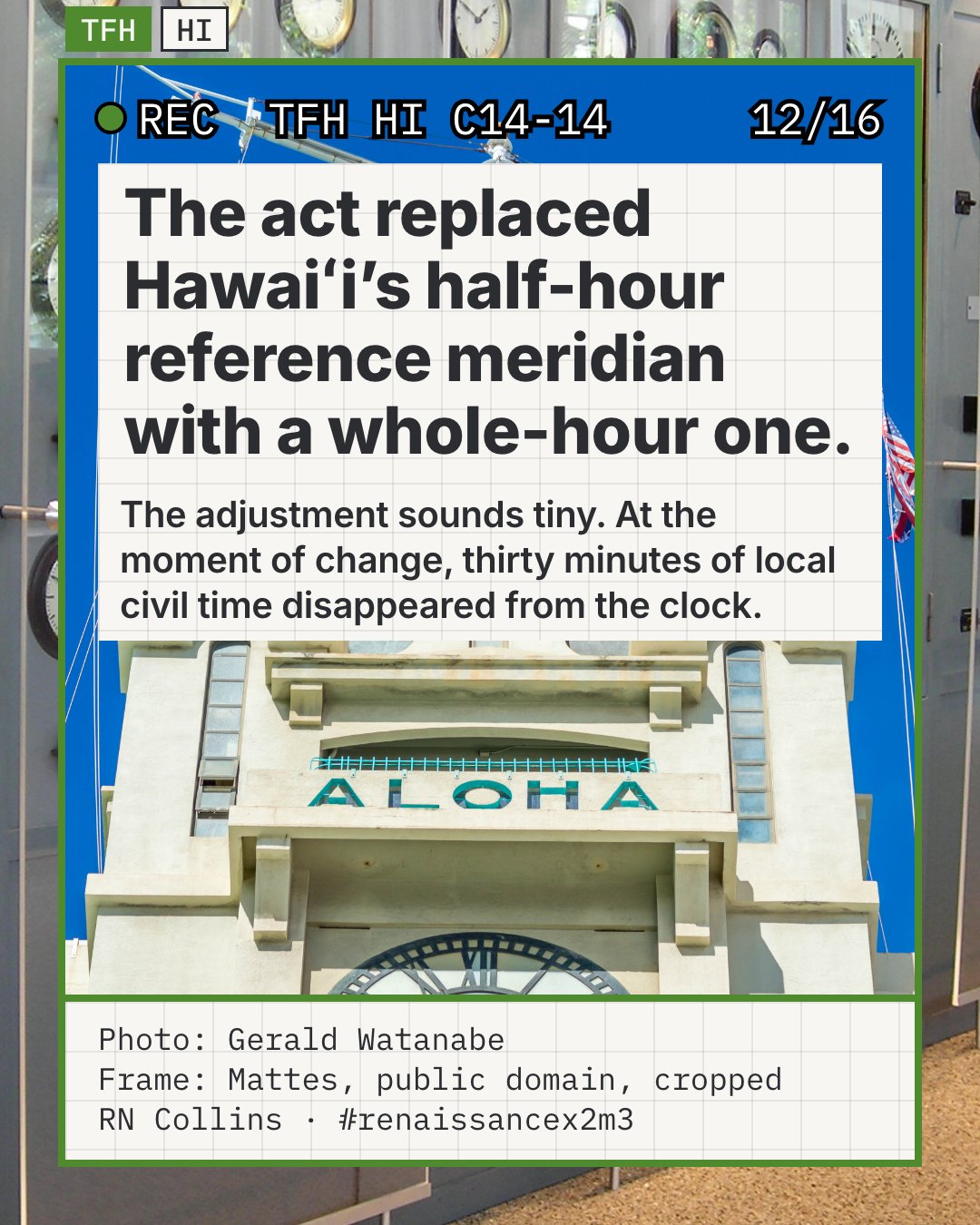
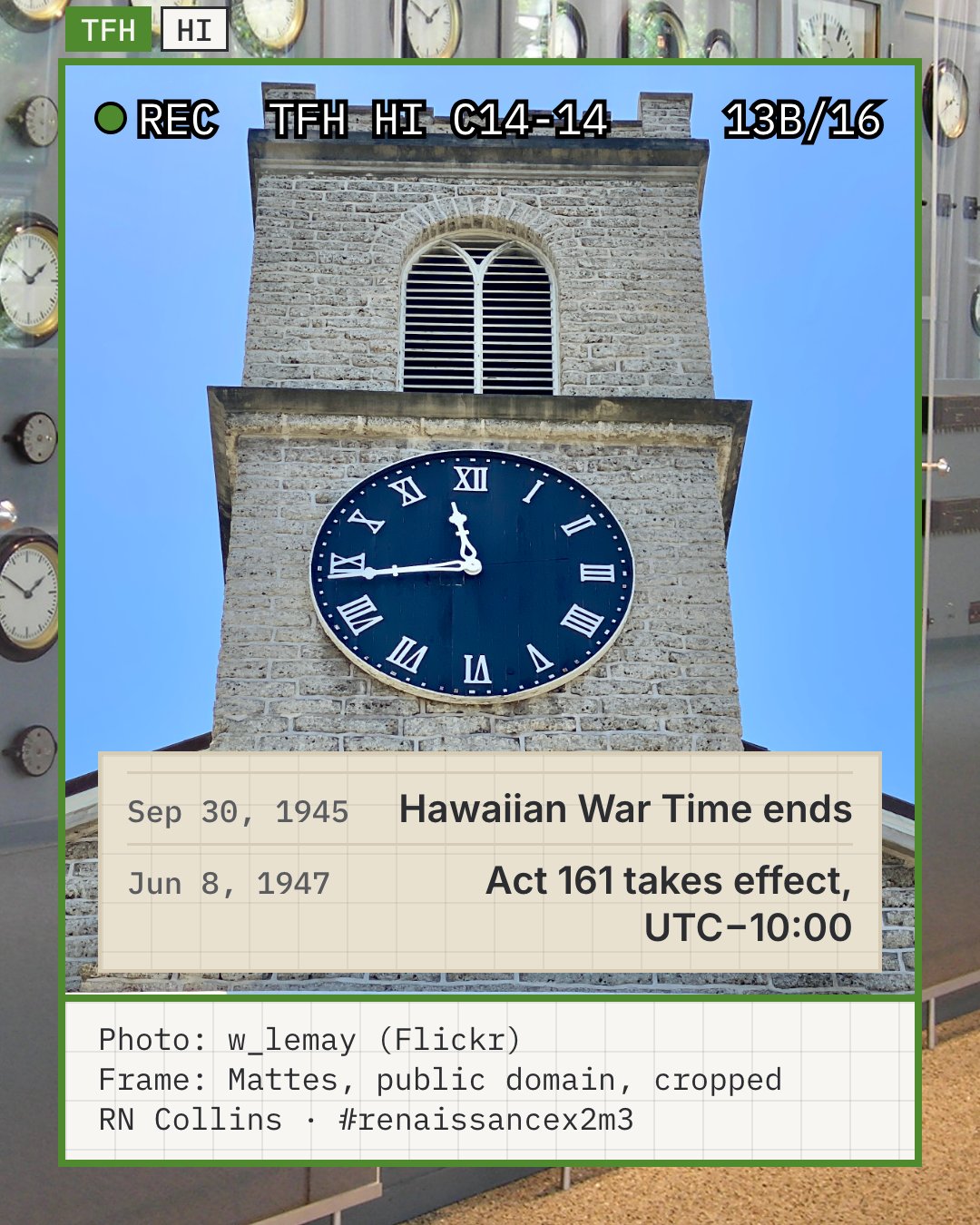
In 1947, Territorial Act 161 moved Hawaiian Standard Time thirty minutes ahead. The act replaced Hawaiʻi’s half-hour reference meridian with a whole-hour one.
The 1947 shift had a false start. On September 18, 1945, the Honolulu Board of Supervisors had already voted, 4–3, to propose the same thirty-minute change, and it went nowhere. Not until the Territorial Legislature passed Act 161 on May 19, 1947, effective the second Sunday of June that year, did the half-hour meridian actually give way to a whole-hour one. The individual legislator or legislators who introduced Act 161, and any floor debate, do not appear to survive in digitized form; that remains a gap in the open record, not a settled fact.
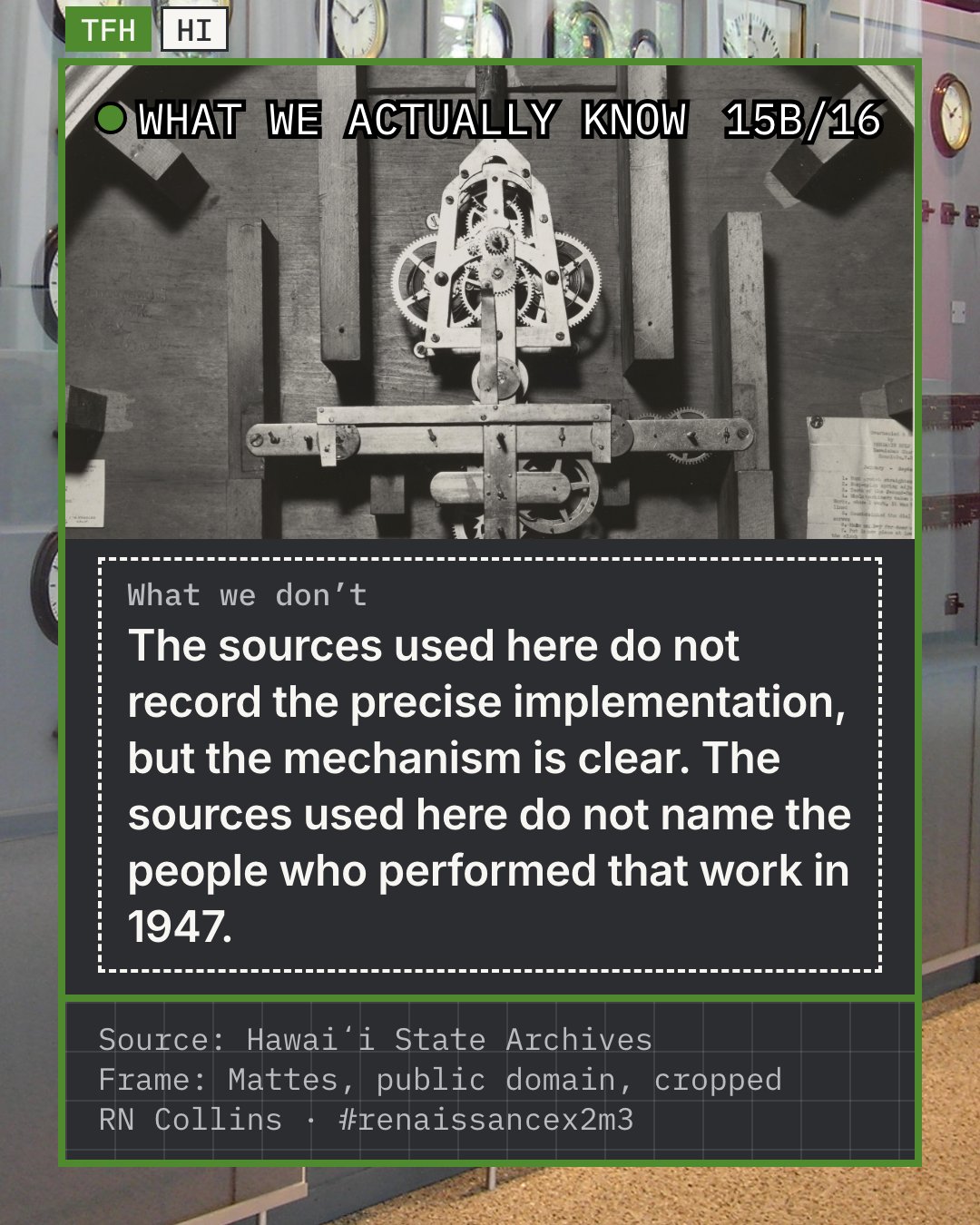
The adjustment sounds tiny. At the moment of change, thirty minutes of local civil time disappeared from the clock. Recurring appointments moved relative to sunrise and sunset. Timetables, work shifts, school hours, broadcasts and household clocks all depended on people noticing and applying the new rule. The precise implementation record is still being reconstructed; the mechanism is clear even before every worker is named. A person who missed the change could arrive thirty minutes late without misreading their own clock.
One accurate clock is useful. A population of clocks applying different rules is a coordination failure. The value comes from common adoption, reliable distribution, and a method for resolving which authority controls when rules conflict.
The conversion burden is distributed. A government can enact the rule in one document, but the rule becomes real only when schedule makers, employers, workers, clerks, broadcasters and households apply it. Which named people performed that work in 1947 remains an evidence question, not a license to invent a representative scene.
Changing time also creates edge cases that a clean timeline hides. What happens to an event recorded inside the skipped interval? Which date governs a transaction that crosses the change? How should a later historian interpret a diary entry whose writer did not state the time standard? The statute answers the prospective civil rule; archives must preserve enough context to answer retrospective questions.
A message may be sent on one civil date and received on another. A ship or aircraft may move among locally governed clocks. A national office may calculate a deadline from Washington while a territorial or state office acts in Honolulu. Standardization reduces ambiguity within a network, but connecting networks creates conversion problems at their boundaries.
The federal record is stranger than the Hawaiian one. When Congress passed the Standard Time Act on March 19, 1918, it divided “the territory of continental United States” into five zones, and the fifth, which “shall include only Alaska,” sat on the 150th meridian west. Hawaiʻi was not named. The act left the zone boundaries to an order of the Interstate Commerce Commission, having regard for the convenience of commerce and the existing junction points and division points of common carriers, a reminder that the first federal clock law was written for railroads. Schmitt and Cox put it flatly: neither the 1918 law nor the 1919 repeal of its daylight saving clause affected the Islands. For decades Hawaiʻi's clocks followed rules of the Republic and the Territory that no federal statute described.
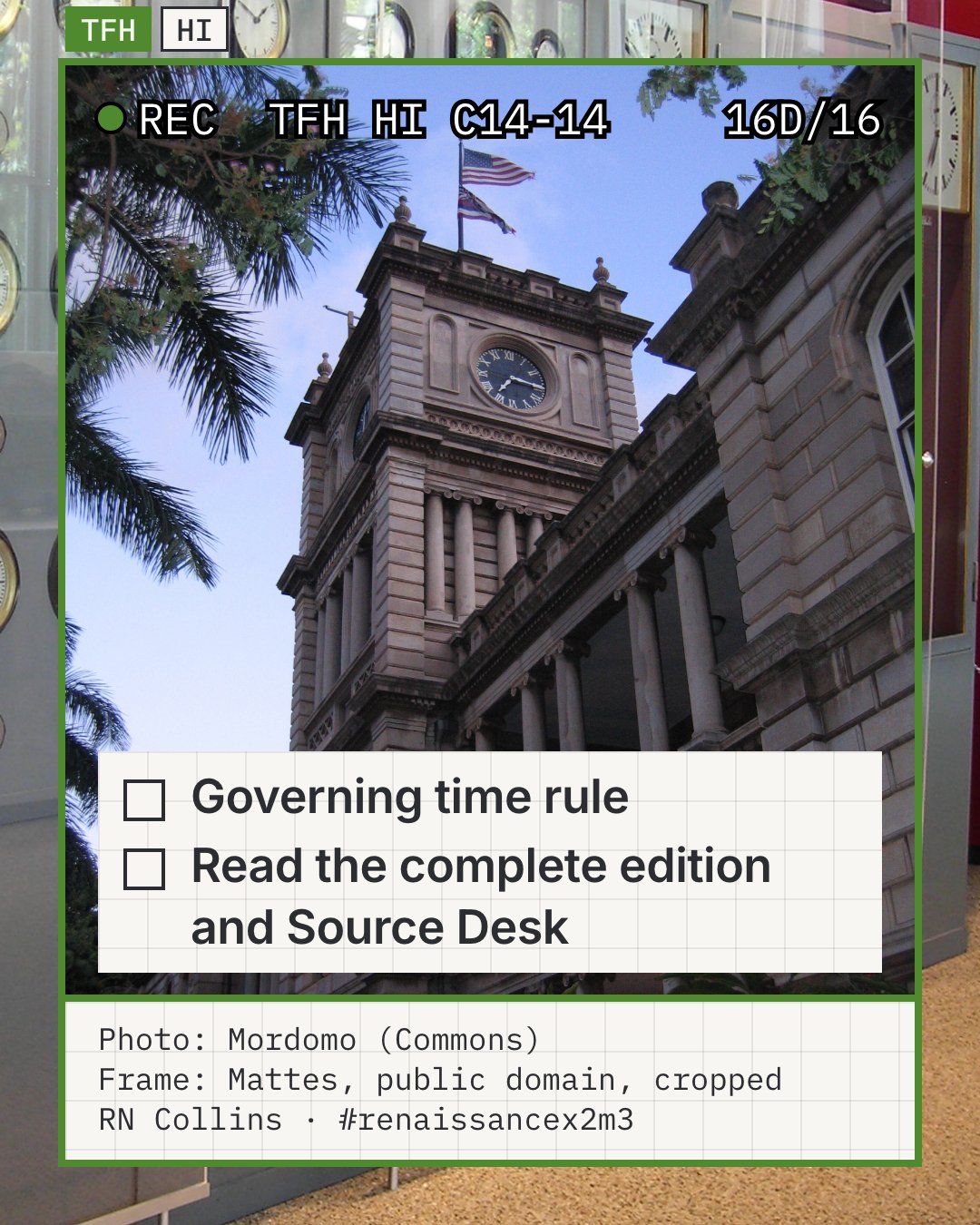
The 1966 Uniform Time Act finally placed the Islands on the federal map. It rewrote the law so that “the territory of the United States” was divided into eight zones, put the seventh on the 150th meridian, and named it Alaska-Hawaii standard time. By then Hawaiʻi had already moved there: the state statute that descends from the 1947 Territorial Act still defines Hawaiian standard time by the one hundred and fiftieth degree of longitude west from Greenwich. Congress changed the zone's name to Hawaii-Aleutian in 1983, and today the rule at 49 CFR 71.12 says the zone includes the entire State of Hawaii plus the western Aleutians. The agency that keeps the national atomic clocks says plainly that it is not involved in the administration of time zones. Time zones are a transportation matter.
Current state law defines Hawaiian standard time, and Hawaiʻi does not seasonally advance its clocks.
People often explain this only through latitude: daylight length varies less in the tropics, so seasonal clock shifting offers less benefit. That is relevant but incomplete. The deeper history is institutional. Hawaiʻi tried seasonal time, repealed it, experienced wartime time, changed its base meridian, entered a federal framework, and then exercised the statutory power to refuse seasonal shifting.
The half-hour shift outlived its own repeal debate. When the federal Uniform Time Act of 1966 required states to observe nationwide daylight saving unless their legislatures opted out, Hawaiʻi's 1967 Legislature did, reasoning that the islands already ran a permanent, partial daylight-saving offset: since 1947, Hawaiian Standard Time had sat thirty-one minutes ahead of true solar time in Honolulu. The exemption, Act 4 of 1967, is the direct statutory ancestor of the year-round Hawaiian Standard Time on phones today.
The clock on your phone makes all of this disappear. It reads a database, applies a jurisdictional rule, and displays the result as if “8:00” were a property of the universe. Underneath are observatories, longitude, legislation, military orders, federalism, software maintenance, and decades of political choice.
The IANA Time Zone Database records rules for named jurisdictions, including historical transitions for Honolulu. That history matters whenever a computer converts an old local timestamp, calculates elapsed time across a change, or schedules something in the future. A bare label such as “HST” or a fixed −10:00 offset cannot fully describe a date from the half-hour era. The location and date together determine which rule applies.
If a historical database stores only “8:00” without the location, offset, or governing time rule, later systems may silently reinterpret the record. Even if the text survives perfectly, its temporal meaning can be corrupted. The lost half hour is therefore also a data-governance story: standards need provenance.
A fixed numerical offset is not a complete time zone because legislatures can change rules. An abbreviation is not enough because abbreviations are reused and can describe a standard without its history.
Hawaiʻi’s time history demonstrates why. A modern program that projects today’s −10:00 backward would assign the wrong instant to records from the 1896–1947 base standard. A program that notices wartime daylight shifting but misses the underlying half-hour would still be wrong. The apparent trivia becomes a test of whether a technical system respects legal history.
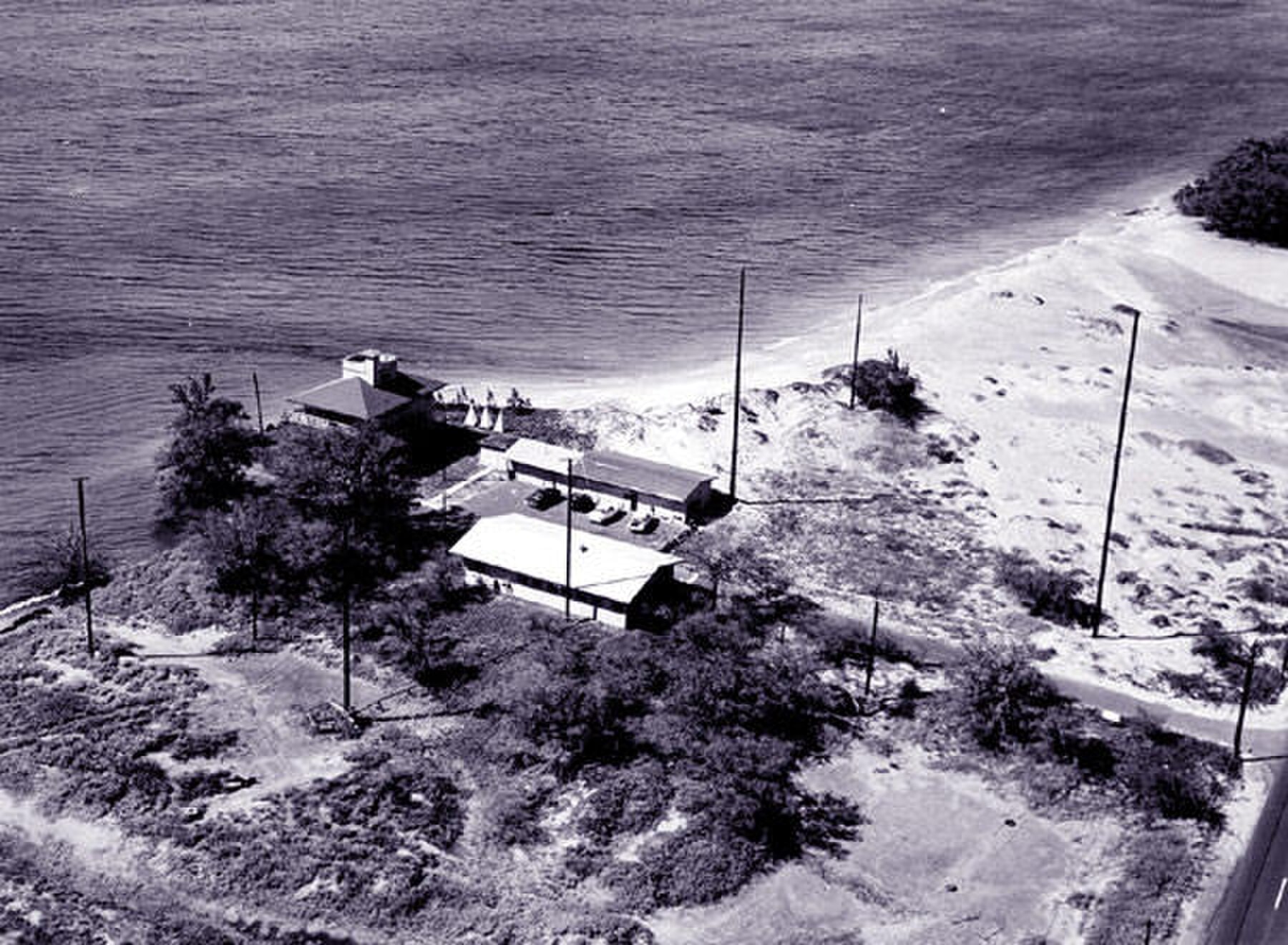
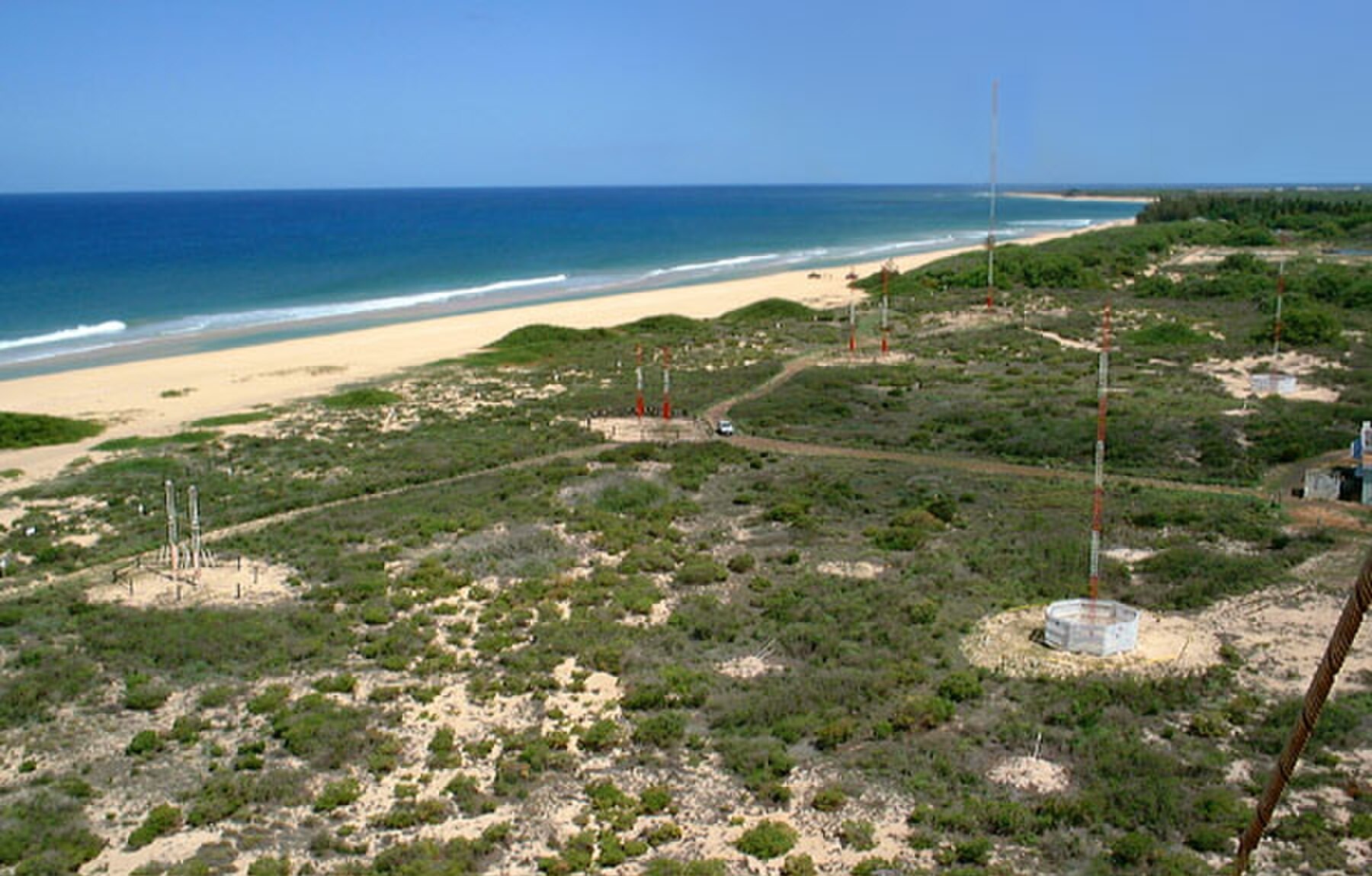
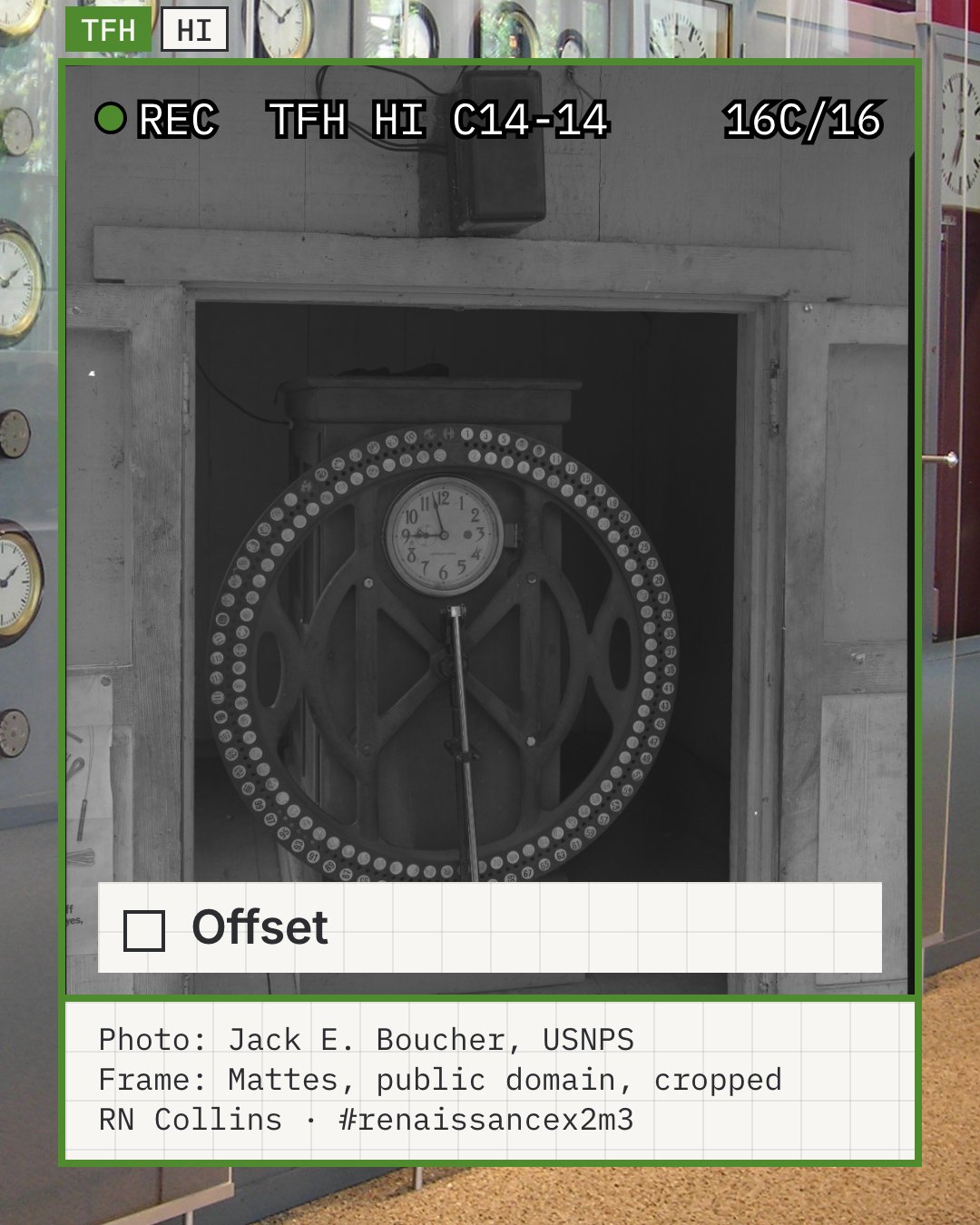
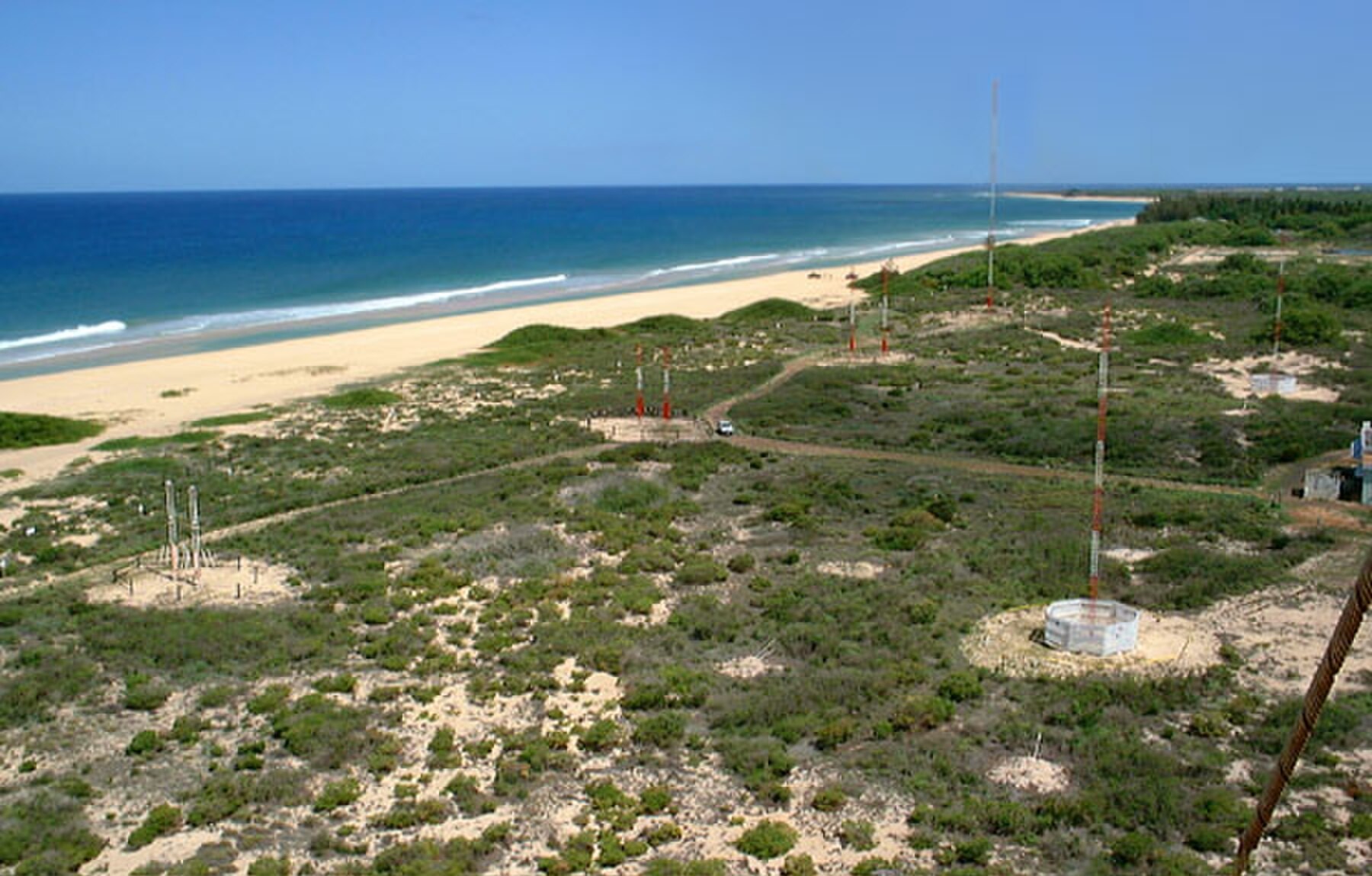
The station pictured in the essay's captions is the closest thing Hawaiʻi has to an official voice of the clock, and its history has the same quirks as the law. WWVH began broadcasting on November 22, 1948, from Kihei on Maui, a low-power signal on 5, 10 and 15 megahertz. It spent its first two decades losing the beach: NIST estimates about 75 feet of shoreline vanished between 1949 and 1967, and by 1965 the ocean stood within a few meters of the main building and the 10 megahertz antenna. In July 1971 the station moved to a site near Kekaha on Kauaʻi.
It does not announce Hawaiian time. A woman's voice, used so that listeners can tell WWVH from the man's voice at WWV in Colorado, reads Coordinated Universal Time at the top of each minute, and NIST's own advice is that it will be necessary to adjust the hour to your local time zone. Until January 1974 the announcements were in Greenwich Mean Time. A 1979 handbook from the National Bureau of Standards lists those who depend on the signal as electric utilities, broadcasters, telephone companies and navigators of ships and planes. The Territory's decision to move thirty minutes in 1947 sits inside a chain whose reference point is a rounded UTC offset read aloud from the western edge of Kauaʻi.
Its antennas for 5, 10 and 15 megahertz were designed to radiate a cardioid pattern with maximum gain toward the west, toward the Pacific it serves, and NIST says its broadcasts include time announcements, standard time intervals, standard frequencies, UT1 time corrections, a time code, and geophysical alerts. According to a 1980 brochure cited by Schmitt and Cox, the station reached the entire Pacific Basin on three atomic clocks accurate to one millionth of a second per month.
Standard time coordinates bodies and institutions at enormous scale. It determines when a child arrives at school, when a court filing is due, when a market opens, when a live broadcast begins, and which date appears on a message crossing the Pacific.
Hawaiʻi once answered that coordination problem with a half hour tailored to its longitude. Later authorities answered it differently. Today’s whole-hour clock is not more “real” than the old one. It is simply the rule that survived.
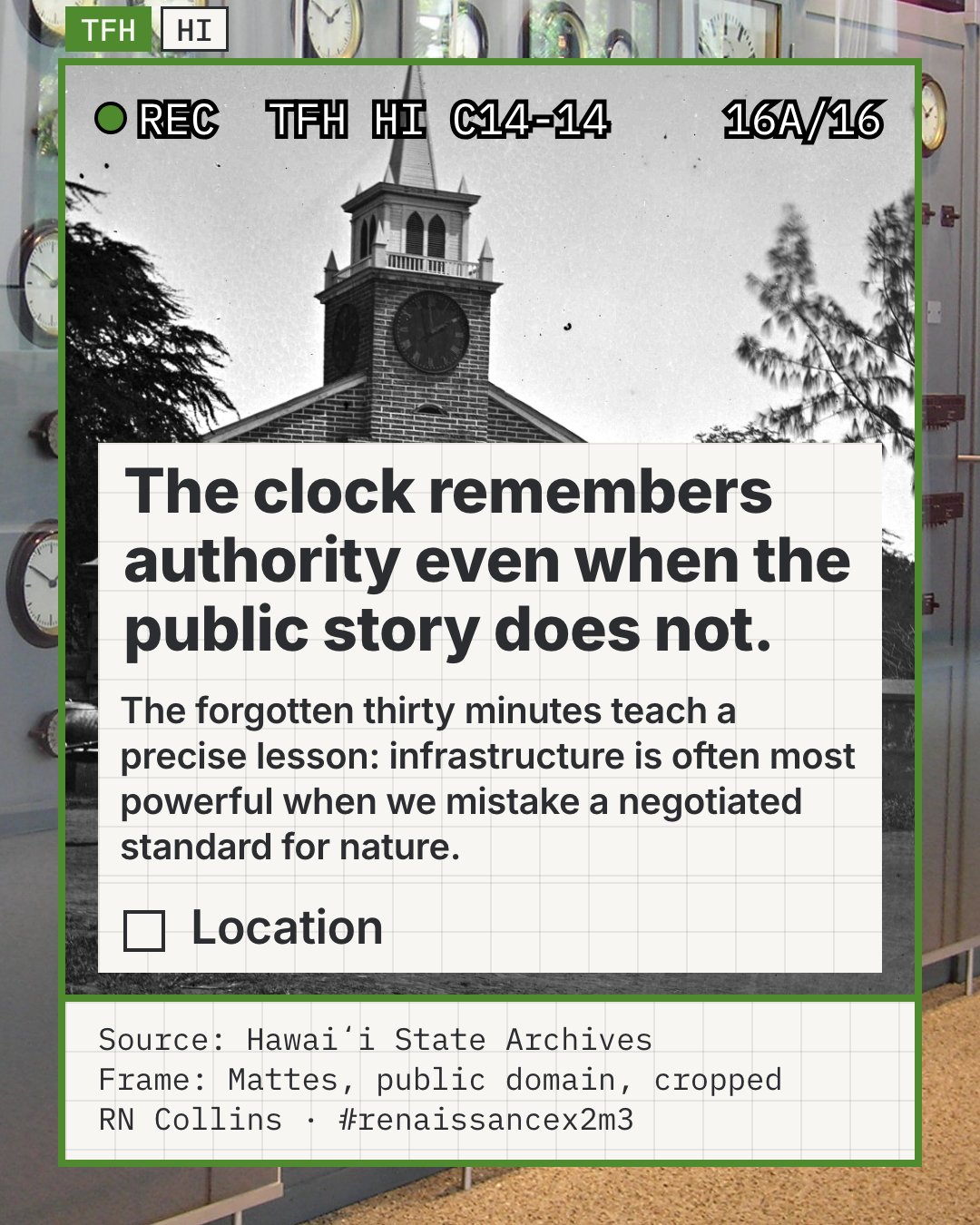
The forgotten thirty minutes teach a precise lesson: infrastructure is often most powerful when we mistake a negotiated standard for nature.
The clock remembers authority even when the public story does not.
Sources added October 3, 2026 (each page checked on that date): Robert C. Schmitt and Doak C. Cox, “Hawaiian Time,” The Hawaiian Journal of History, vol. 26 (1992), pp. 207-225, via evols.library.manoa.hawaii.edu; the Standard Time Act of March 19, 1918, 40 Stat. 450, text at webexhibits.org/daylightsaving/usstat.html; the Uniform Time Act of 1966, Pub. L. 89-387, 80 Stat. 107, at govinfo.gov; Hawaii Revised Statutes section 1-31, at data.capitol.hawaii.gov; 49 CFR 71.12, at law.cornell.edu; the IANA time zone database file for North America, at github.com/eggert/tz; and Peter T. Young, Images of Old Hawaiʻi, entry on daylight saving time, at imagesofoldhawaii.com.


.jpg)

_secure(?)_the_time(?)_LCCN2016821018.jpg)

.jpg)


,_WW2_German_underground_hospital._2009.jpg)
.jpg)


.jpg)


