The story
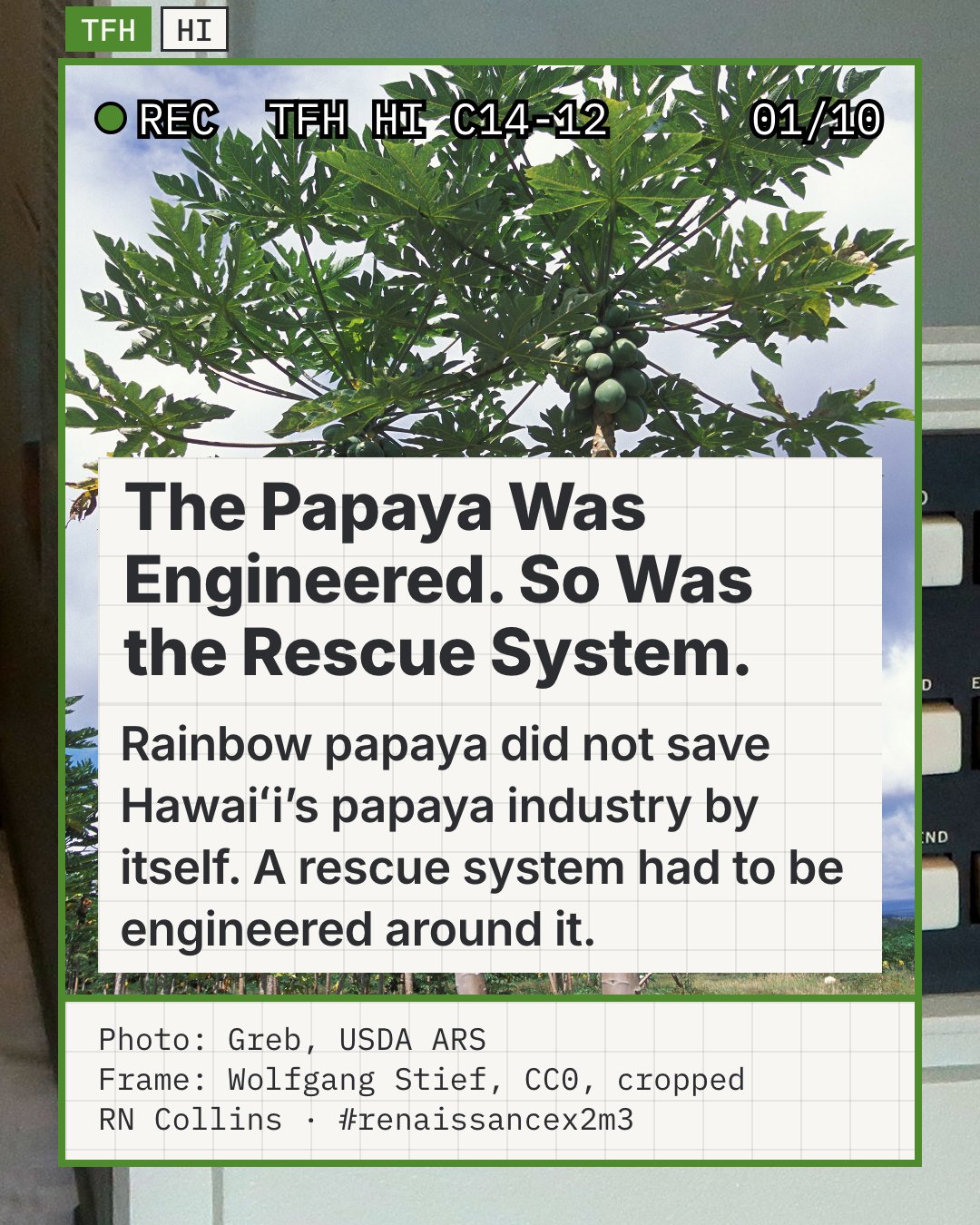
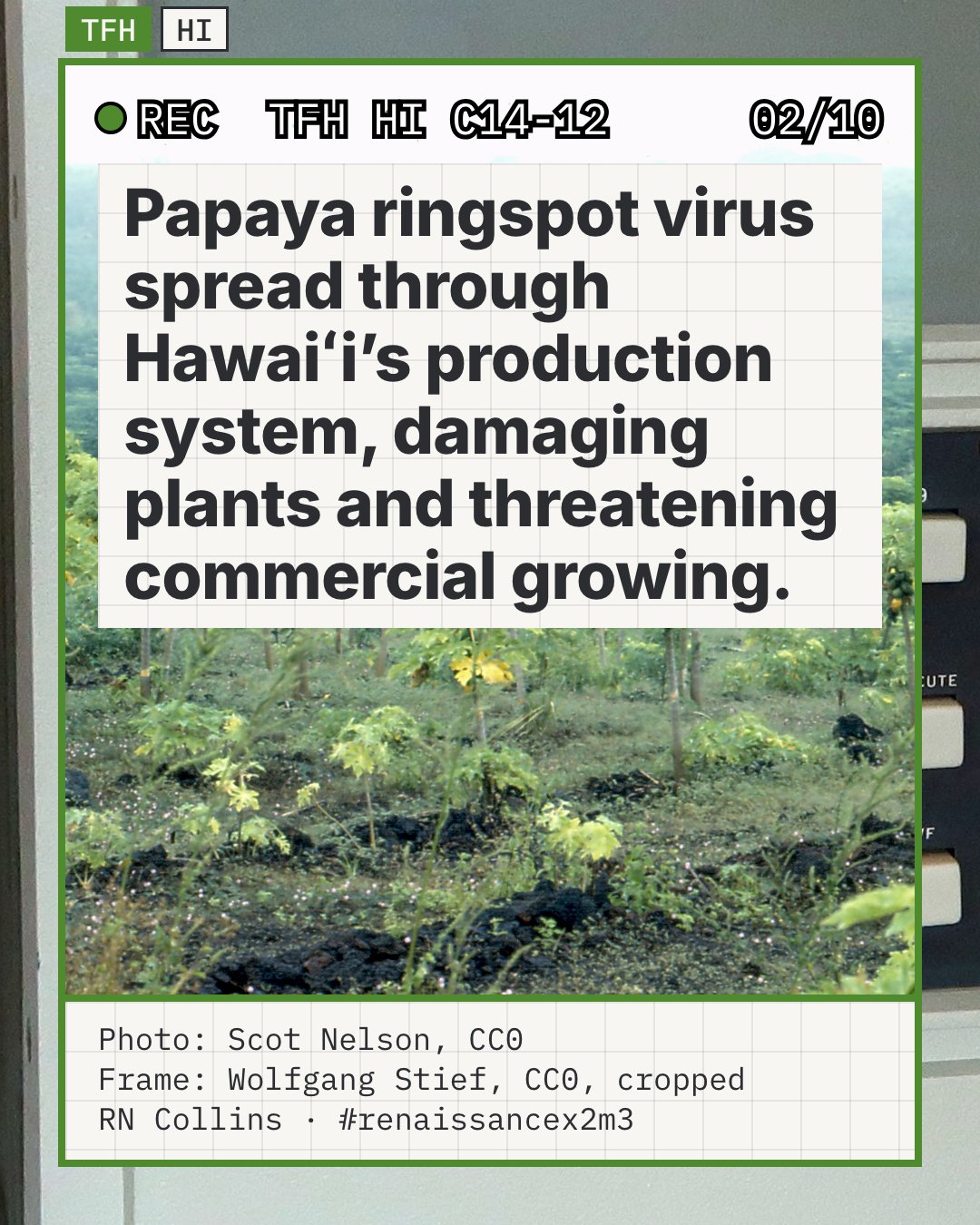
In the version of this story that gets repeated, a virus nearly wiped out Hawaiʻi's papaya industry, and scientists built a genetically engineered papaya that stopped it. That much is true. It's also the smallest part of what actually happened.
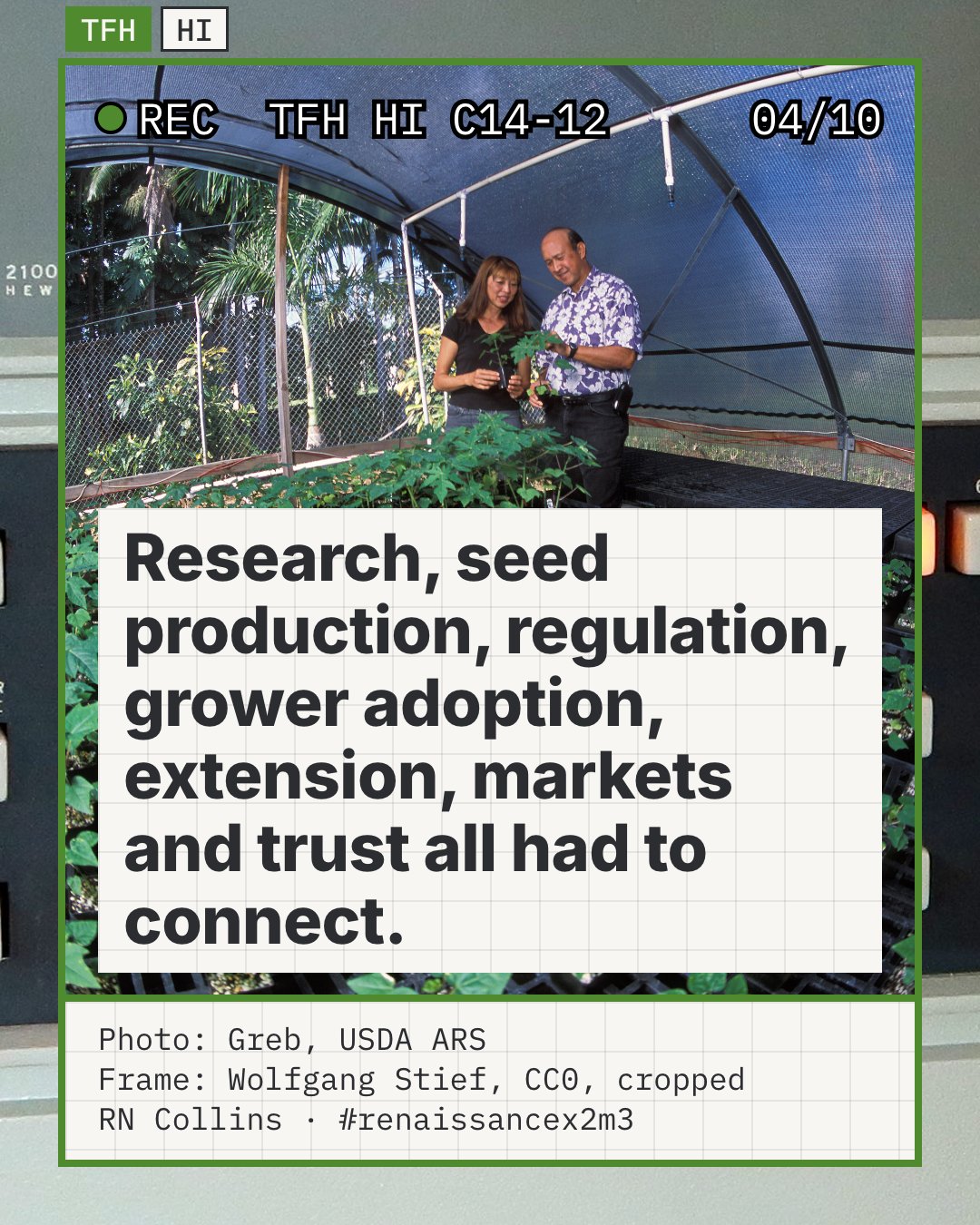
The Rainbow papaya didn't travel in a straight line from lab bench to farm field. Getting it there took plant pathology, years of breeding, a large field trial, a federal regulatory review split across three agencies, patent and licensing negotiations that reached outside Hawaiʻi entirely, a grower committee, a seed production and security system, an international market fight that outlasted the domestic approval by more than a decade, and a public argument over genetic engineering that hasn't really ended.
How Ringspot Virus Nearly Ended Puna Papaya
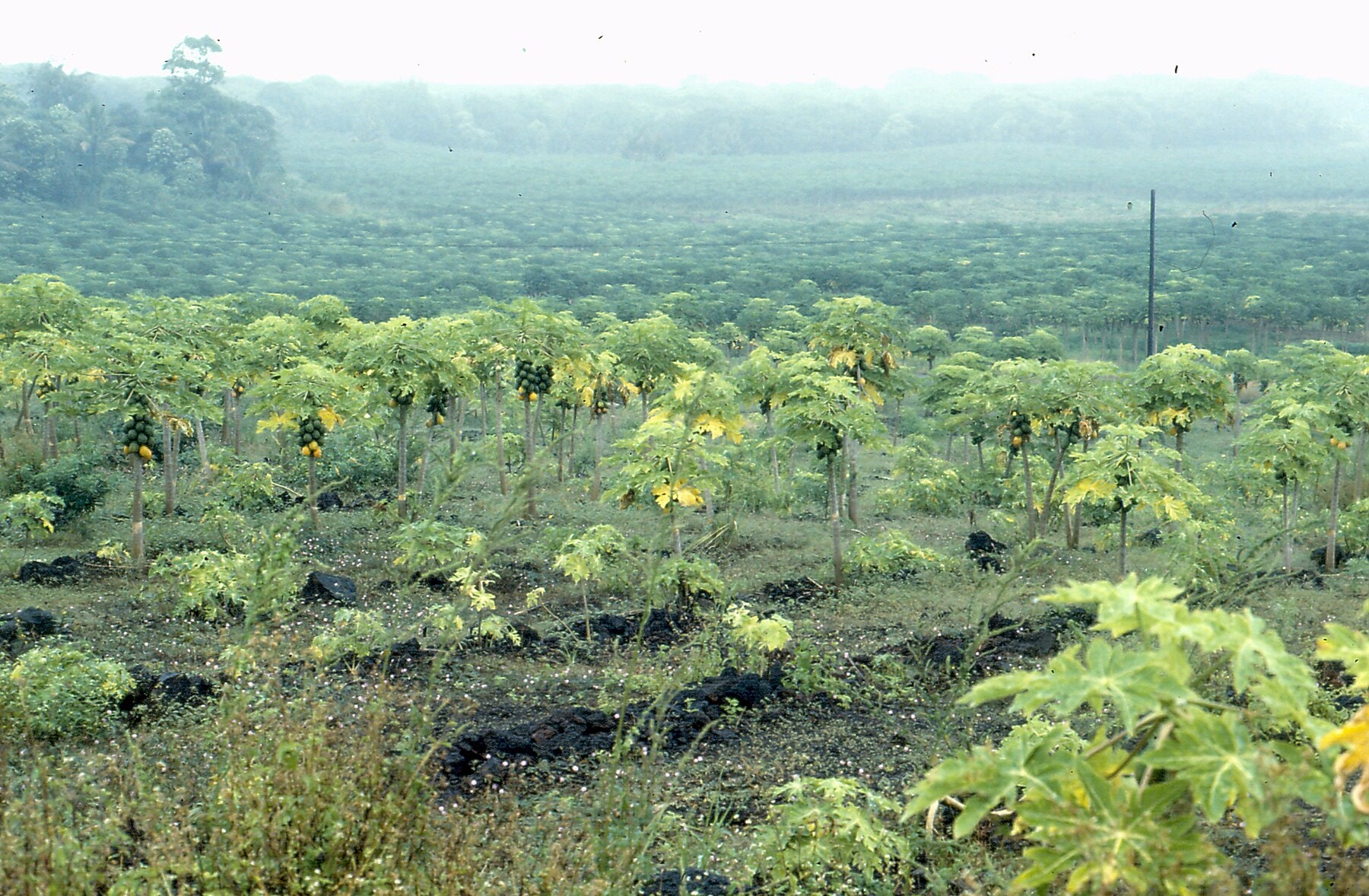
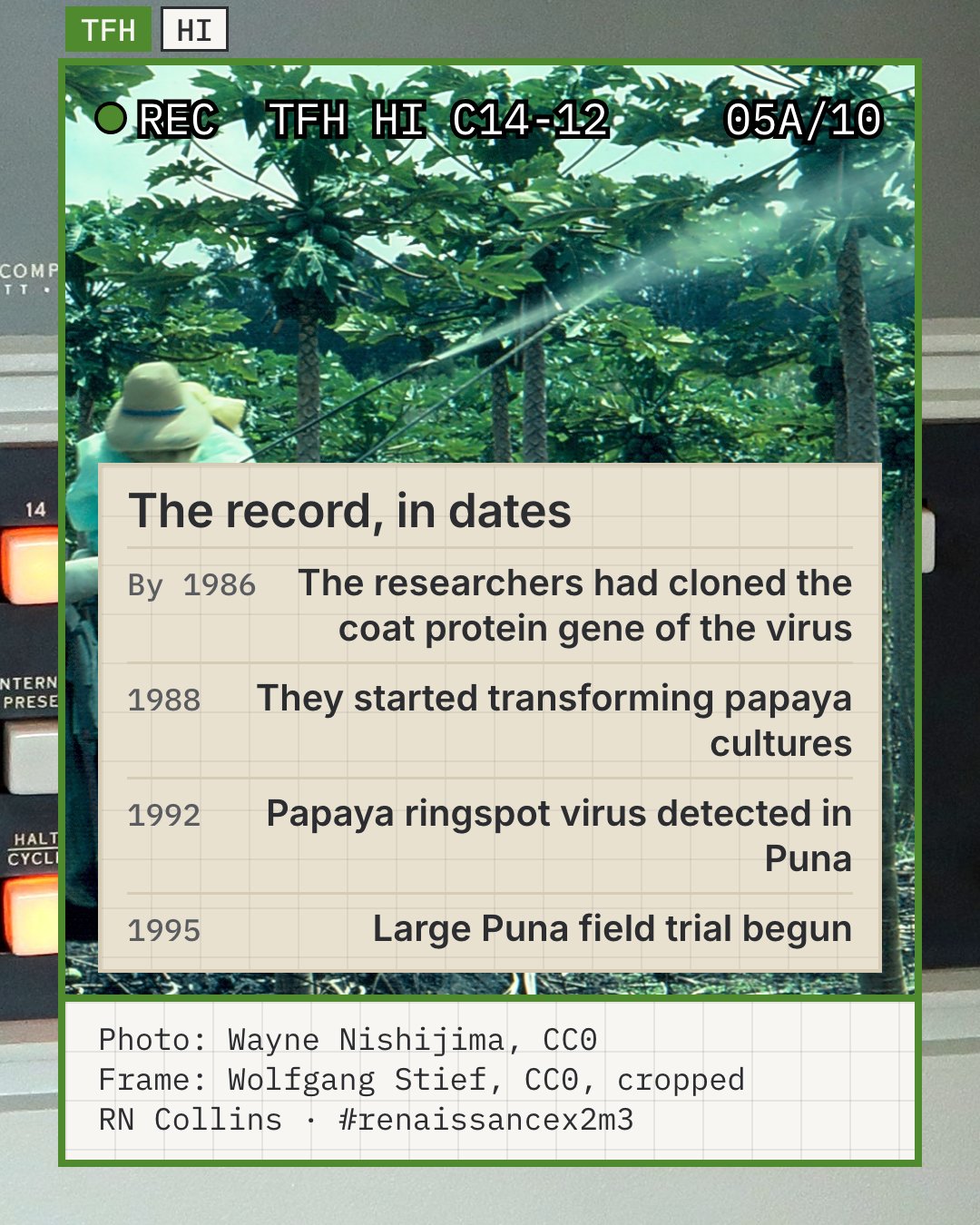
Papaya ringspot virus wasn't new to Hawaiʻi when it turned up in Puna in 1992. Oʻahu had been the main production area through the 1950s, but the same virus had already pushed the industry to relocate to Puna in the 1960s. By 1992, Puna was growing about 95 percent of the state's papaya, nearly all of it in one place, all of it about to be exposed at once.
Engineering a Virus-Resistant Papaya
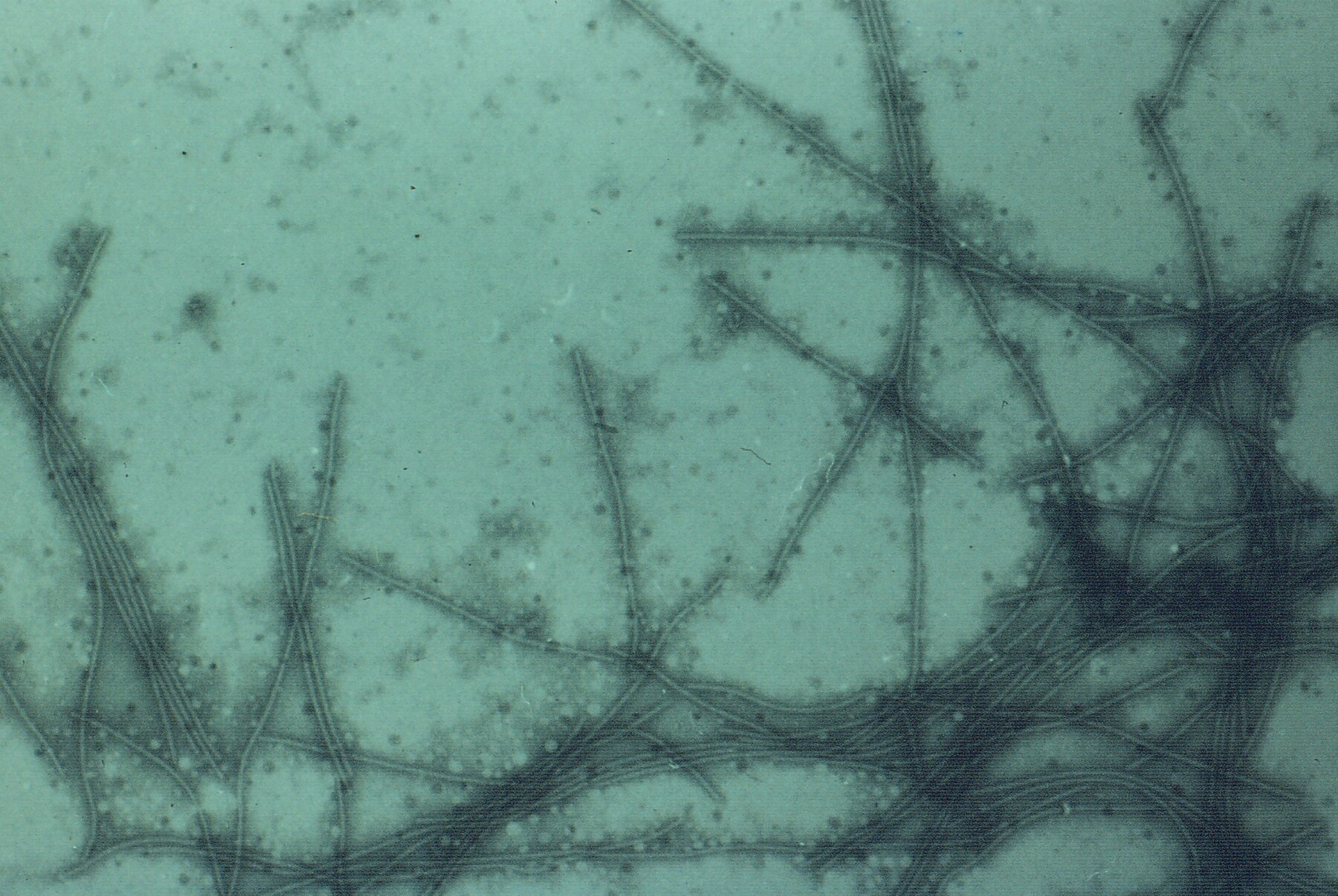
Dennis Gonsalves had already spent years working out how the virus itself operated (a 1985 paper with T.A. Yeh mapped how PRSV's genome gets translated into protein inside an infected cell) before the attempt to put a piece of that genome into a papaya plant began in earnest around 1987. Gonsalves, at Cornell, and Jerry Slightom, a scientist at the Upjohn Company, isolated the virus's coat-protein gene and modified it for use in plants. The technique itself didn't originate with either of them. Plant virologist Roger Beachy, then at Washington University in St. Louis, had shown in 1986 that tobacco plants engineered to produce a virus's own coat protein became resistant to that virus, the first demonstration of what came to be called pathogen-derived resistance. Slightom, pursuing the same approach for Upjohn's Asgrow Seed subsidiary, contacted Beachy and then Gonsalves; Gonsalves proposed testing it specifically on papaya and the ringspot virus.
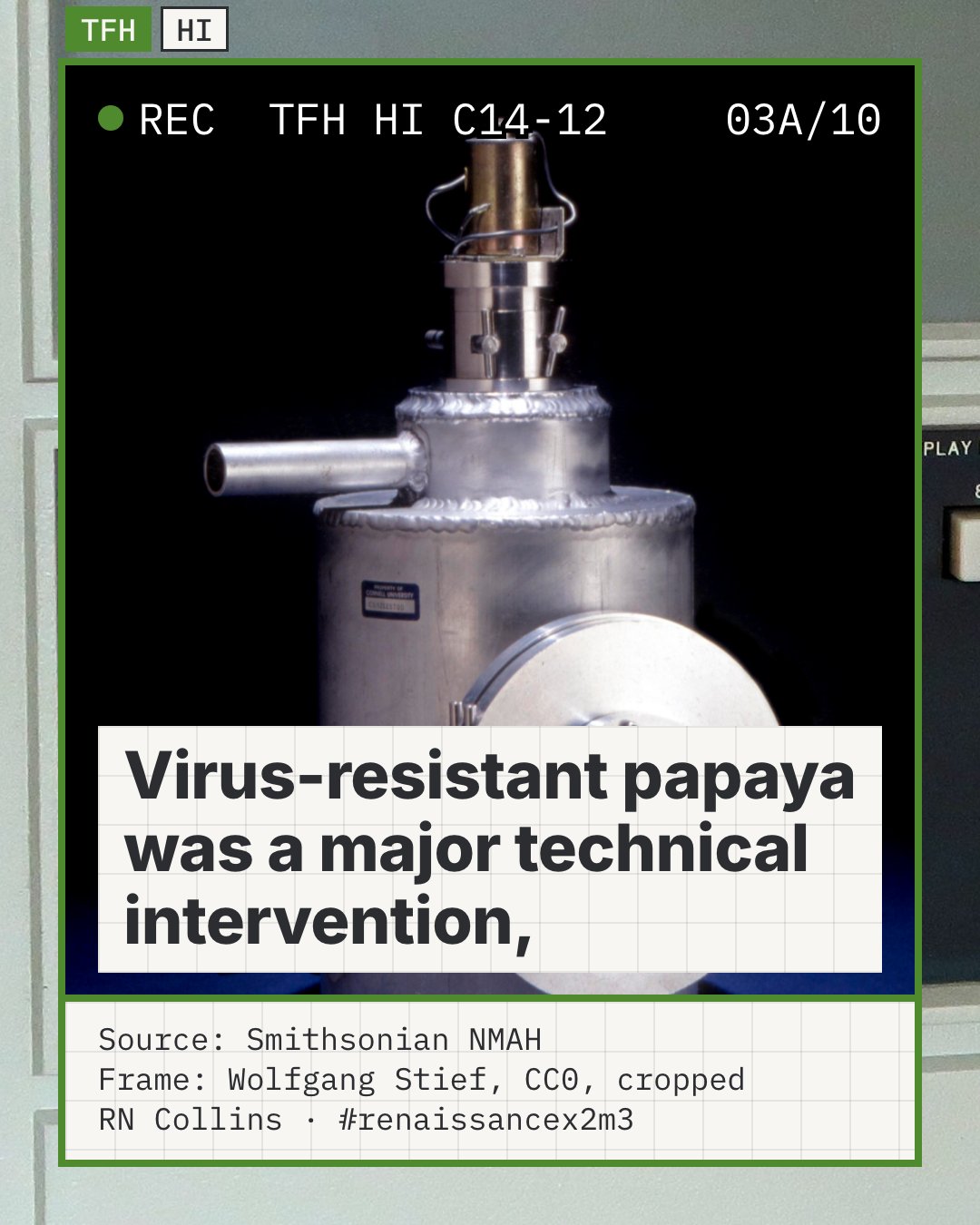
The approach was pathogen-derived resistance: inserting part of the virus's own coat-protein gene into the papaya so the plant would resist the virus it came from. In 1989, John Sanford (the Cornell engineer who had built the particle gun used to fire genetic material into plant cells) helped shoot copies of that gene into cultured tissue of the papaya cultivar Sunset. Gonsalves's team identified the first resistant plant (designated line 55-1, the transgenic ancestor of both SunUp and, through crossing, Rainbow) in 1991. The resulting red-fleshed resistant line became known as SunUp.
The published record credits a team, not a lone inventor: Dennis Gonsalves, Carol Gonsalves, Steve Ferreira, Karen Pitz, Maureen Fitch, Richard Manshardt, and Jerry Slightom all appear on the core papers. Fitch, then a graduate student at the University of Hawaiʻi, built the tissue-culture system needed to regenerate whole plants from the bombarded cells: without it there was no plant to test, let alone breed from. Ferreira ran the large Puna field trial; Manshardt's breeding work is what connected the resistant line to a cultivar growers and buyers already knew. Even that list undersells the labor behind the project. The growers, committee staff, seed handlers, regulators, and community members who carried it out, or fought it, deserve their own record.
Rainbow's resistance was bred against the specific Hawaiian strain of the virus used in the research. It isn't a blanket answer to every ringspot isolate worldwide: it's a documented response to one defined pathogen, under particular genetic and environmental conditions. Even within Hawaiʻi, that resistance wasn't absolute from the day a seed went into the ground: greenhouse studies found Rainbow seedlings stayed susceptible to infection for roughly their first seven weeks, becoming reliably resistant only after about three months. Growers were instructed to rogue out any infected young plants immediately and clear infected material from abandoned orchards nearby, so the virus wouldn't get a chance to adapt around the resistance already built in.
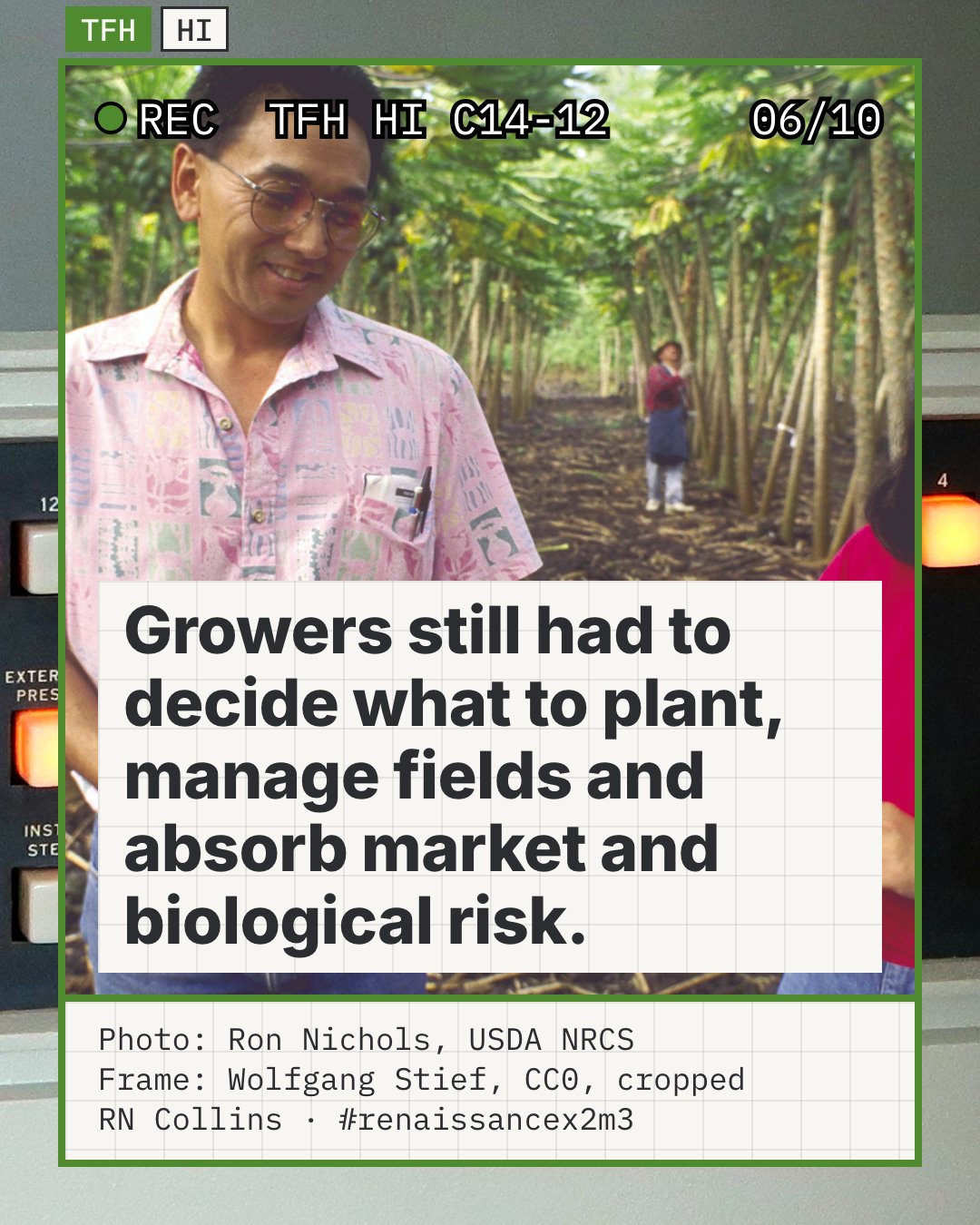
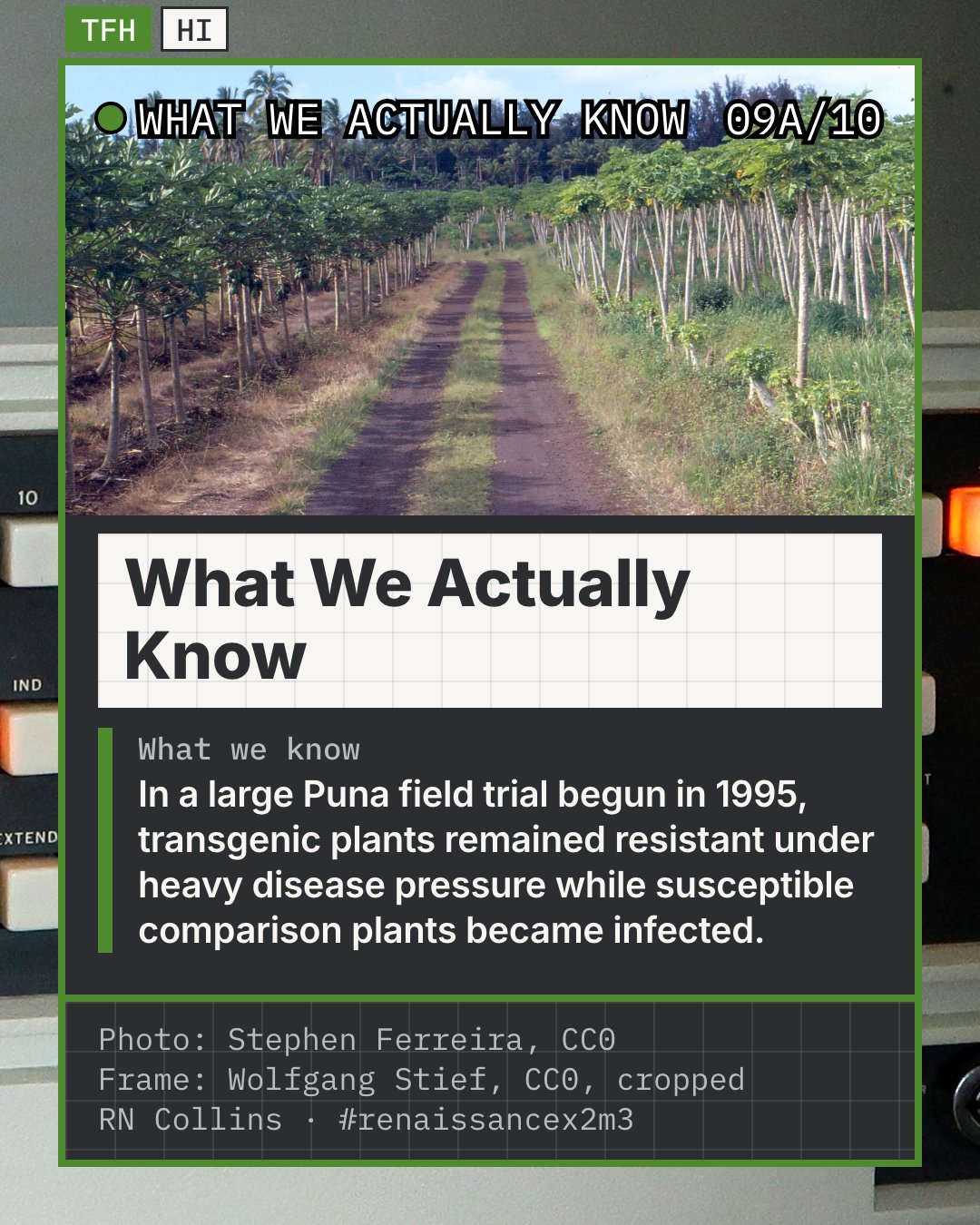
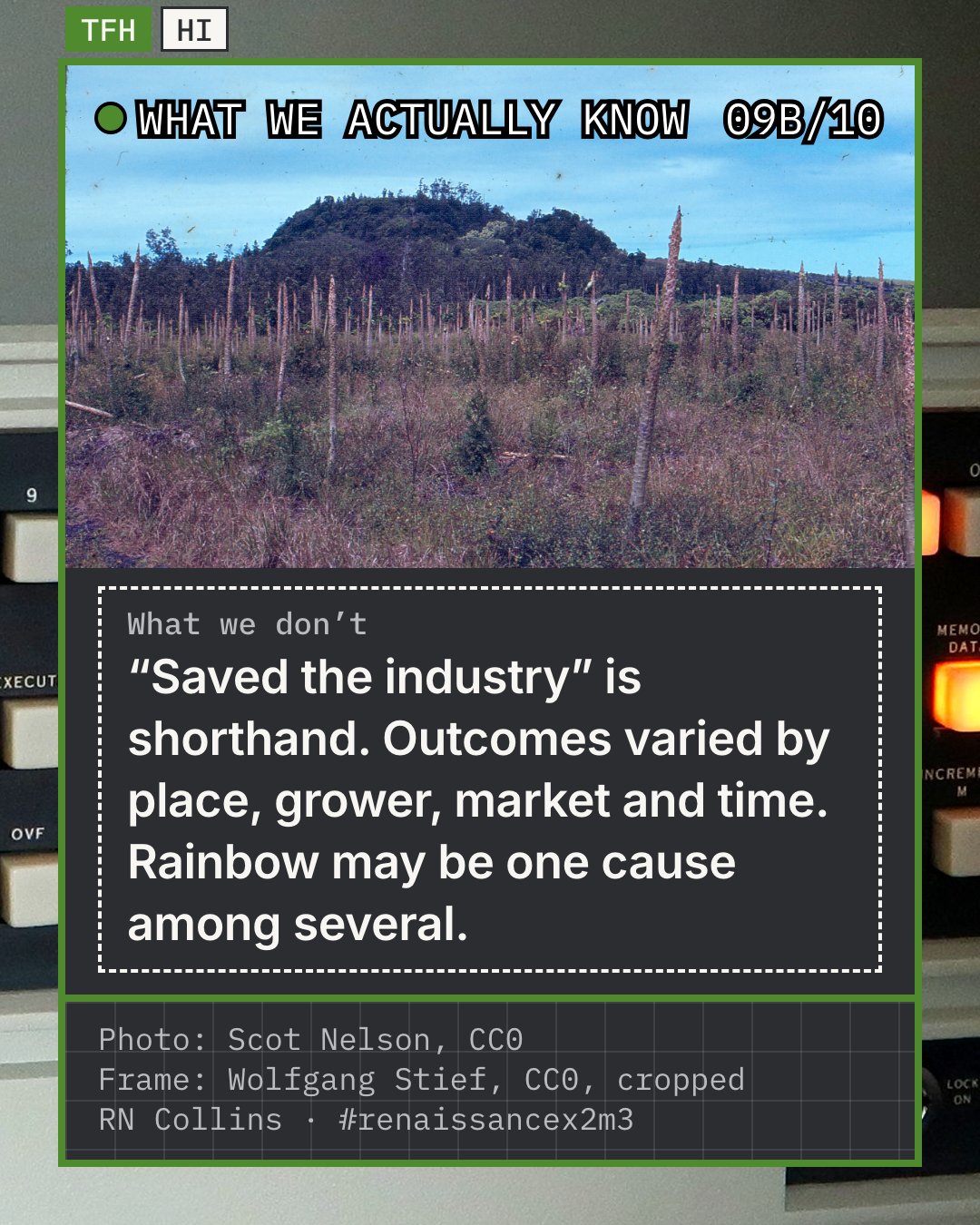
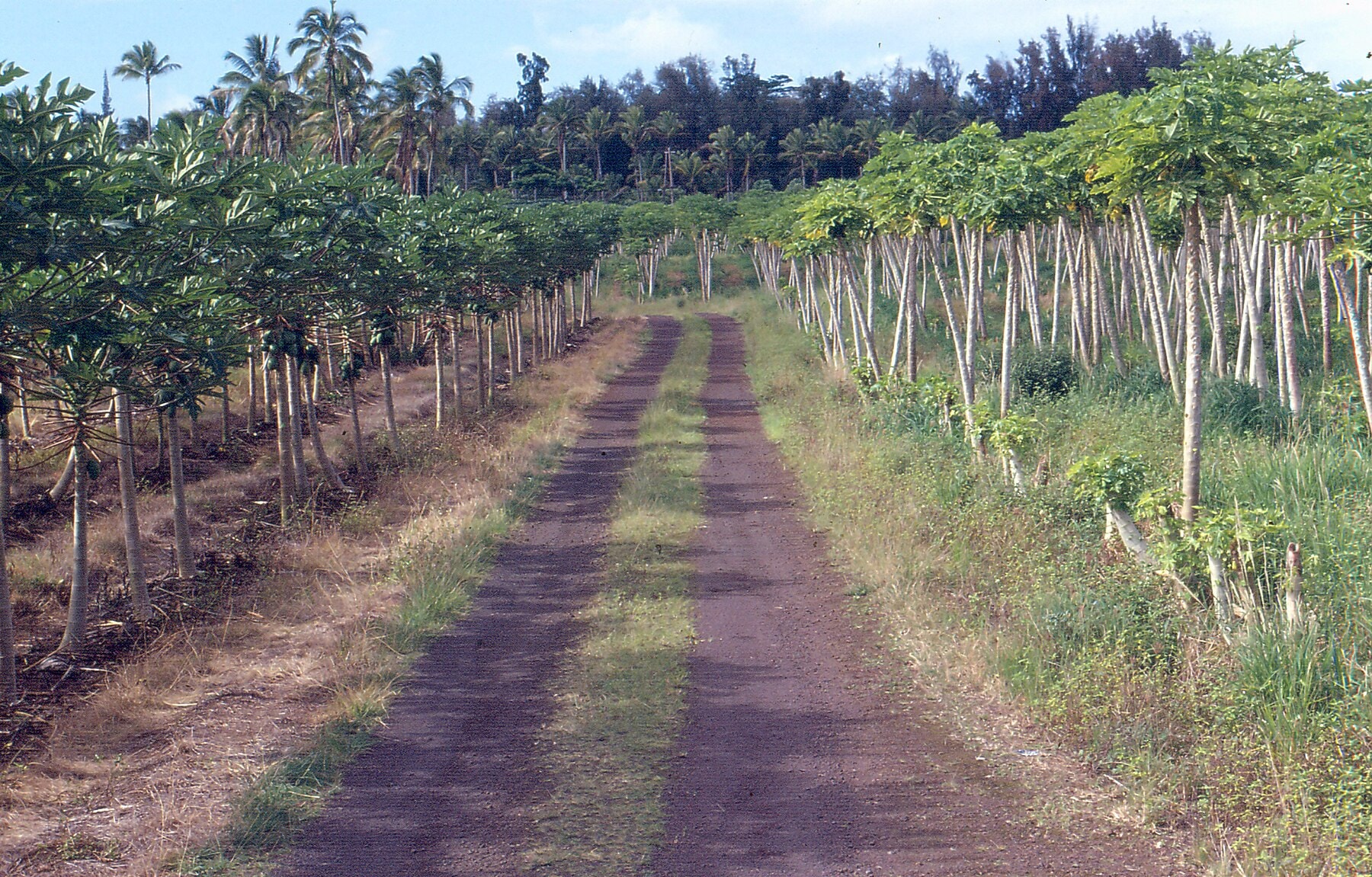
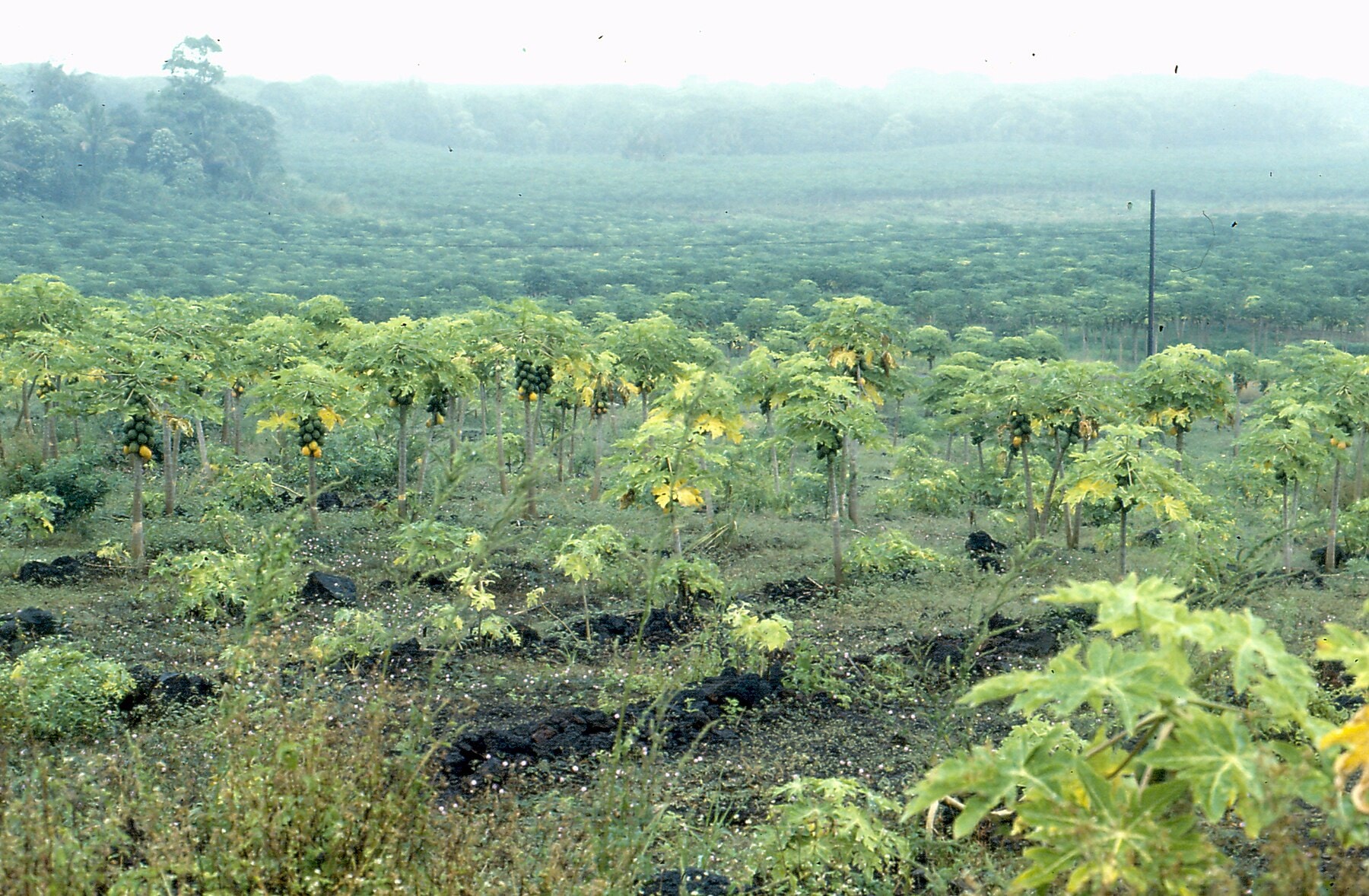
The dominant commercial papaya in Puna was the yellow-fleshed Kapoho, and Rainbow was produced by crossing SunUp with nontransgenic Kapoho to bring the resistance into a marketable variety. A large field trial planted in Puna in 1995 put the answer in the ground next to the problem: transgenic plants stayed healthy under heavy disease pressure while the susceptible plants beside them got infected. The photos from that trial are the ones people remember: a green, healthy block next to visibly wrecked trees.
Three Federal Agencies, Three Different Questions
Getting the papaya to market took three separate federal reviews, not one, and each one asked a different question.
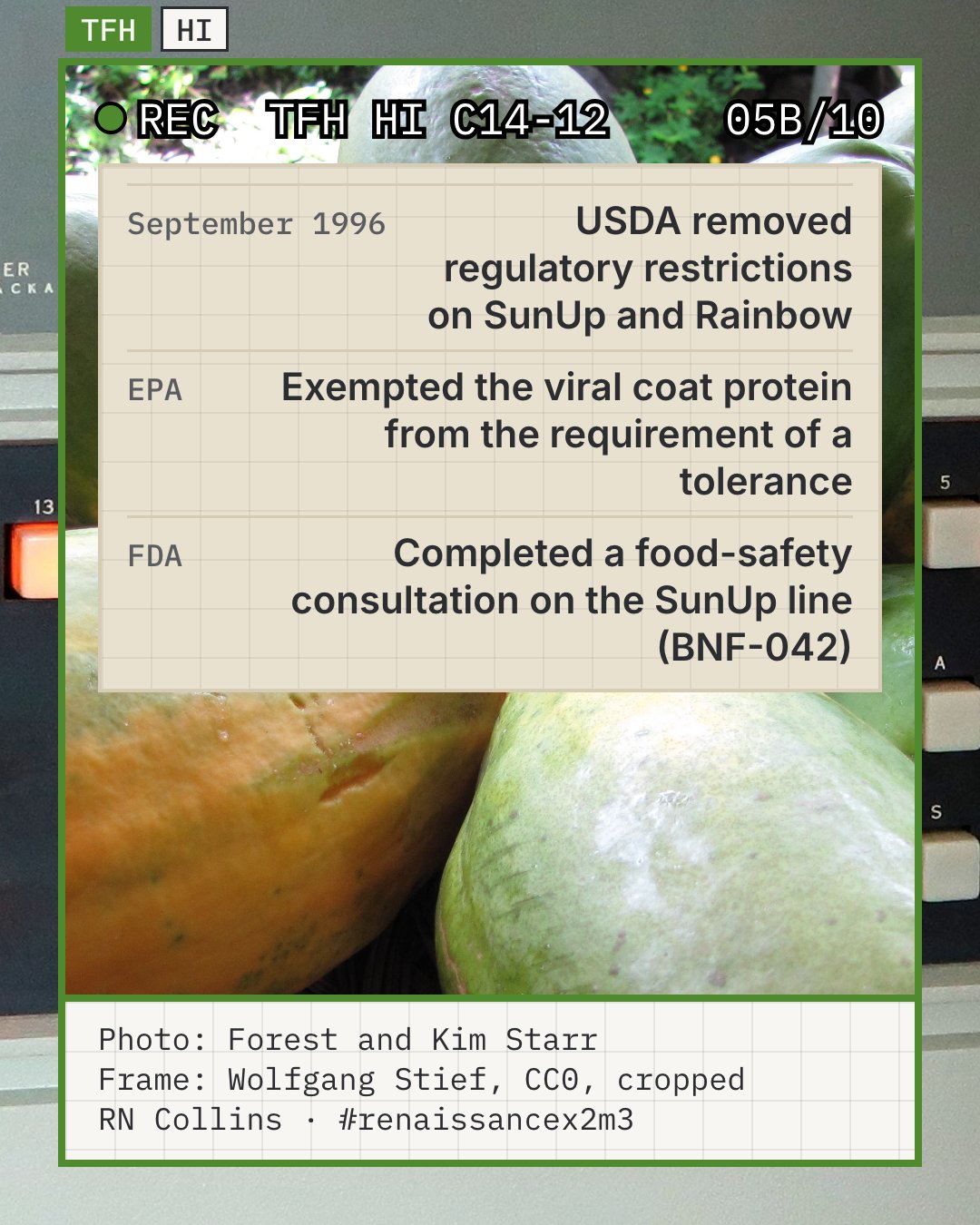
The USDA's Animal and Plant Health Inspection Service treated it as a question of plant-pest risk: could the transgenic line behave like a pest if released without restriction? By September 1996, APHIS had decided it wouldn't, and stripped the transgenic line behind SunUp of regulated status. Cornell and the University of Hawaiʻi announced the decision jointly on September 23, 1996, with APHIS's then-acting biotechnology director, John H. Payne, confirming the finding on the record.
The EPA's question was different, and stranger if you didn't already know the reasoning: because the plant had been engineered to produce part of a viral protein, and that protein was there specifically to interfere with the virus, EPA's own rules treated it as a pesticide under the Federal Insecticide, Fungicide, and Rodenticide Act. The agency had spent the first half of the 1990s working out a general regulatory framework for plant-virus coat proteins as a class, and papaya ringspot virus coat protein ended up with its own exemption from a food-residue tolerance requirement, a rule still on the books today, at 40 CFR 174.515.
The FDA's process was voluntary by design: since the mid-1990s, the agency has asked developers of new plant varieties to consult with it before commercial sale rather than requiring formal pre-market approval, and Rainbow and SunUp went through that consultation like the biotech varieties before them.
All three reviews were complete by September 1997, according to the University of Hawaiʻi's own extension literature on the two cultivars. Seed reached growers the following spring, on May 1, 1998.
Even that summary compresses a lot. The Federal Register notice on the APHIS petition, EPA's rulemaking record on plant-virus coat proteins, and FDA's consultation file go into far more procedural and scientific detail than fits here: what evidence convinced each reviewer, what conditions attached to each finding, what the public raised in comment and how it was answered.
Licensing, Seed, and a Black Market
Getting seed to growers afterward wasn't simply a matter of Cornell and the University of Hawaiʻi giving away what they'd built. The universities' own papaya-specific inventions carried no royalty for Hawaiʻi's growers. But SunUp and Rainbow had been made using other people's patented tools and techniques along the way, and before any seed could be sold, Hawaiʻi's Papaya Administrative Committee had to negotiate separate use licenses with those outside patent holders: Monsanto, Asgrow Seed Company, Cambia Biosystems, and the Massachusetts Institute of Technology. Clearing that intellectual property cost PAC $100,887. One version of this story says the rescue technology was simply given away. The university's own record is more specific: growers purchased seed from PAC under a signed sublicense agreement, not at retail markup, but not for free either. What Cornell and the University of Hawaiʻi didn't charge for was their own invention. The platform technology underneath it still had a price, and someone still had to pay it.
What PAC sold came with conditions attached to every packet. Growers had to attend an educational session covering the virus and the license terms, sign the sublicense before buying seed at all, agree to plant it only in Hawaiʻi, and keep transgenic fruit out of any export market that hadn't cleared it for import. Because Rainbow is an F1 hybrid, seed saved from a Rainbow harvest doesn't grow true: some resulting plants come up red-fleshed, some yellow, and only some keep the virus resistance. Growers who wanted to keep growing it had to return to PAC and buy new seed every season, ordinary hybrid-seed economics, though the timing and the disease pressure made that recurring purchase feel like something more deliberate than it was.
That scarcity had a black-market cost. In March 1997, a university technician found papaya fruit at a Puna farm that had been cut open and stripped of their seeds. A year later, in March 1998, 700 pounds of Rainbow fruit (worth an estimated $30,000) were stolen from a research station on Kauaʻi. The investigation that followed found signs that ten to twelve growers had obtained unauthorized seed and planted an estimated 50 acres of it, and that the thefts had gone unreported to the state's biosafety oversight committee for more than a year. None of this makes it into the story most people know about Rainbow. The fuller account still needs the people in it: who physically handled the seed, how growers learned the new planting requirements, what the licensing and education process cost them in time and money, and how neighboring farms made different choices about adopting it, legally or otherwise.
Did Rainbow Actually Save the Industry?
Production climbed back from the epidemic's low point, and Rainbow became central to Puna cultivation. That's where the line "Rainbow saved the papaya industry" comes from. The numbers underneath it move more slowly than the line suggests. Puna's papaya yield had fallen from roughly 29,500 pounds an acre before the virus took hold in 1992 to about 18,800 pounds an acre by 1998, even on land growers kept working the whole time; that year's harvest, 26 million pounds, still came almost entirely off bearing Kapoho, since Rainbow hadn't yet produced mature fruit. Rainbow's own adoption crept rather than jumped: about 41 percent of Hawaiʻi's bearing papaya acreage in 2001, dipping to 37 percent in 2002, reaching 59 percent of Big Island acreage by 2004 as growers still holding Kapoho and other susceptible varieties converted field by field. By the mid-2010s, Rainbow and other resistant lines accounted for most of what Hawaiʻi grew, with estimates from that period ranging from about 77 to 85 percent of the crop depending on the year and the source.
The recovery has limits worth stating plainly. Hawaiʻi's papaya industry as a whole kept shrinking afterward for reasons virus-resistant seed can't touch: competition from other growing regions, rising land and labor costs, and agricultural land shifting to other uses. By 2022, the state's total papaya production had fallen to about 7 million pounds off roughly 500 bearing acres, a fraction of what Puna alone produced before the virus ever appeared. Rainbow solved the problem it was built to solve. On its own, it didn't stop Hawaiʻi's papaya industry from continuing to contract for reasons that had nothing to do with the virus.
The state statistics add detail to that contraction. NASS records 55.0 million pounds in 2001, the high point after the rescue, and 28.6 million pounds in 2011 from 1,300 harvested acres, with sales of $9.7 million. Its July 2012 summary lists pest and disease problems, low prices, vandalism and the cost of inputs as continuing concerns, and says lower prices were a deciding factor for some growers who stopped. Virus resistance addresses none of those directly.
The Decade-Long Fight Over Japan
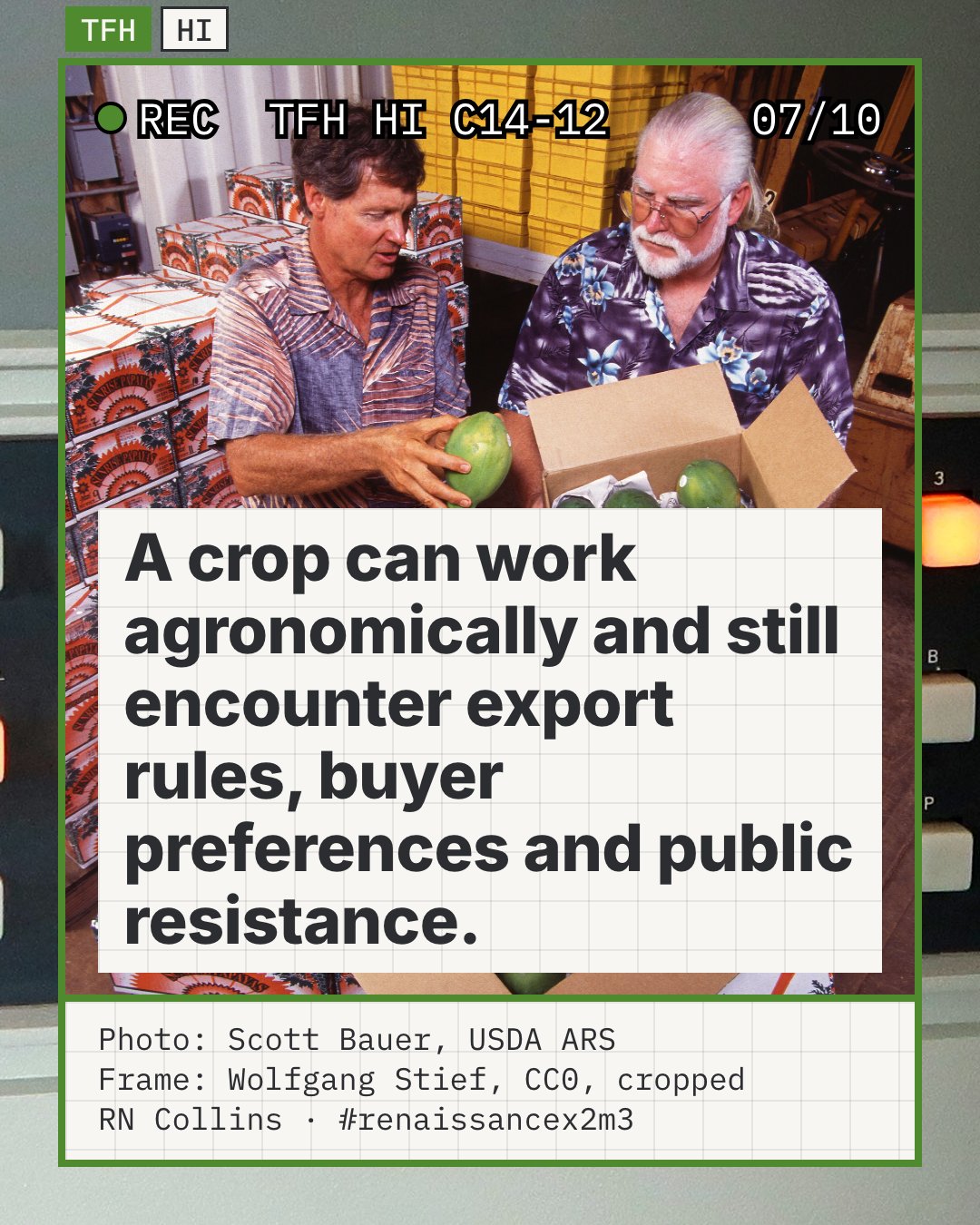
But non-transgenic papaya stayed essential for export, since some overseas markets wouldn't accept genetically engineered produce, and nowhere did that cost more than in Japan, historically Hawaiʻi's largest overseas papaya market. Japanese sales had run around $15 million a year through the mid-1990s; by 2010, with Rainbow already covering most of Hawaiʻi's bearing acreage but Japan still refusing to approve it for import, those sales had collapsed to about $1 million. Canada became the first country to approve the transgenic papaya, in 2003. Japan didn't follow until September 2011, permitting commercial imports that December, a licensing and safety-review process that took roughly a decade longer than the entire domestic approval had taken in the 1990s. So the technical rescue created a second technical problem: how to run engineered and non-engineered supply chains side by side without one contaminating the other's market access, for as long as the slower-moving market took to decide.
The Japanese approval has its own administrative history. The USDA Foreign Agricultural Service office in Tokyo reported on December 19, 2011 that Rainbow would be fully approved for commercial shipments on December 1, 2011, at the end of a process that began in 1999. The report calls biotech papaya the first horticultural product and the first direct-to-consumer food product to gain regulatory approval in Japan, and treats consumer acceptance as a leading indicator for other biotech products in the pipeline. It also records that U.S. shipments of papaya to Japan began in 1989.
County records and press coverage add detail on the ordinance. The Hawaiʻi County Council passed Bill 113 by a vote of 6 to 3 on November 19, 2013. The bill, introduced by Councilwoman Margaret Wille, barred new open-air genetically engineered crops and exempted papaya already in the ground, which Civil Beat reported was grandfathered as too pervasive to control. Growers of the exempted papaya still had to register their fields with the county each year for a $100 fee. An exemption in this case meant tolerated and counted.
Rainbow as a Political Flashpoint
Partly because of Rainbow, Hawaiʻi became a flashpoint in the larger fight over genetically engineered crops: field testing, corporate control of seed, contamination risk, labeling, land use, and who gets to decide what risk an agricultural community accepts. The fight reached Rainbow directly in December 2013, when Hawaiʻi County’s mayor signed an ordinance, passed by the Council on November 19 of that year, banning open-air cultivation of new genetically engineered crops on the island where Rainbow had already been grown commercially for fifteen years. The county carved out an explicit exemption for existing GE papaya, an acknowledgment that undoing Rainbow's presence in Puna wasn't a serious option even for the ordinance's own authors. Agrochemical companies and industry groups, including the Hawaii Papaya Industry Association, sued over the ordinance's broader provisions anyway. U.S. Magistrate Judge Barry Kurren struck it down on November 26, 2014, ruling it preempted by state law and, in part, by the federal Plant Protection Act. The county appealed, and the Ninth Circuit affirmed Kurren's ruling on November 18, 2016, ending the legal fight over the ordinance itself, though not the larger argument it was part of. Rainbow gets used constantly as the simple example, for whichever side of that fight is telling the story: proof biotechnology delivers, or proof it intrudes.
The field data on virus resistance is strong. It doesn't settle the harder questions: about consent, about who absorbed the cost of coexistence, about dependence on patented technology, about ecological monitoring, about market access, about whose definition of "rescue" gets to be the official one.
What This Account Still Leaves Out
A full history here would need Puna growers who adopted Rainbow, growers who didn't or who bore the coexistence costs, Native Hawaiian perspectives on land and food systems, the regulators, the plant scientists, and the people who ran the export and seed systems. Some of that record already exists in fragments. Gonsalves gave his own first-person account late in his career, a reflective essay called "The Wayward Hawaiian Boy Returns Home," published in the Annual Review of Phytopathology in 2015, and the Kohala Oral History Project separately recorded an interview with him about growing up on a Big Island sugar plantation and about solving the ringspot problem. Neither substitutes for the grower- and community-side history that's still missing. What follows here is the science and the rescue infrastructure specifically: a Puna story because that's where the disease concentrated, where Kapoho grew, where the field trial happened, and where growers made the call to plant something new.
In 2014, University of Hawaiʻi researchers Scot Nelson and Richard Manshardt built Pic-a-Papaya, a citizen-science app that let users photograph papaya plants around Honolulu and submit them for ringspot-virus diagnosis, helping researchers map where the virus and the resistant plants were actually showing up. That's a later addition to the story, not part of Rainbow's original chain of causes, and whether the app is still running today isn't clear from what's publicly documented.
It belongs in this account anyway, because it continues the same problem Rainbow only partly solved: after a resistant variety ships, someone still has to track where the disease and the resistance actually are.
The same caution applies further out: to the production recovery, to later export approvals, to whatever biotechnology policy followed. Rainbow may be one cause among several. A credible causal account has to say plainly which outcome came from the virus resistance itself, which came from the governance system built around it, and which simply happened during the same period.
After the Rescue
Dennis Gonsalves died in June 2023, at 74, in Kāneʻohe. After Rainbow's release he spent years directing the USDA's Pacific Basin Agricultural Research Center in Hilo and working on virus-resistant crops for growers in Venezuela, Jamaica, Brazil, and elsewhere. The papaya he helped engineer outlived the industry crisis it was built for, and so far it has outlived him too. What hasn't been finished is the fuller accounting his own essay gestured toward but didn't attempt: who else carried the weight of getting it into the ground.
The papaya's role as a research subject didn't end with commercial release, either. In April 2008, Nature published the draft genome of SunUp (led by the University of Hawaiʻi's Maqsudul Alam, with Gonsalves among the co-authors) making it the first genetically engineered crop anywhere to have its genome sequenced. A more detailed follow-up in 2022, led by Ray Ming at the University of Illinois, sequenced SunUp against its exact non-transgenic parent, the cultivar Sunset, and found the original gene-gun transformation had done more than insert the intended coat-protein gene: it left a 1.6-million-base-pair rearrangement on one chromosome, carrying dozens of stray fragments of chloroplast and mitochondrial DNA that were swept in during bombardment, along with a large deletion relocated into the same site. None of it, the researchers reported, disrupted a single gene's function. "We looked at every gene sequence and there is no impact on the genome function," Ming said. Three decades on, the actual scope of the engineering turned out to be messier than the original story suggested, and, on the evidence so far, no less safe for it.
Sources for material added October 3, 2026 (each checked on that date): USDA National Agricultural Statistics Service, Hawaii papaya statistics, data.nass.usda.gov/Statistics_by_State/Hawaii/Publications/Archive/Papayas_Annual/xpap11.pdf. USDA Foreign Agricultural Service, GAIN report on Japan’s approval of genetically modified papaya, December 19, 2011, apps.fas.usda.gov/newgainapi/api/report/downloadreportbyfilename?filename=Japan%20approved%20GM%20papaya_Tokyo_Japan_12-19-2011.pdf. Civil Beat, civilbeat.org/2013/11/20454-hawaii-county-council-passes-biotech-ban/, and Big Island Video News, bigislandvideonews.com/2013/11/19/video-hawaii-county-council-final-reading-on-gmo-bill-113. The mayor signed Bill 113 on December 5, 2013, per West Hawaii Today, westhawaiitoday.com/2013/12/06/hawaii-news/mayor-kenoi-signs-anti-gmo-bill/.

.jpg)


.jpg)
(NRCS_Photo_Gallery).jpg)


.jpg)
.jpg)


(NRCS_Photo_Gallery).jpg)


