The story
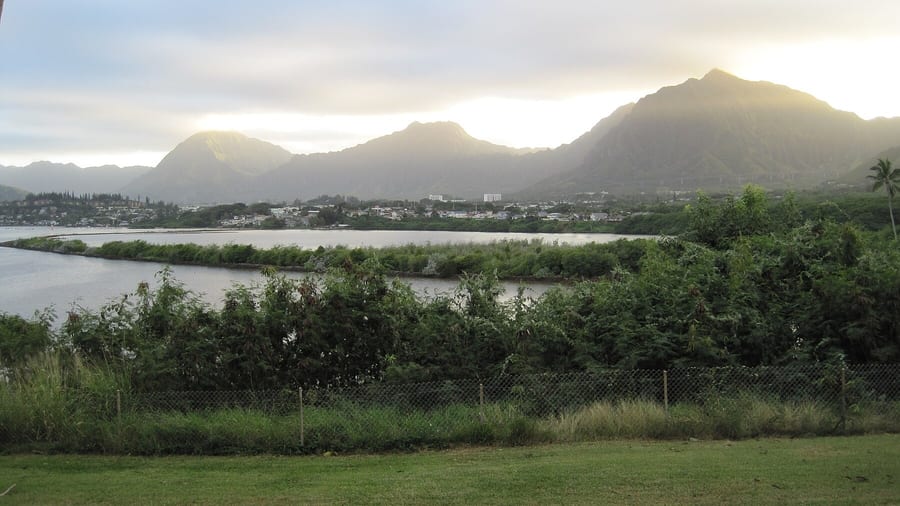
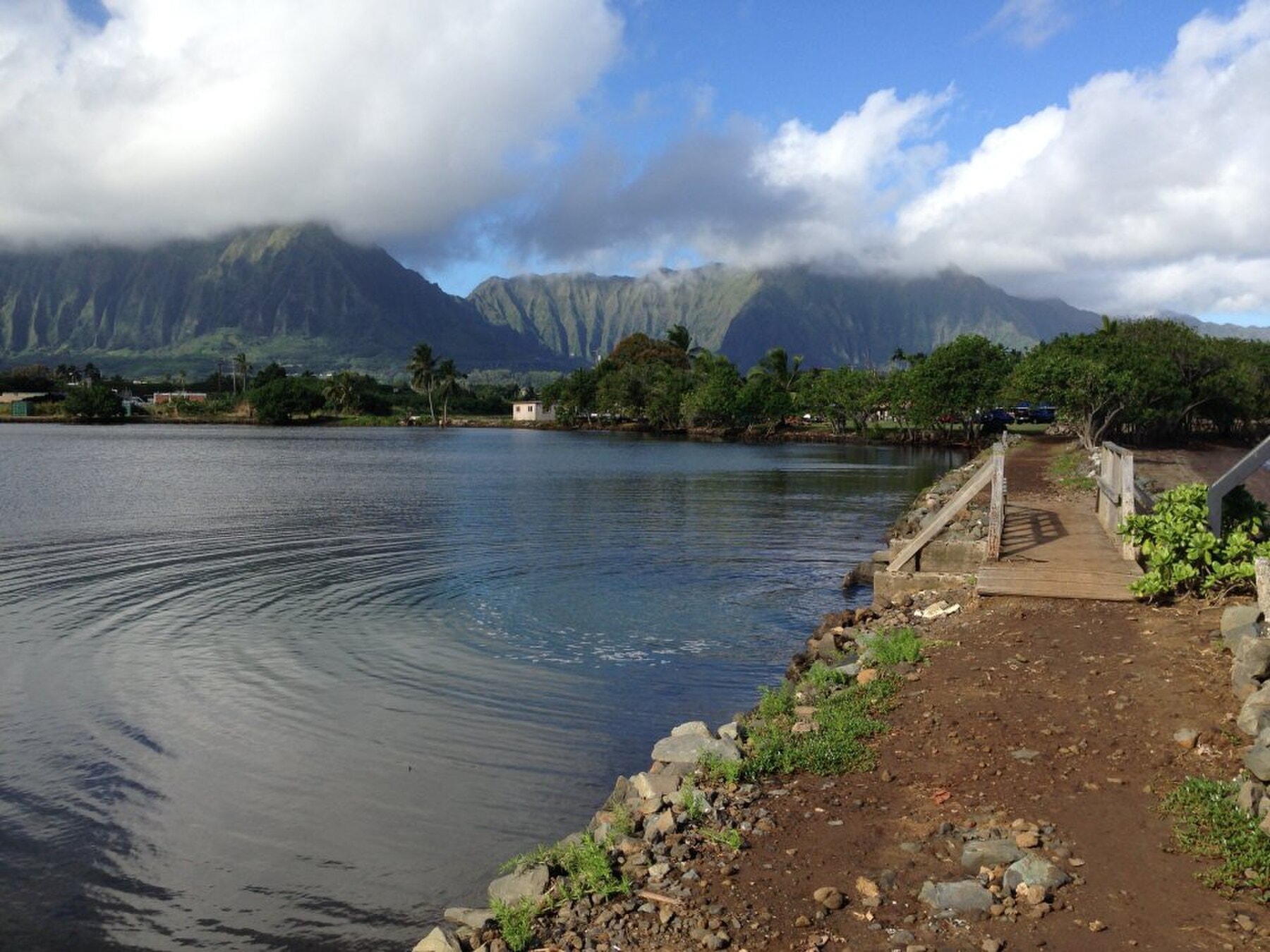
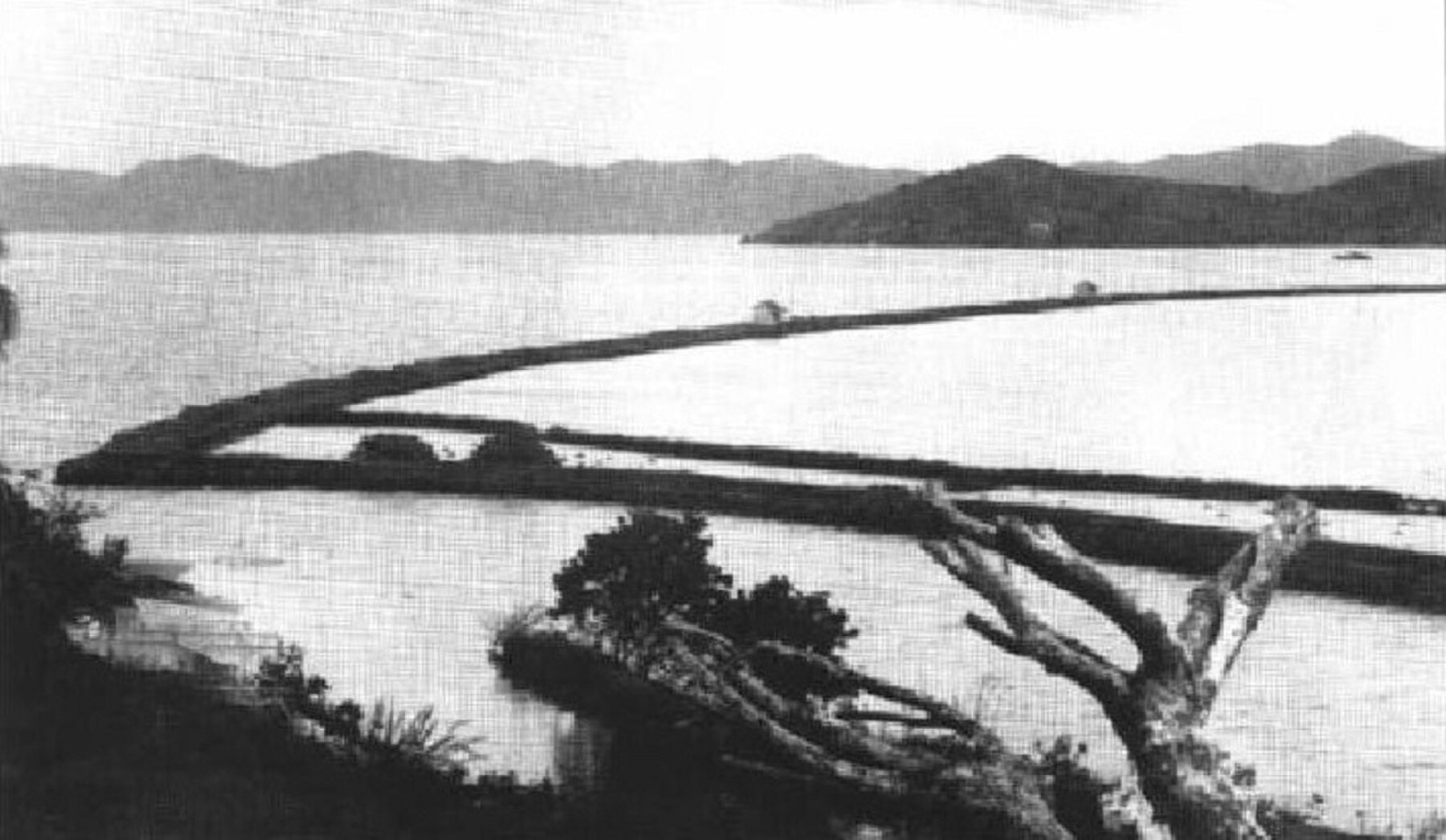
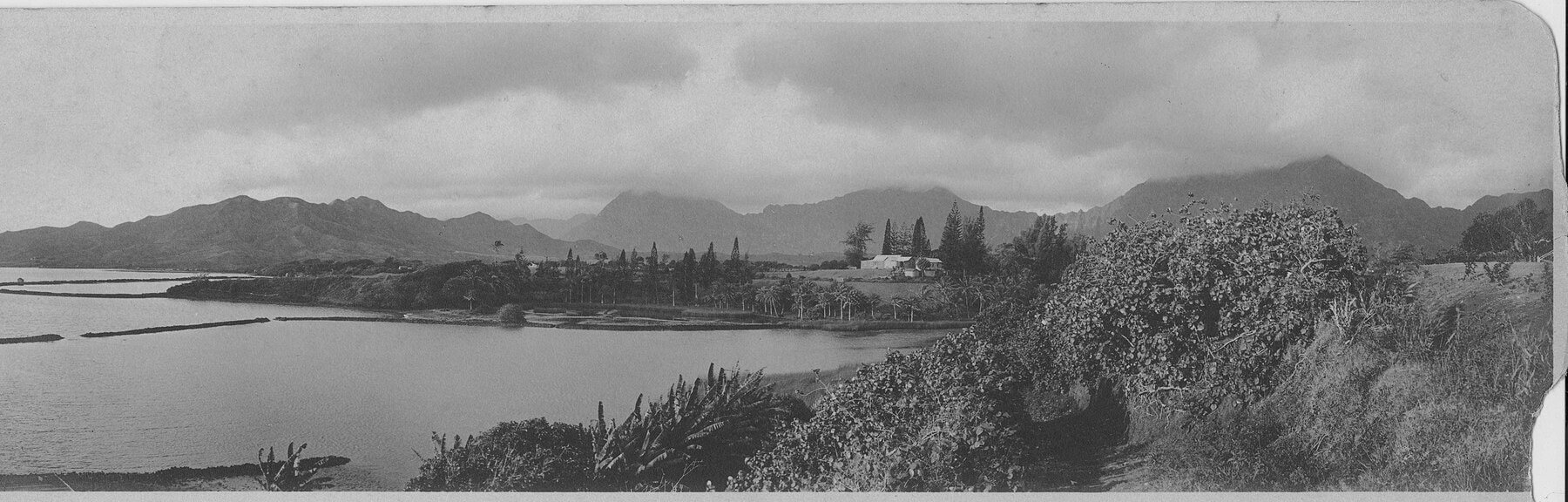
The kuapā at Heʻeia runs through Kāneʻohe Bay: stone and coral stacked into a wall that holds tide water without shutting it out. Behind that wall, salt and fresh water mix into brackish conditions where limu and the fish that feed on it can grow.
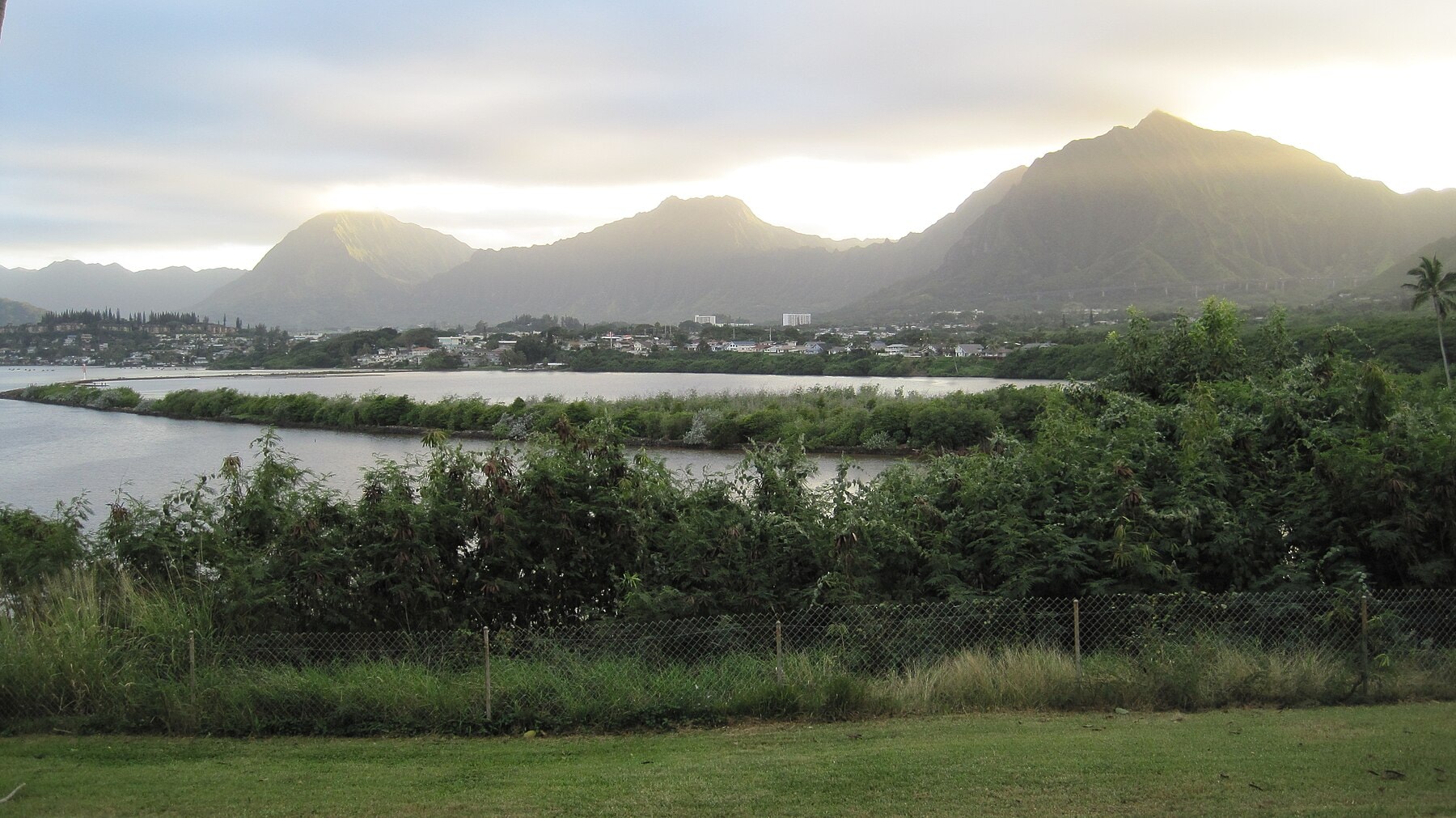
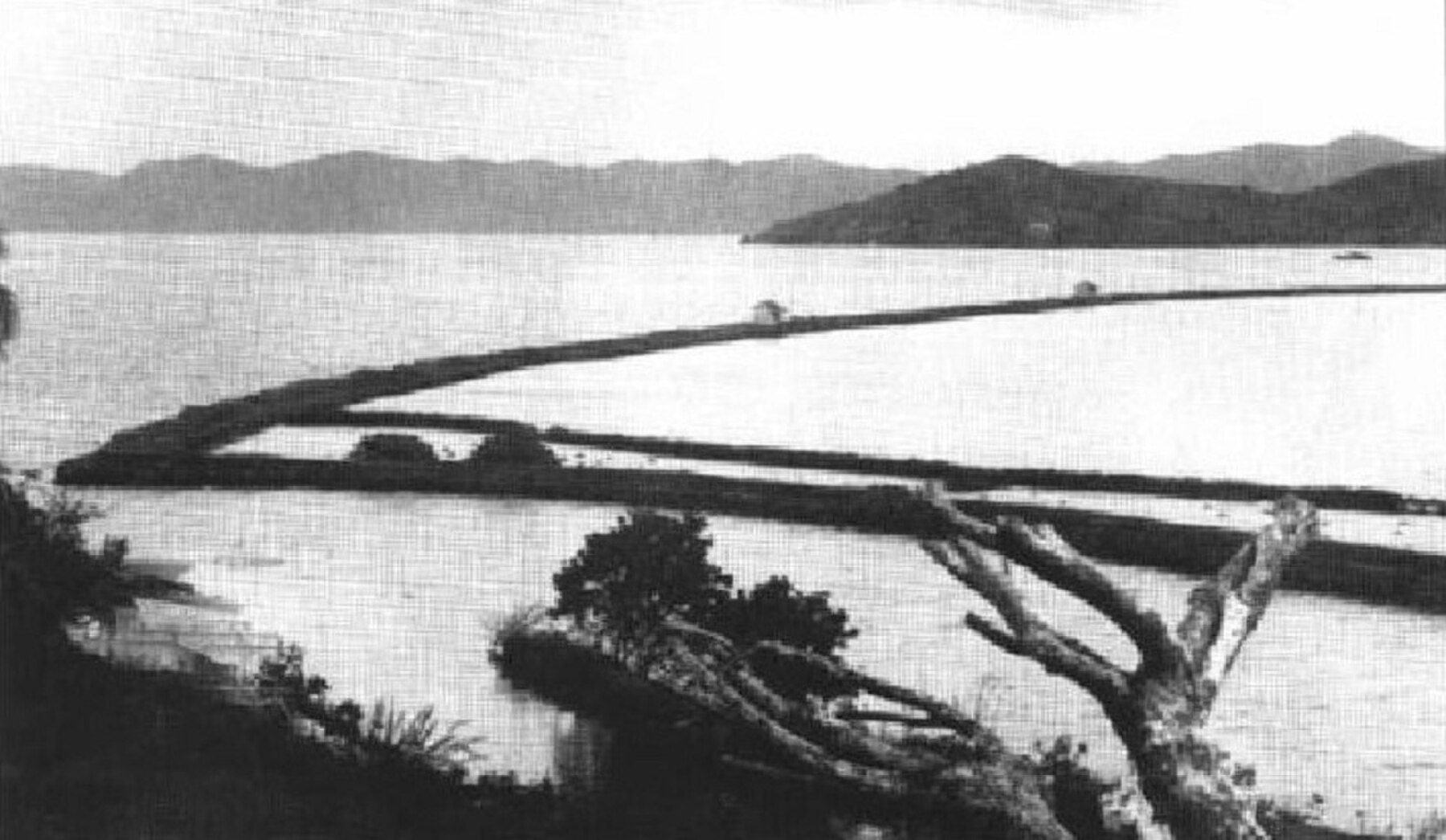
Paepae o Heʻeia describes the kuapā as two parallel basalt walls set twelve to fifteen feet apart, the space between them packed with coral rubble and, in places, dirt. At an estimated 1.3 miles, or roughly 7,000 feet, it ranks among the longest fishpond walls in the islands, and it forms a complete circle around the pond's 88 acres, a design almost no other loko iʻa shares; most run straight or bow out in a semicircle from the shore. Radiocarbon dates and oral accounts place its construction 600 to 800 years ago, sometime between the early 1200s and the early 1400s, built over an estimated two to three years by hundreds, maybe thousands, of people passing stone and coral hand to hand.
Hawaiian fishponds entered the scholarly record in the early 1970s. William Kikuchi finished a doctorate at the University of Arizona in 1973 on Hawaiian aquacultural systems, and a National Park Service landmark file cites his work for a count of 449 ponds built before 1830. A colleague later wrote that his statewide inventory became the foundation for fishpond restoration, and that he turned afterward to sediment cores from pond floors to build a chronology. That same year, on January 17, 1973, Heʻeia Fishpond went onto the National Register of Historic Places, which lists two periods of significance, 1500 to 1749 and 1750 to 1900.
Between 1973 and 1976 Marion Kelly wrote two reports for the Bishop Museum on Heʻeia, one on the relationship between fishponds and Hawaiian values, legends, genealogies and stewardship, and one on its disrepair and the possibilities for restoration. Dates for the wall itself are estimates. The National Park Service file offers a reasoned range of A.D. 1200 to 1400 for fishponds in general, and the University of Hawaiʻi manual says some pond walls have been carbon-dated to the 1400s. The firm radiocarbon numbers found for this piece come from Kauaʻi, where a 2002 study of sediments suggests pond-building began about 830 years before present and the large Alekoko pond by about 580. No published radiocarbon date for the Heʻeia wall itself turned up, so the 600 to 800 years usually cited for it should be read as an estimate.
A mākāhā gets translated as "sluice gate," which is accurate but small. The spacing lets water and small fish move freely. Juvenile fish enter, feed, and grow until their bodies no longer fit back through the same gap. Some early gates were lattices of wood and fern lashed across the opening rather than stone; the engineering lived in the spacing, not the material. A kiaʻi reads the tide, the water, the weather, the species, and the season, then works the gate and calls the harvest.
The word mākāhā carries its whole job in the dictionary. The Pukui and Elbert dictionary of 1986 defines it as a sluice gate “as of a fish pond,” and also as an “entrance to or egress from an enclosure.” Andrews's 1865 dictionary gives “an outlet or inlet of a pond where the sea flows in and out.” The traditional gate had no moving parts. A University of Hawaiʻi restoration manual says builders lashed tree branches about half an inch in diameter vertically, half an inch apart, to two or three larger horizontal pieces, and that there was no set place for a gate: builders positioned them to maximize the flow of current through the whole pond.
Fish do the sorting. The manual says mature fish gather on the pond side of the grate on an incoming tide and on the ocean side on an outgoing tide, and that the crowding grows stronger in spawning season, so a keeper could scoop out the size and kind he wanted and let the rest go. One design change came late: the manual, citing earlier survey work, says Chinese immigrants in the mid-1800s added a second grate a few feet behind the first, making a small trap between the two. A saying printed by Hawaiʻi Sea Grant puts the idea in eight words, Wehe i ka mākāhā i komo ka iʻa, open the gate that the fish may enter.
Loko iʻa don't reduce to a single clever mechanism.
No record names one designer of Heʻeia Fishpond. Hawaiian aquaculture built at least four distinct pond forms, from inland taro ponds to excavated freshwater ponds to muddy brackish ponds near the coast; the walled seawater pond, loko kuapā, built entirely by hand against open ocean, exists nowhere else. Heʻeia's wall holds evidence of coordination instead of authorship: people selecting and moving material, reading a hard coastal environment, organizing labor, keeping a shared food system running, and handing the knowledge forward.
The work didn't end when the wall went up. Keeping the pond productive takes ongoing mālama: clearing channels, repairing storm damage, maintaining gates, watching fish and water, controlling predators and invasive species, coordinating harvests, and tending relationships upstream and downstream.
Two jobs kept a loko iʻa running, and the gate sat between them. The konohiki managed the land and water of the whole ahupuaʻa and called out the labor for building and repair. The kiaʻi loko lived at the pond. A University of Hawaiʻi manual on fishpond restoration describes the keeper as the resident caretaker of the royal fishponds, a post held within one family and handed down through the generations, and its authors say the keeper's decisions could be held above those of the aliʻi on matters of pond management.
A National Park Service landmark file on Huilua Fishpond, on Kahana Bay, says most ponds of this kind had a guard house near the gate, a shelter for the caretaker on poaching patrol. Rules ran through the year. A kapu closed certain fish while they spawned, and a branch of hau marked a restricted area. Mullet and milkfish were the fish set aside for chiefly and religious use. Upkeep was shared. Women of the ahupuaʻa cleared seaweed mats by hand under the keeper's direction, and a bamboo rake dragged behind a canoe loosened silt that the outgoing current swept out through the gate. The work of the keeper and the work of the water were one system.
Loko iʻa are living systems, not finished artifacts.
Heʻeia was one pond among hundreds. Researchers put the number of loko iʻa operating across the islands before Cook's ships arrived in 1778 somewhere between 360 and 500, together yielding close to two million pounds of fish a year without imported feed. Counts vary by source and method: an early-1900s inventory identified 360 loko iʻa but found only 99 of them active, producing an estimated 680,000 pounds a year. By 1994, just over 120 remained in fair-to-excellent physical condition, and only six statewide were still functioning as working fishponds. Heʻeia nearly became one more entry on the list of the lost. The pond never sat idle before 1965. Oversight had shifted by the early twentieth century from appointed kiaʻi loko to paying lessees: the Au family held the lease until floods in 1921 tore into the wall, then sold it to the Hee family, who rebuilt after a second flood in 1927. In 1930, Hau Hee took over from his father and ran it as a working fishery, subdividing ponds, feeding young mullet on middlings and bran, fishing only April through October to let stock spawn the rest of the year, and hauling an average of 100 pounds a day of mullet, āholehole, weke, and awa to his stall at the fish market. He employed five workers full time and up to fifteen more in season, and experimented with growing shrimp.
A flood on May 2, 1965, tore out, by one account, more than 200 feet of the kuapā. Another account puts the main breach at about 80 feet, and the 56 meter eastern gap measured in 2018 is a separate, later figure. Red mangrove, planted in the area in 1922 to hold soil in place, had already crept into the pond; once the flood opened a breach, it spread almost unchecked, shading out the limu, blocking the wind that kept water moving, and trapping sediment the tides would otherwise have flushed back out. For nearly 25 years, the pond sat mostly abandoned, more mangrove thicket than fishpond.
Restoration started small and informal. Brooks, an aquaculturist whose first name is given as Mary in Wikipedia and Paepae o Heʻeia’s materials and as Mark in a University of Hawaiʻi Windward account, began patching the broken wall with volunteer crews between 1988 and 1990. In 2000, Brooks partnered with the University of Hawaiʻi at Mānoa and the Kamakakūokalani Center for Hawaiian Studies to teach the first Mālama Loko Iʻa fishpond-management class, work that led directly to Paepae o Heʻeia's founding the following year. Over the next quarter-century, staff and volunteers cleared invasive mangrove from more than 3,000 feet of the wall's 7,000-foot length.
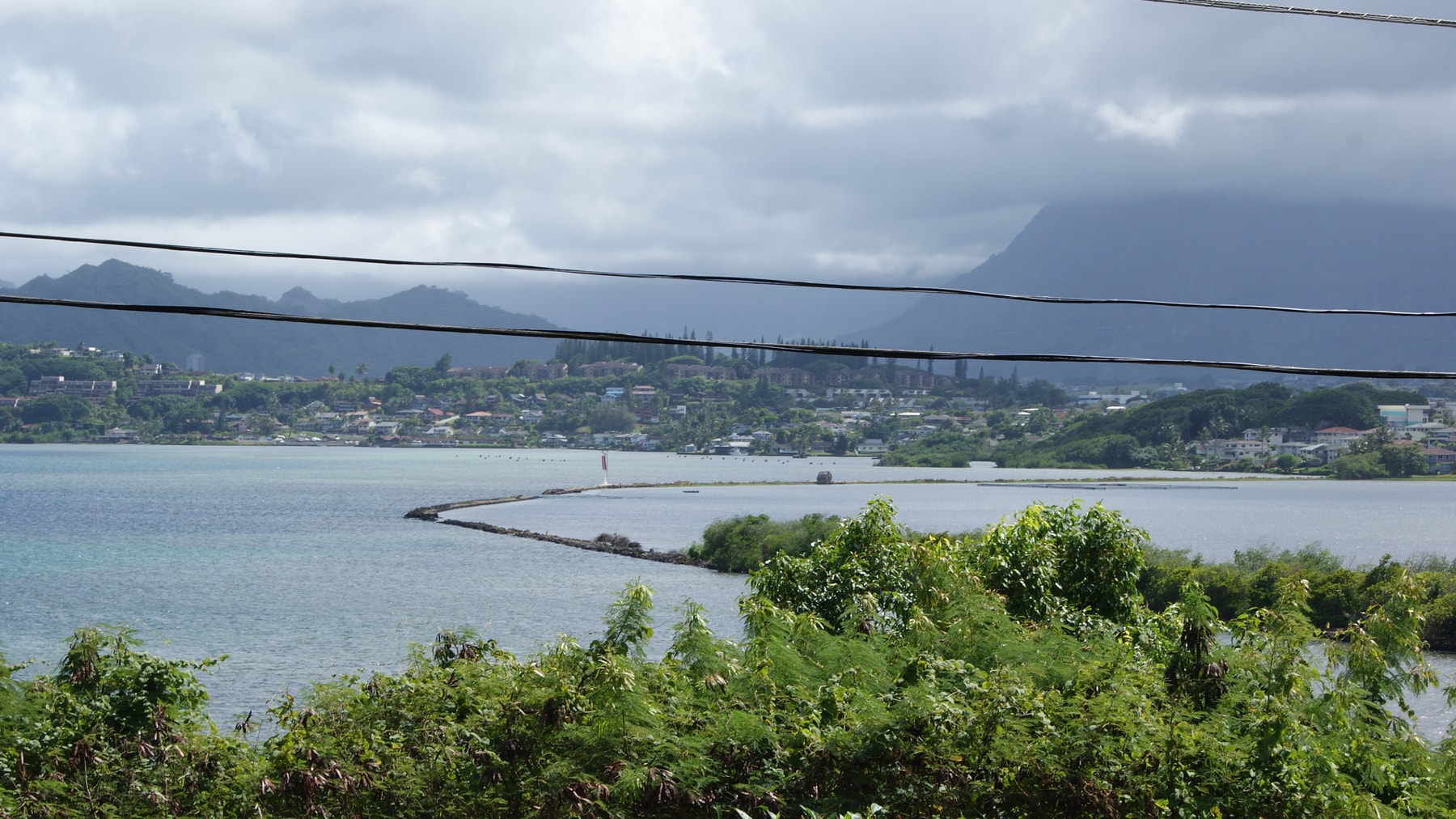
Paepae o Heʻeia describes a wall built in compact layers that slow water loss and hold a base level at low tide, with seven mākāhā (four facing the sea, three facing Heʻeia Stream) tuning how much water moves through. Together they hold the brackish balance that limu and fish need.
In 2018 University of Hawaiʻi oceanographers and Paepae o Heʻeia staff put a current meter in each working mākāhā for seven days, logging flow every 20 seconds, and compared it with readings from 2012. The paper, led by Paula Möhlenkamp, shows what the repaired wall does. Before the repairs, a 56 meter gap in the eastern kuapā was bridged by a 0.9 meter elbow wall lower than the wall on either side, so the pond could exchange water through it only at high tide, yet that gap carried about 80 percent of all exchange.
Volunteers closed it in 2014 and 2015, in a phase called Pani ka puka, Shut the door, and left a gate in it, named Kahoʻokele, 3.05 meters wide. The kiaʻi loko chose the spot by watching where fish, oysters, algae and sponges were most abundant and diverse. Afterward Kahoʻokele carried about 28 percent of the flood and 39 percent of the ebb, and Nui, 6.48 meters wide, carried about half, with a peak of 9.7 cubic meters per second on a spring flood. The pond is flood-dominant: at every gate the incoming tide runs shorter than the outgoing one. The minimum time water stays in the pond fell from 38 hours to 32, and the longest stay at neap tide dropped from 102 hours to 64. Clearing mangrove from the stream mouth raised the stream gate Wai 1's share of the flood from about 1 to 2 percent to about 5.
Restoration work ran into a harder set of problems along the way: watersheds reshaped by development, shifting sediment and nutrients, invasive species, unreliable numbers of incoming juvenile fish, warmer water, storms, permitting, and money.
Permitting is one of those problems, and it has a paper trail. By 2014 the Department of Land and Natural Resources had counted five separate permits a practitioner needed to restore a fishpond, written to satisfy seventeen federal and state regulations, and its own staff report said that in the previous two decades only a small handful of fishpond groups had managed to secure them. In June 2014 the Board of Land and Natural Resources approved a single permit, Hoʻāla Loko Iʻa, with three tiers. The lightest covers replacing rocks in a wall, repairing gates, clearing mud by non-mechanized means, emergency repair of breaches and removing alien species such as mangrove.
The middle tier covers work that changes the historic structure by more than 10 and no more than 50 percent, and the heaviest covers work beyond half and mechanized dredging. New ponds are excluded. In 2015 Act 230 waived the Department of Health's water quality certification for projects under the program, and the state's permit page now lists 24 permits across six islands. In June 2024 Act 124 added a rule for government-owned ponds: a lease applicant must show a management plan built on traditional native Hawaiian practices and protocols, including kilo, kiaʻi loko stewardship, and uhau humu pōhaku for rock-walled ponds. Heʻeia is privately owned, so that act does not govern it.
On December 13, 2025, nearly 2,000 volunteers gathered for a restoration event called Moʻokuapā to lay the final stones.
"Everyone wants you to be done," Paepae o Heʻeia executive director Hiʻilei Kawelo said afterward. "But it's never-ending." In 2017, NOAA designated the surrounding 1,385 acres (the fishpond, Heʻeia State Park, the Hoʻi wetlands, and Moku o Loʻe) the 29th National Estuarine Research Reserve in the country, the first new one added in six years, co-managed by the state and the University of Hawaiʻi's Hawaiʻi Institute of Marine Biology.
She meant the water. Even with the wall complete, the pond still can't get enough fresh water to work the way it should. A Board of Water Supply tunnel built through Haʻikū Valley in 1940 has been diverting stream flow to windward customers and a nearby military installation ever since, and by 2021 dry-season flow below the tunnel had dropped under 300,000 gallons a day, well short of the roughly 2 million gallons a day that ran before the tunnel existed. "Our makaha is boarded up by two 2-by-12s to not allow freshwater to come into the pond," Kawelo has said of Heʻeia's own stream-side gate, the very kind this pond is built around. "If we pulled the boards, we would drain the stream. That's how little water makes its way down to our muliwai." The state water commission has since ordered the Board of Water Supply to study a bulkhead that would let more water through, but a 2025 report still measured pond salinity at 27 to 32 parts per thousand, well above the high-teens-to-low-20s range Paepae o Heʻeia says triggers the plankton blooms juvenile fish depend on. One fix under consideration costs an estimated $7.3 million and would take 18 to 21 months to build. That fix, sealing off the diversion tunnel, could raise streamflow by an estimated 20 to 26 percent before accounting for rainfall, but the Board of Water Supply still hasn't presented findings to the water commission: the required seepage study has been delayed by federal staffing shortages and, more recently, a government shutdown, and officials now expect to report back sometime in 2027. "We're trying to do our part to enhance the restoration and watershed," said Barry Usagawa, who heads the water resources division at the Board of Water Supply. "But full restoration, to what it was pre-contact or pre-tunnel construction, is not possible."
A second study, published in 2024 in the journal Ecosphere and led by HIMB researcher Anne Innes-Gold, found that loko iʻa don't just hold fish, they export them: juveniles raised inside the pond supplement wild populations in the surrounding estuary. "We have heard people voice the idea that historically, loko iʻa provided nursery grounds that may have supplemented fish populations in the estuary," Innes-Gold said. "Our study is the first that we are aware of to demonstrate this idea in academic literature." Current work at Heʻeia is also tracking an invasive upside-down jellyfish and testing management options developed jointly with pond practitioners, alongside studies of freshwater inputs, temperature, nutrient cycling, and how to acclimate hatchery-raised ʻamaʻama before release. Paepae o Heʻeia’s caretakers organize volunteer removal days, and on April 29, 2025, about 50 volunteers and staff from the state Division of Aquatic Resources joined one, removing an estimated 20 percent of the jellyfish.
Where does the figure of two million pounds come from? A University of Hawaiʻi fishpond manual traces it to an inventory by Cobb in 1901, which counted 99 ponds in commercial production and estimated their output at 679,692 pounds a year: 485,531 pounds of mullet and 194,161 of milkfish. Yields ran 300 to 500 pounds per acre. Assume an average pond of about 18 acres and apply the low end, and the manual says the annual yield in the years before Captain Cook could have approached two million pounds. It is an extrapolation from a single year at the close of the 1800s. By 1975 and 1976 a state report counted only 20,000 pounds of fishpond production in all of Hawaiʻi, including 1,200 pounds of mullet.
At Heʻeia the record is thinner. A Kamehameha Schools learning site says that from 1987 to 1999 six acres were leased for aquaculture that produced 70,000 pounds of moi a year. Paepae o Heʻeia grew about 1.2 metric tons of Pacific threadfin in net pens between 2006 and 2009, and then lost fish in two mortality events in 2009, which the Möhlenkamp paper says showed that the compromised gate system made regulation of fish migration and recruitment impossible. In 2024 executive director Hiʻilei Kawelo said one to two more years of restoration remained before the focus shifts to food production.
Heʻeia is one pond in a network. Practitioners began meeting as the Hui Mālama Loko Iʻa in 2004, and in May 2014 Kuaʻāina Ulu ʻAuamo, the nonprofit that serves as the hui's backbone, hosted its largest gathering yet, in Hāna on Maui. A one-page summary from that year counted more than 38 fishponds and complexes and over 100 owners, workers and supporters. The statewide survey of 1990 had identified 488 fishpond sites. By 2024 Kuaʻāina Ulu ʻAuamo described more than 60 sites in varying stages of restoration and development. The counts differ because the units differ, since ponds, sites and complexes are not the same thing.
The stakes reach past one pond. Hawaiʻi imports most of what it eats; aquaculture today supplies under 1 percent of the roughly 70 million pounds of seafood available locally each year, against the nearly 2 million pounds a year the islands' fishponds once produced statewide. "The restoration of functional Hawaiian fishponds represents a promising opportunity to increase local seafood production," said Akiona, the 2022 study's lead author, "but there is still much to learn about the ecology and dynamics of fishpond communities." Rebuilding this technology, not just preserving it, is the argument researchers and practitioners are now making together.
None of that research retroactively turns the pond into a laboratory built by outsiders. Native Hawaiian knowledge didn't need outside instruments to validate it before, and it doesn't need them now.
The plainer claim needs no dressing up: Native Hawaiian communities built a sophisticated aquaculture system, and practitioners are still restoring, adapting, and governing it today.
At Heʻeia, the mākāhā is one way into that idea. Fish respond to openings and tides. People decide what gets cared for, what gets taken, and what gets passed on. Other editions in this series read Hawaiian infrastructure the same way: The Observatory That Turned a Volcano into a Century-Long Signal and The Machine Inside the Mountain.
Sources added October 3, 2026 (each checked on that date): Wikipedia, Heʻeia Fishpond, en.wikipedia.org/wiki/He%CA%BBeia_Fishpond, which names Mary Brooks and gives several flood figures (over 1,000 feet damaged, over 200 feet destroyed, an 80-foot main breach). Paepae o Heʻeia, restoration page, paepaeoheeia.org/restoration/. University of Hawaiʻi Windward Community College account naming Mark Brooks, kaohana.windward.hawaii.edu/?p=7569. Wikipedia, Ancient Hawaiian aquaculture, en.wikipedia.org/wiki/Ancient_Hawaiian_aquaculture, for the early-1900s inventory of 360 loko iʻa and 99 active ponds. The sources disagree on Brooks’s first name and on whether the flood was in 1965 or 1969.


.jpg)