The story
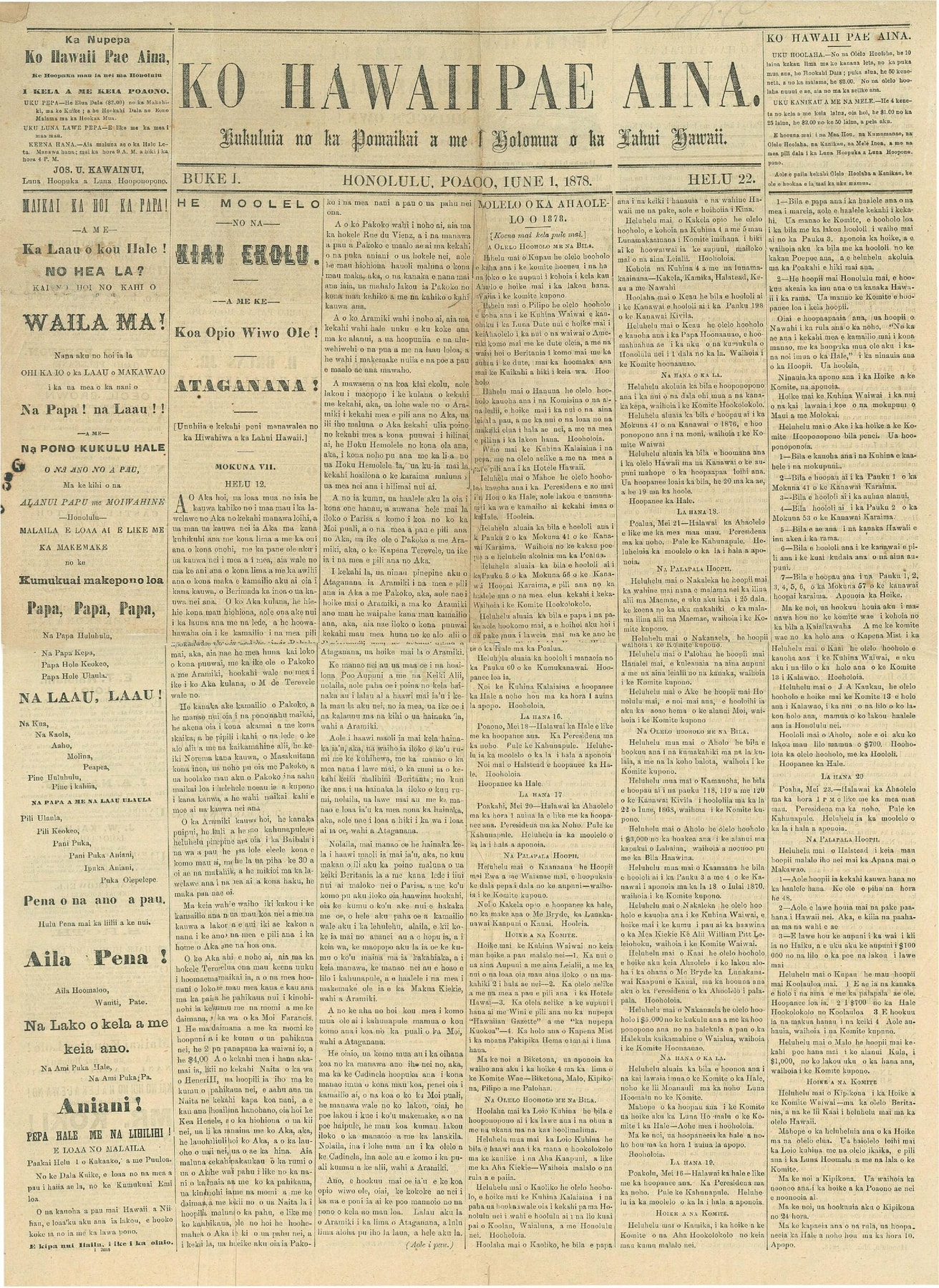
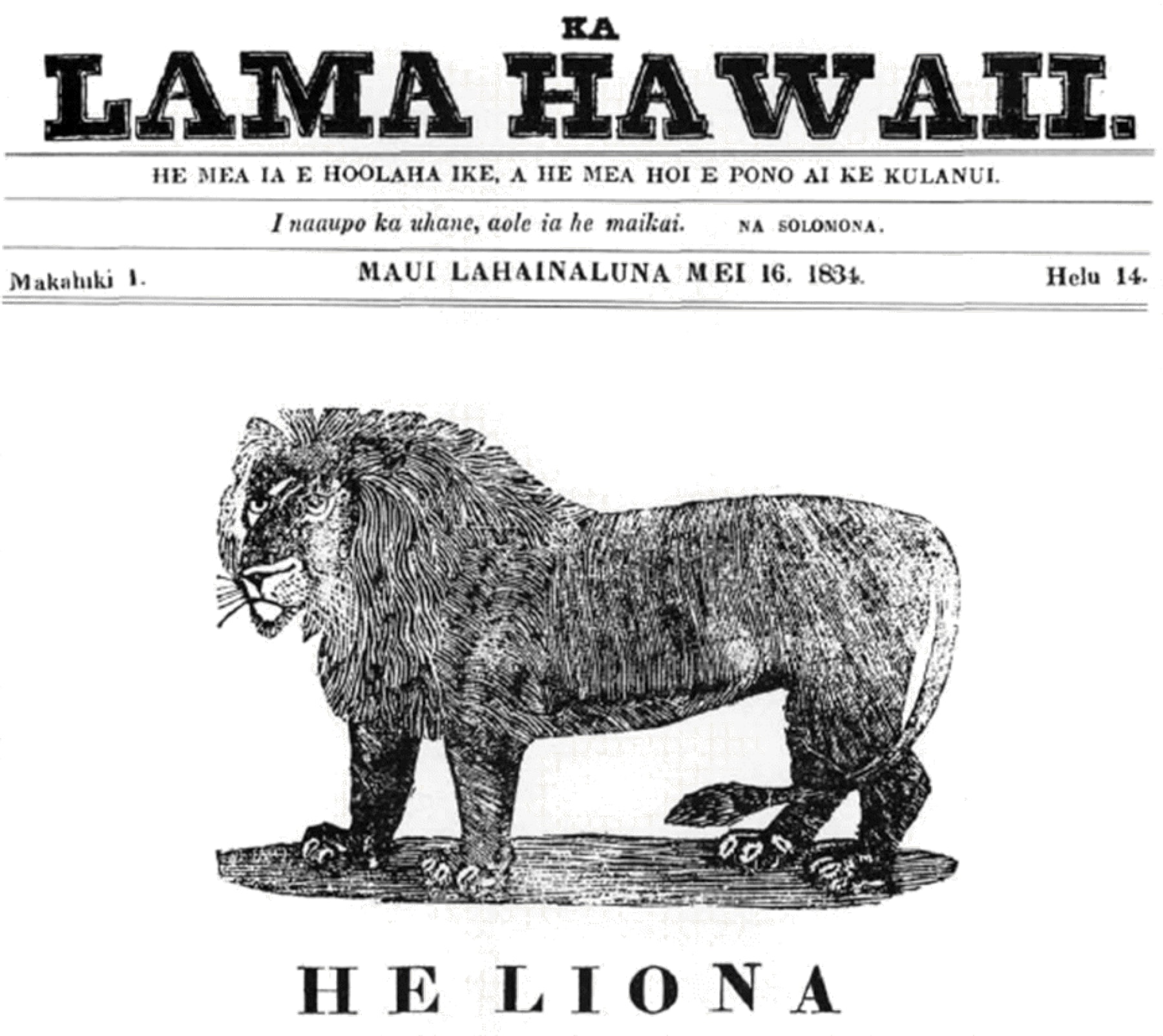
The first issue of Ka Lama Hawaii, in February 1834, carried a woodcut of an elephant. The students at Lahainaluna school on Maui who set the type had never seen one. Neither had most of their readers. The lesson accompanying the image described the animal's habits and habitats for a Hawaiian audience just learning to read Hawaiian on paper, in a language that had been put into a standard written form only in the 1820s. Ka Lama Hawaii, edited by the missionary teacher Lorrin Andrews, was the first newspaper printed in the Hawaiian Islands. It would not be the last. Over the next 114 years, more than a hundred separate Hawaiian-language newspapers rolled off presses in Honolulu, Lahainaluna, Hilo, and a few other island towns, until the last one, Ka Hoku o Hawaii, folded in 1948. What they left behind was a body of text so large, so dense, and so illegible to nearly everyone alive that it took a second act of literacy, a century later, to make it readable again. That second act looked a lot like building a search engine, by hand, article by article, decades before anyone called it that.
The scale of what came out of those printing presses is easy to state and hard to absorb. Estimates of the physical run land around 125,000 newspaper pages. Ka Wai Ola, the Office of Hawaiian Affairs' news publication, reports that scholars put the total at more than a million pages of text, and Bishop Museum estimates that the 125,000 newspaper pages equal about 1.5 million letter-size pages. Puakea Nogelmeier, who has spent much of his career on this archive, is a co-author of a 2018 study that the University of Hawaiʻi described as drawing on the largest native-language cache in the Western Hemisphere. Nogelmeier has described what that cache actually holds in blunt terms: "You have a fully literate nation. That's important. And full distribution, so it [had] governance, business, history – everything the Internet is today was embedded." Genealogies. Court proceedings. Weather logs. Farming almanacs. Translated European fairy tales, Grimm among them, rendered into ʻōlelo Hawaiʻi for readers on Kauaʻi and the Big Island. Reports filed home about the American Civil War. All of it was written for subscribers who wanted to know what happened this week, and there were, remarkably, enough of them to support more than a hundred titles over 114 years, though only about ten were publishing at once in the 1870s, in a kingdom whose population ran from about 130,000 in the early 1830s to under 60,000 in the 1870s.
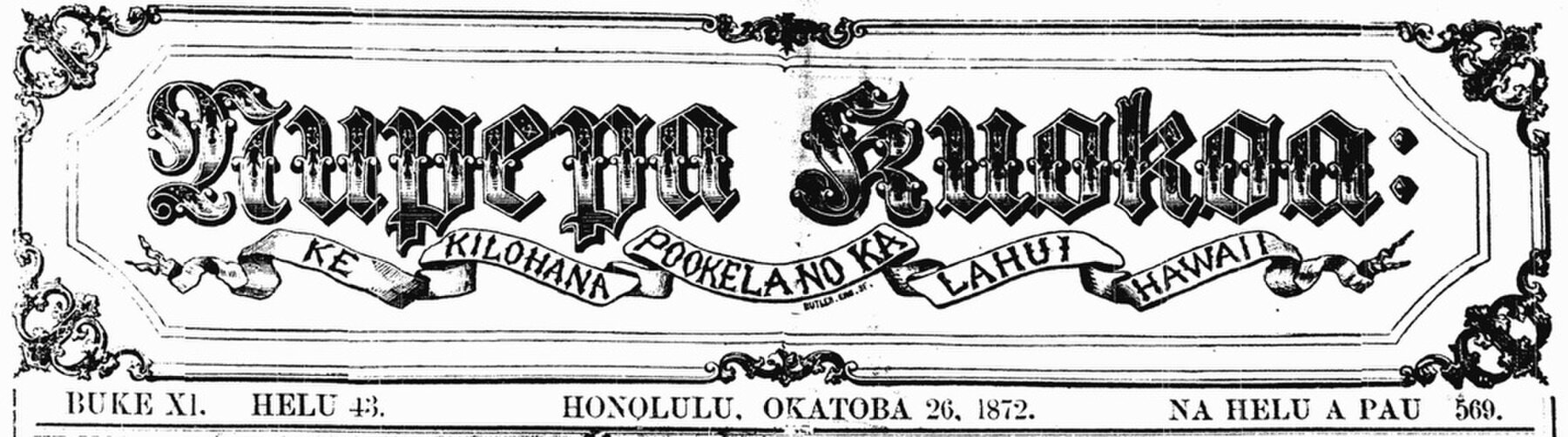
That density of readership was deliberate. When American missionaries reached Hawaiʻi in 1820, ʻōlelo Hawaiʻi had never been set down in an alphabet. Within five years, the missionaries and the aliʻi who backed them had built one, and by one scholarly estimate literacy in Hawaiian reached about 91 percent by the early 1830s, higher than in the United States and in most of Europe at the time. Kamehameha III made the ambition explicit as a boy king in 1825, declaring in a line still quoted today that his would be a kingdom of letters, He Aupuni Palapala, the same phrase later borrowed as the name for the newspaper preservation project this story eventually leads to. By 1840 the Kingdom had created a Ministry of Education with compulsory schooling, years before Britain or most American states managed the same, and by 1853, the Hawaiʻi Department of Education says, more than 400 Hawaiian-language schools were operating across the islands. A literate nation needs something to read. Newspapers were the answer, and Hawaiians did not wait for permission to make them their own. Ka Hoku o ka Pakipika, begun in September 1861 by David Kalākaua and other Hawaiian editors, offered a more independent Hawaiian voice, and a week later Henry Whitney, son of missionaries, took on Ka Nupepa Kuokoa, which its Hawaiian-edited rivals called the voice of haole businessmen. The newspaper business became one more arena, alongside the legislature and the courts, where competing visions of the Kingdom's future got argued out in print.
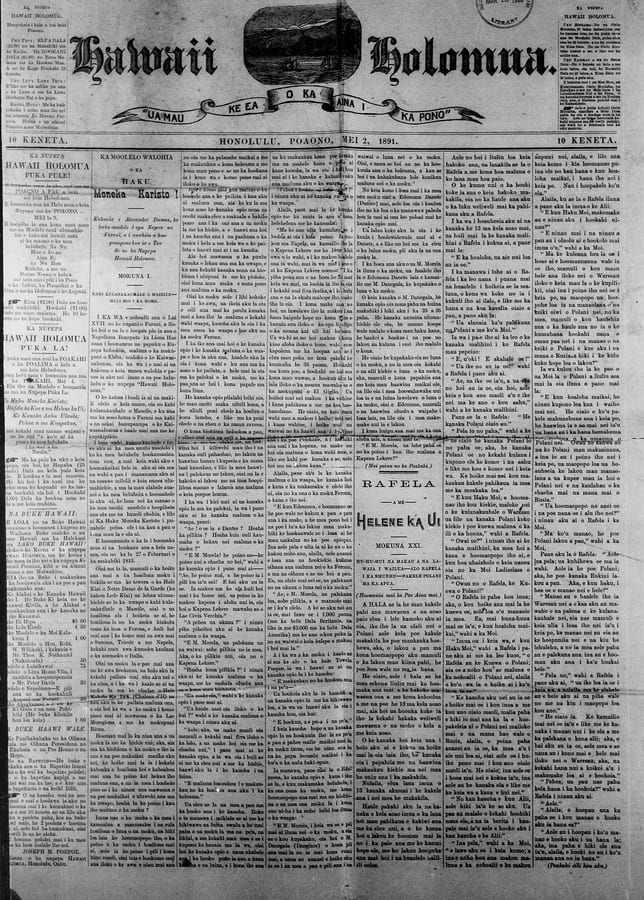
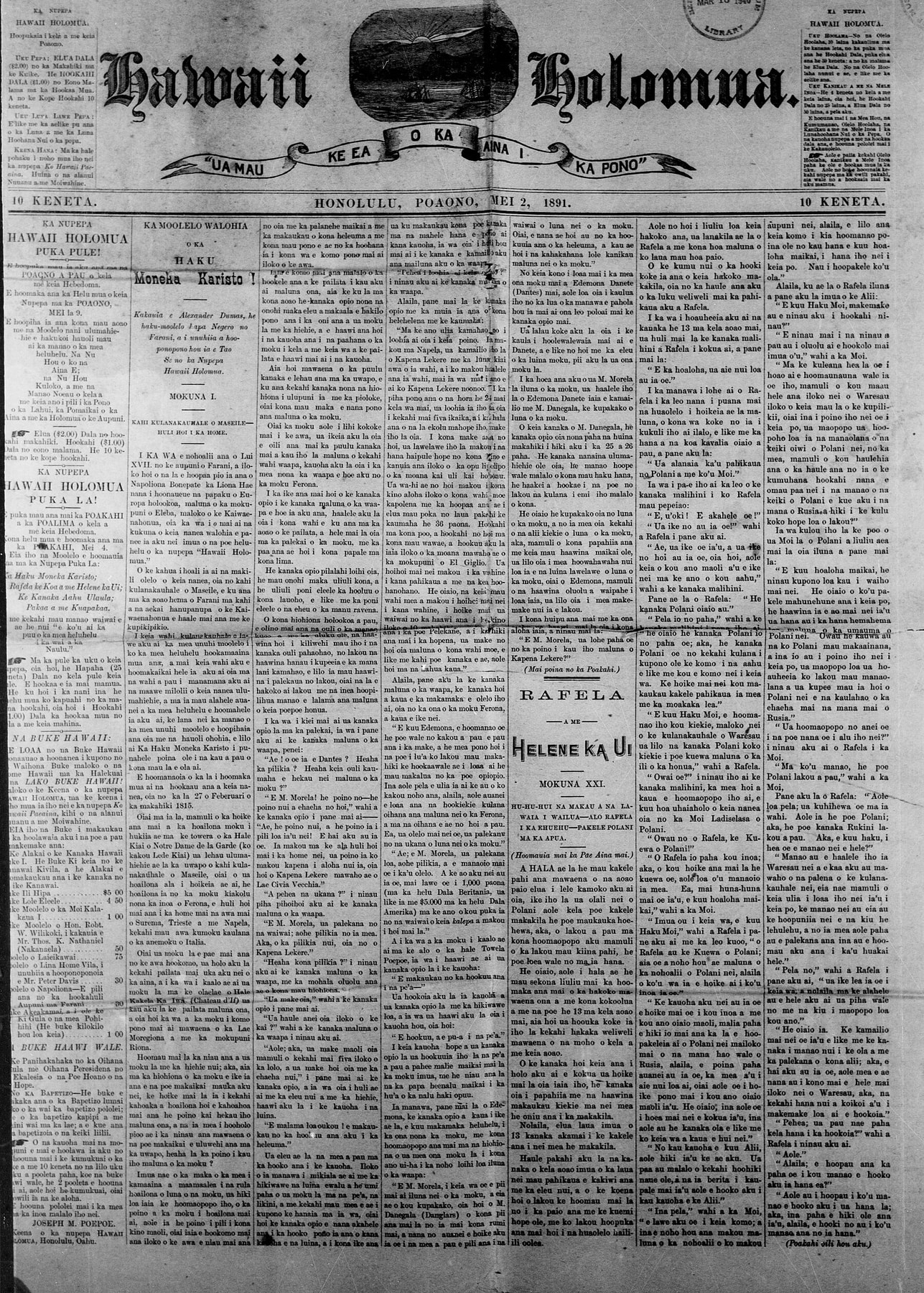
The overthrow of the Hawaiian monarchy in 1893 did not end that argument, and the newspapers recorded its final round. Hawaii Holomua, founded in 1891 under editor Joseph Mokuʻōhai Poepoe, was the only Hawaiian-language paper willing to publish Queen Liliʻuokalani's formal protest against the overthrow and her appeal to President Grover Cleveland for restoration. Three years later, the Republic of Hawaii's legislature passed Act 57 of 1896, an English-only law that stripped Hawaiian out of publicly funded classrooms and, according to accounts collected decades later, saw children physically punished for speaking it on school grounds. The number of fluent Hawaiian speakers fell from roughly 40,000 in 1896 to an estimated 2,000 by 1978. The newspapers kept publishing for another half-century as the language lost speakers, until Ka Hoku o Hawaii closed its books in 1948. By the time Atlas Obscura went looking for the story of that archive in 2018, only about 1.2 percent of Hawaiʻi's population spoke Hawaiian.
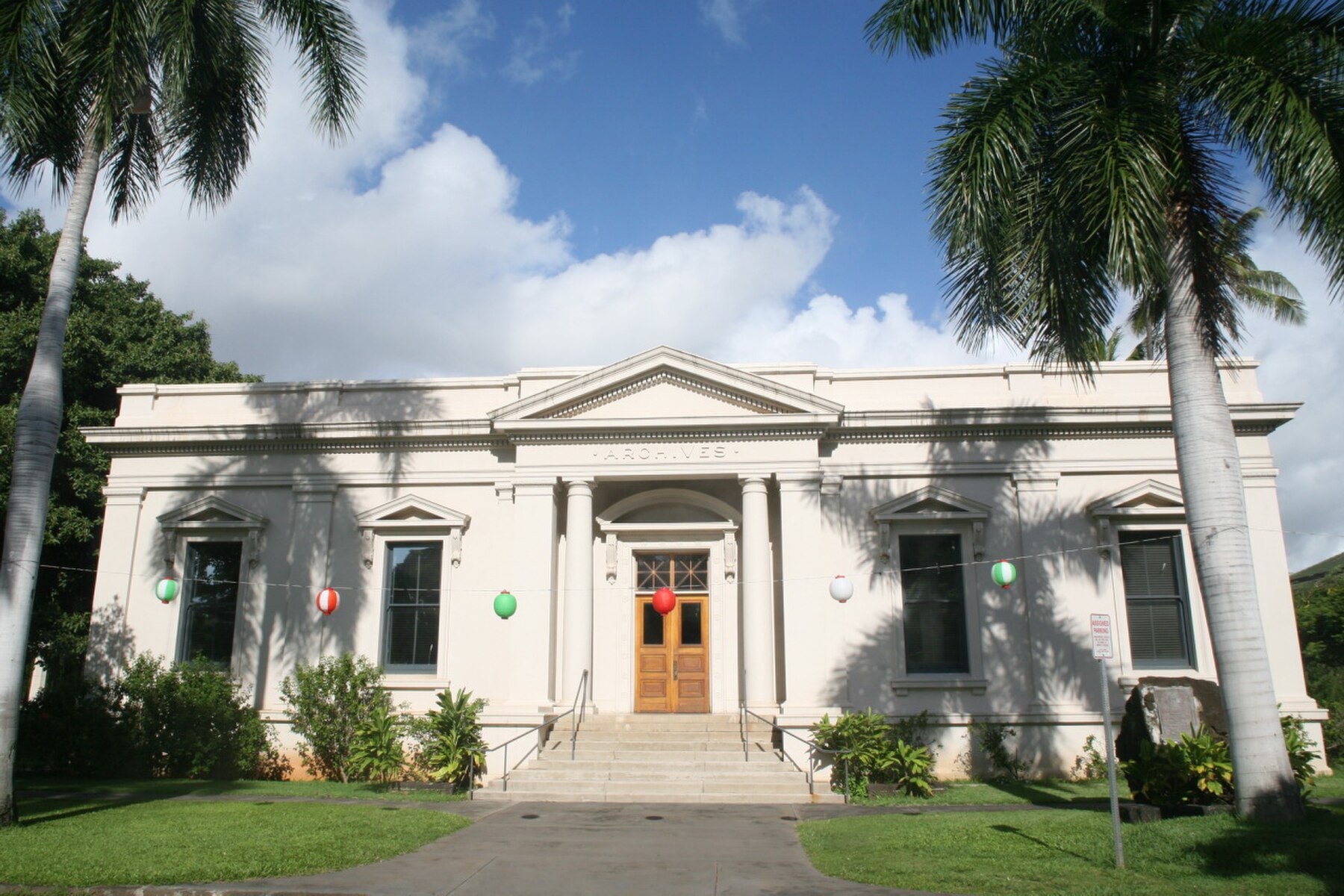
For most of the twentieth century, that meant one of the most important primary-source archives on Hawaiian history sat in plain sight and functioned as though it did not exist. The physical pages survived, scattered across the Bishop Museum, the Hawaiʻi State Archives, the University of Hawaiʻi's Hamilton Library, the Hawaiian Historical Society, and the Hawaiʻi Mission Children's Society Library. Survival did not give anyone access. A researcher who wanted to know what a specific nūpepa said about a specific ancestor, storm, or land dispute had no index to consult and, increasingly, no fluency to read the page even after finding it. A few institutions tried to compensate. The Hawaiian Historical Society built partial indexes to marriage and birth notices between 1850 and 1950 and to obituaries from 1836 to 1950, but by its own account only a small fraction of its newspaper holdings were ever fully indexed. The most ambitious early effort came from the folklorist and translator Mary Kawena Pukui, whose Hawaiian Ethnological Notes drew on Hawaiian-language newspaper material from the 1860s through the 1940s and translated it by hand, one clipping, one card, at a time. That is what searching this archive meant before anyone thought to computerize it: a scholar, a stack of index cards, and a working knowledge of a language most of the population had lost.
The English-language papers fared better, and the contrast is instructive. Bob Krauss, the longtime Honolulu Advertiser columnist, spent years building his own research index by reading nineteenth- and twentieth-century English-language Hawaiʻi newspapers on microfilm and copying names and subjects onto cards, a project that eventually covered 1840 through 1944. The Hawaiʻi Newspaper Agency kept a clippings morgue organized by name and subject from roughly 1929 to 1985, and the Hawaii State Library indexed the Advertiser and the Star-Bulletin from 1929 onward. Historian Helen Chapin capped decades of this work in 2000 with her Guide to Newspapers of Hawaiʻi, 1834 to 2000, a reference so thorough that a searchable version is still online, maintained by the Hawaiʻi State Library. Chapin had already mapped the ideological terrain of the era in a 1984 essay for the Hawaiian Journal of History, tracing editorial rivalries from 1834 to 1903, from He Liona, the lion lesson Ka Lama Hawaii ran in May 1834, through to the completion of the Pacific cable in January 1903. English-language Hawaiʻi got indexed by hand across the twentieth century. The Hawaiian-language record waited for a workforce fluent enough in ʻōlelo Hawaiʻi to do the same job, and by the 1970s that workforce had shrunk to a few thousand people.
Building the Search Box, By Hand
The modern effort to change that began in 2001, when a Hawaiian-language newspaper project called Hoʻolaupaʻi got underway under the direction of Kauʻi Sai-Dudoit, a lifelong student of Hawaiian history. Hoʻolaupaʻi's task was blunt: locate every surviving nūpepa in every repository willing to cooperate, photograph it, and get the images onto a platform where a search box could stand in for the index nobody had ever finished building. The results fed into Ulukau, the Hawaiian electronic library jointly run by the University of Hawaiʻi at Hilo's Ka Haka ʻUla O Keʻelikōlani College of Hawaiian Language and Alu Like's Native Hawaiian library, which hosts tens of thousands of digitized pages of native-language newspapers, searchable by keyword, title, and date. A decade later, a second layer arrived. In 2011 the Office of Hawaiian Affairs launched Papakilo, a public-facing database that had begun in 2007 as an internal staff tool for pulling environmental and cultural records without a drive to three different archives. Kale Hannahs of OHA has led it since the start. Nogelmeier and Sai-Dudoit gave it its name: papakilo, a word chosen to mean a foundation for seeking, searching, and observing. OHA's former chief executive, Kamanaʻopono Crabbe, described the ambition behind that name in more expansive terms, as a "continual exploration of infinite spaces and levels of knowledge as a perpetual cycle for the next generations to come." What started as thirteen collections and roughly 500,000 records from seven partner organizations has grown into more than seventy collections and upward of 1.2 million records contributed by 22 partner organizations, with more than 5.5 million page views logged between launch and late 2021 from users in Hawaiʻi, along the West Coast, and overseas. According to the collection's own page, the Hawaiian Newspapers Collection within Papakilo accounts for 12,723 issues, 72,146 pages, and 417,284 individually searchable articles. The page also says approximately 53,000 records come from more than 45 newspapers digitized by Hoʻolaupaʻi and Awaiaulu. Type a name, a place, or a date range into that search box and the database returns article-level results across a run of newspapers that, twenty years earlier, would have required weeks in a reading room and a translator on retainer.
Why a Scanner Was Not Enough
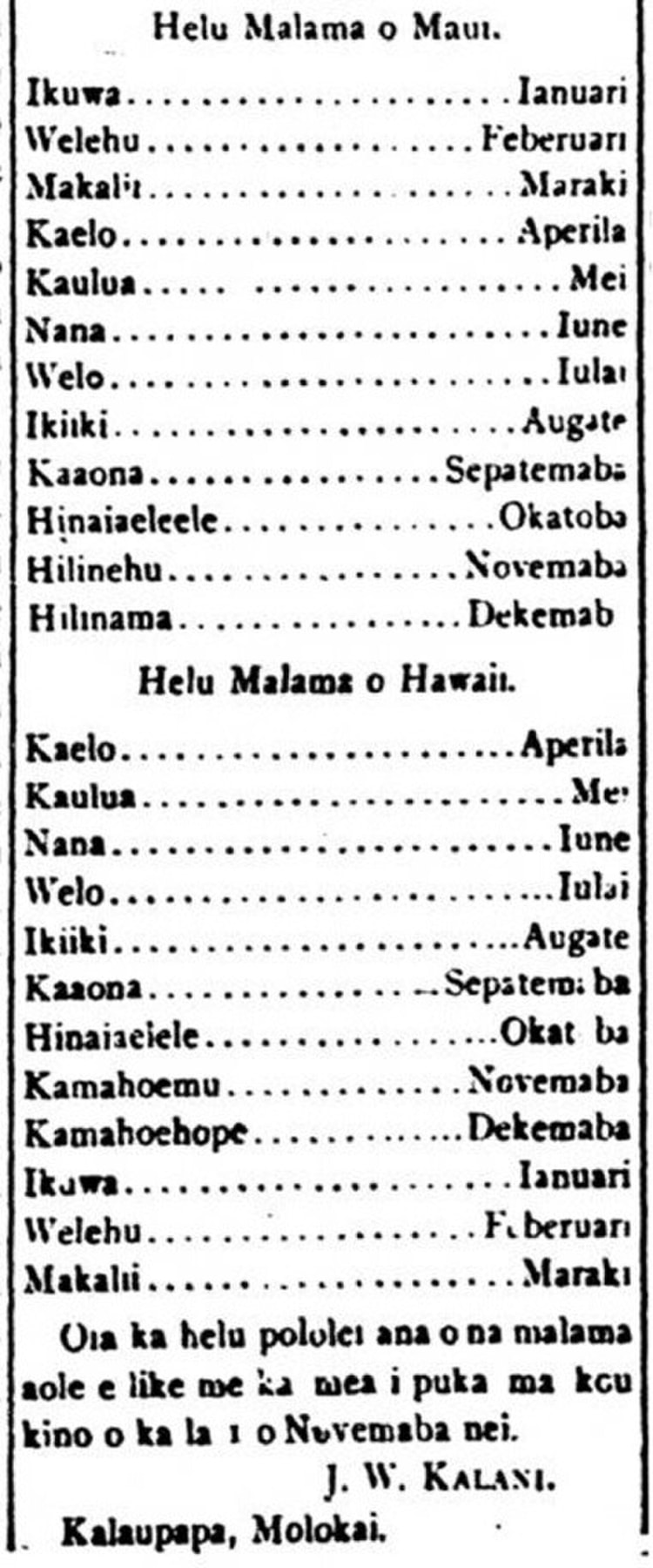
Pointing a scanner at microfilm and letting optical character recognition sort it out gave unreliable results: Bishop Museum says word searches on the microfilm-based images are accurate only about 70 percent of the time. Nineteenth-century Hawaiian orthography used the ʻokina and kahakō, the glottal stop and macron that carry real meaning in the language, inconsistently or not at all, which means software trained to expect modern diacritics can misread words it has never been shown. Add a century of ink bleed, water damage, and brittle newsprint that crumbles when unbound, and raw OCR output turns into text nobody can search reliably. Bishop Museum's own project notes describe staff working with delicate volumes prone to smudging and specialized handling requirements just to get a clean scan, before a single word gets indexed. The institutions that share their scans with Chronicling America, the Library of Congress's national newspaper portal built through the National Endowment for the Humanities' National Digital Newspaper Program, post that OCR text with an explicit disclaimer that it was generated by machine without correction. The University of Hawaiʻi's Hamilton Library has contributed English-language Hawaiʻi papers to that federal program since 2008, and the resulting text search generally works better on that English-language material. Point the same software at a 130-year-old page of ʻōlelo Hawaiʻi set in a font with no macrons and it misses roughly three words in ten, by Bishop Museum's own estimate for the microfilm images, which is why the project is re-imaging the original newspapers. For a project trying to make Hawaiian text word-searchable, the work combined better images, OCR software, and people fluent enough in Hawaiian to check and translate what came out.
That is the piece of the story that a search engine analogy tends to flatten: somebody had to read the pages. In 2021, Bishop Museum, which holds the largest single collection of Hawaiian-language newspapers, launched He Aupuni Palapala with Awaiaulu, funded in part by the Hawaiʻi Tourism Authority and staffed with help from Kamehameha Schools, alongside repositories that include Hamilton Library and the Hawaiian Historical Society. The technical side used a Digital Transitions Titan camera system to capture newspaper pages, at a resolution sharp enough to recover captions and fine print that decades of microfilming had blurred into illegibility. By May 2026 the project had rescanned over half of Bishop Museum's nūpepa holdings and was preparing more than 15,000 newly digitized pages for release on Papakilo. The excavation has not stopped at that count. Cataloging work under the same project turned up an entire missing decade of Ka Hoku o Hawaii, its first run of issues from 1906 to 1917, roughly 1,990 pages that had never been put online in any form. Museum staff scanned them from microfilm on newly acquired equipment for eventual upload to Papakilo, a lower-resolution stopgap than the fresh photography used elsewhere in the project, but the only version of those pages that existed when the scans were made.
Three new researchers joined the Library and Archives team to keep the underlying work moving: a UH Mānoa library-science graduate student who previously interned at the Hawaiian Historical Society, an undergraduate from Waipiʻo, and a dual-degree candidate in Hawaiian language and library science who grew up in Kaʻaʻawa and came up through Kamehameha Schools.
Making those pages understandable still needs people fluent in nineteenth-century Hawaiian: when the hurricane study described below was published in 2018, only about 2 percent of the archive was available in English. Nogelmeier's own count, as Hawaiʻi Sea Grant reported it, put the pace of that work at roughly 76,000 pages digitized and translated over fifteen years, much of it through the University of Hawaiʻi's Institute of Hawaiian Language Research and Translation, which he directed until his retirement in 2018. The University of Hawaiʻi has said that only a tiny fraction of the material has been translated. He does not expect that to slow the demand: "This resource will keep everybody busy for a hundred years, and it'll still be valuable for another hundred."
Nogelmeier's instinct for making Hawaiian language findable predates Hoʻolaupaʻi by two years: in 1999 he recorded and helped standardize pronunciation for more than 5,000 Hawaiian place names and phrases used on Honolulu's public bus system, a smaller-scale version of the same problem, making a language's information retrievable by people who did not already know exactly how to say it.
A meteorologist gave the clearest demonstration of what a searchable nūpepa archive is actually good for. In a study published in 2018, University of Hawaiʻi scientists Steven Businger and Thomas Schroeder teamed with Nogelmeier and education professor Pauline Chinn to reconstruct the path of a hurricane that struck the Hawaiian Islands on August 9, 1871, using eyewitness accounts printed in Hawaiian-language newspapers in the days after the storm, checked against modern hurricane science. Before that reconstruction, the storm was largely unknown to the public and to officials, and the English-language record said little about it. The newspaper record, read closely and cross-checked place by place, let the team trace its track from Waipiʻo to Kohala and on to Maui, and rate it retroactively as a Category 3 system, information detailed enough that the team noted it could bear on present-day insurance and legal assessments of hurricane risk in the islands. The finding ran in the Bulletin of the American Meteorological Society in January 2018, a peer-reviewed climate paper built on sources a search index made findable and a team of Hawaiian-language readers made legible. Businger, the study's lead author, put his own debt to that work directly: "Puakea's vision has helped conserve Hawaiian language of the past and is opening a window on the historical record that has been long overlooked in Hawaiʻi." Chinn framed the payoff as a way of orienting the present: “We are hopeful that knowing the past can help us to understand where we are now and provide pathways for the future.”
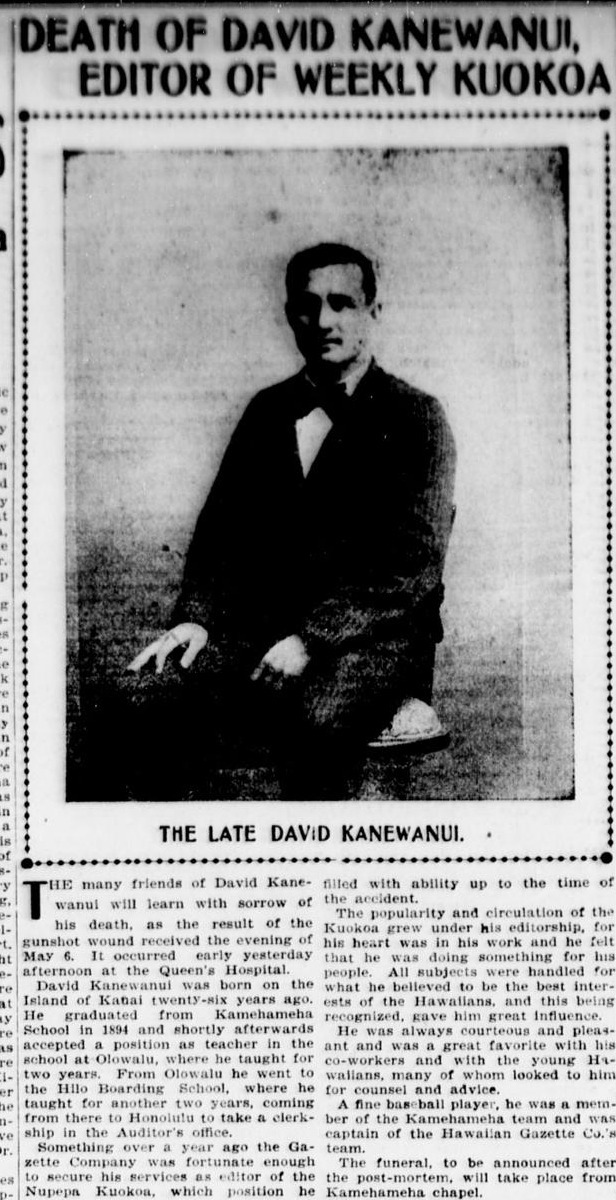
That same searchability changes what an ordinary family can find as well as what a scientist can publish. Searching the nūpepa by surname turns up family records, too: in 2007 the Honolulu Advertiser described Kauʻi Sai-Dudoit finding a woman's great-grandparents that way. Take a single name pulled from the Hawaiian Gazette's issue of May 23, 1902: David Kanewanui, twenty-six years old, born on Kauaʻi, a graduate of Kamehameha School and a member of Ka Nupepa Kuokoa's editorial staff, whose death from a gunshot wound was recorded in enough biographical detail to anchor a family tree. That kind of record, a full name, birthplace, school, employer, and date, sat in a single physical newspaper issue for generations before anyone could search for it. Indexed and searchable, it becomes exactly the kind of fact a genealogist searching for a Kauaʻi ancestor could find in seconds. Marriage announcements, obituaries, and land notices that ran only in Hawaiian for a hundred years are now one search box away from a genealogist who does not read the language at all, though most of the archive still waits for a translator. The same organizations built the search tool and trained the fluent readers. Sai-Dudoit, who now leads He Aupuni Palapala after directing Hoʻolaupaʻi, and Nogelmeier, who built Awaiaulu into a pipeline for training new Hawaiian-language translators and researchers, treated the index and the interpreter as two halves of the same machine. A search engine without readers behind it just returns pictures of pages nobody can parse. A translator without an index has to read a hundred years of newsprint cover to cover to find one name.
The stakes underneath all of this searching are concrete. Hawaiian went from a language spoken by roughly 40,000 people in 1896 to one spoken fluently by roughly 2,000 people by the late 1970s, the direct legacy of an 1896 law and decades of school policy built to enforce it. That decline has only partly reversed, and the reversal is recent enough to still be counting. The Office of Hawaiian Affairs reported Census Bureau survey figures of about 18,400 people speaking Hawaiian at home in 2016 and 27,338 in a 2024 report (the 2019 to 2023 estimate is 27,611), a gain of roughly 48 percent, while a 2024 federal survey found Hawaiian is now the most common non-English language spoken by school-age children anywhere in the state. State-run Hawaiian-medium schools grew from 14 campuses to 26 over that same decade, with enrollment up 68 percent, and the bottleneck now is teachers: the advisory group ʻAha Kauleo puts the shortfall at roughly 165 Kaiapuni teachers needed over the next ten years, against a pipeline that produced 12 new ones in 2025. The Hawaiian language renaissance that followed, immersion schools, university programs, a new generation of speakers, needed source material to rebuild from, and the newspapers were one of the largest such sources that existed. Every article Hoʻolaupaʻi indexed, every page He Aupuni Palapala rescanned at higher resolution, every record Papakilo made searchable by keyword functioned as raw material for a language and a history that had been legislated toward disappearance. The mechanism is the same one that makes a modern search engine useful: an index built so that the right page finds the right reader at the right moment, at a scale no single human memory could hold.
What makes Hawaiʻi's version of that mechanism worth telling as its own story is how early, and how manually, it had to be built. There was no crawler to send out across a web of hyperlinks, because there was no web, only stacks of brittle newsprint in five separate buildings and a shrinking population able to read what was on the page. The index had to be assembled the hard way, by Kauʻi Sai-Dudoit's team locating volumes repository by repository, by Kale Hannahs leading the database that would eventually hold 1.2 million records, by Puakea Nogelmeier and a generation of Awaiaulu-trained translators reading text that OCR software could not reliably parse, and by Mary Kawena Pukui's index cards decades before any of them, proving the concept by hand. Only a tiny fraction of the archive, by the University of Hawaiʻi's account, has been translated. The search box at Papakilo and Ulukau works today because enough of that manual work got done to make one, and it keeps working only as long as someone keeps doing the part a machine still cannot: reading the page, understanding what it says, and deciding what it is worth to somebody searching for it a hundred and fifty years later. The same Hawaiian-language text runs into a modern obstacle in The Two Marks Your Computer Had to Learn, on how the ʻokina and kahakō were finally made typable, and the gaps that remain.