The story
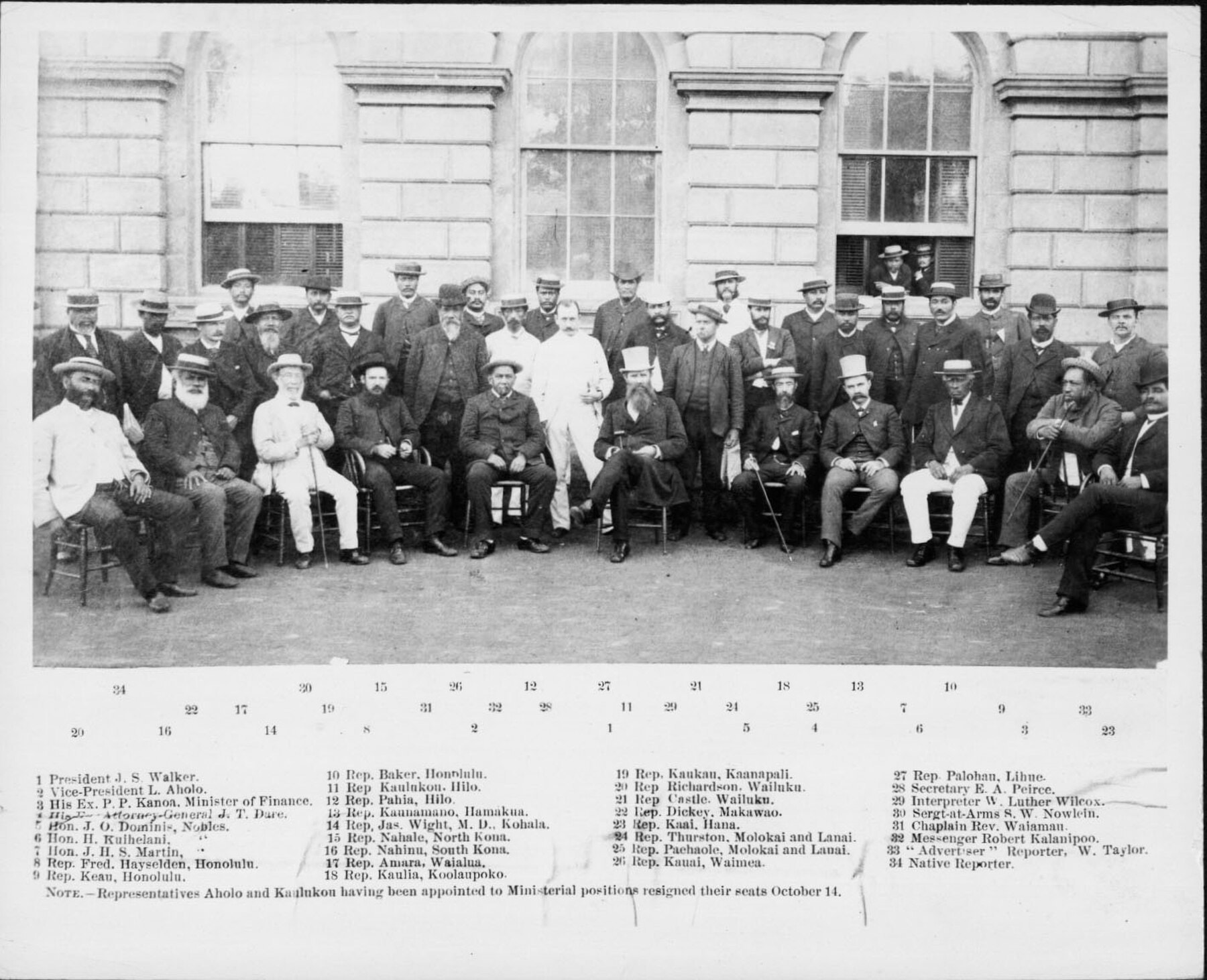
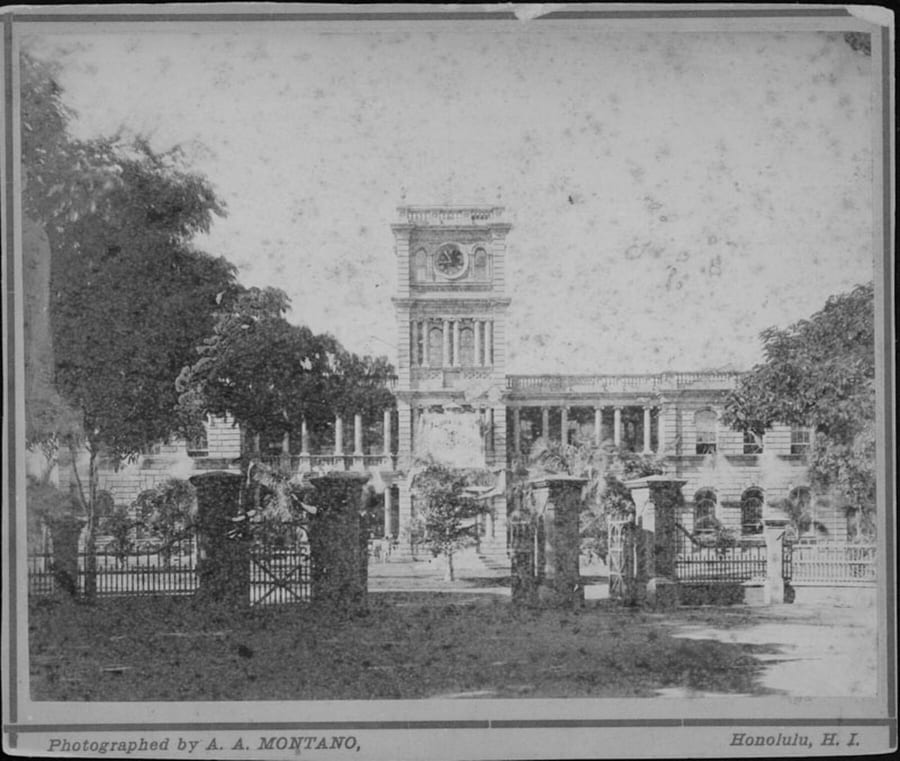
The Hawaiian Kingdom governed through laws published in two languages at once. A measure had to be drafted, debated, and enacted, and then proofread twice (once in Hawaiian, once in English) with printers on both texts checking for dropped words, wrong letters, and punctuation that could quietly change what a statute meant. Usually the two versions held together. Sometimes they did not, and when they did not, someone had to decide which text was actually the law.
A constitution in two languages
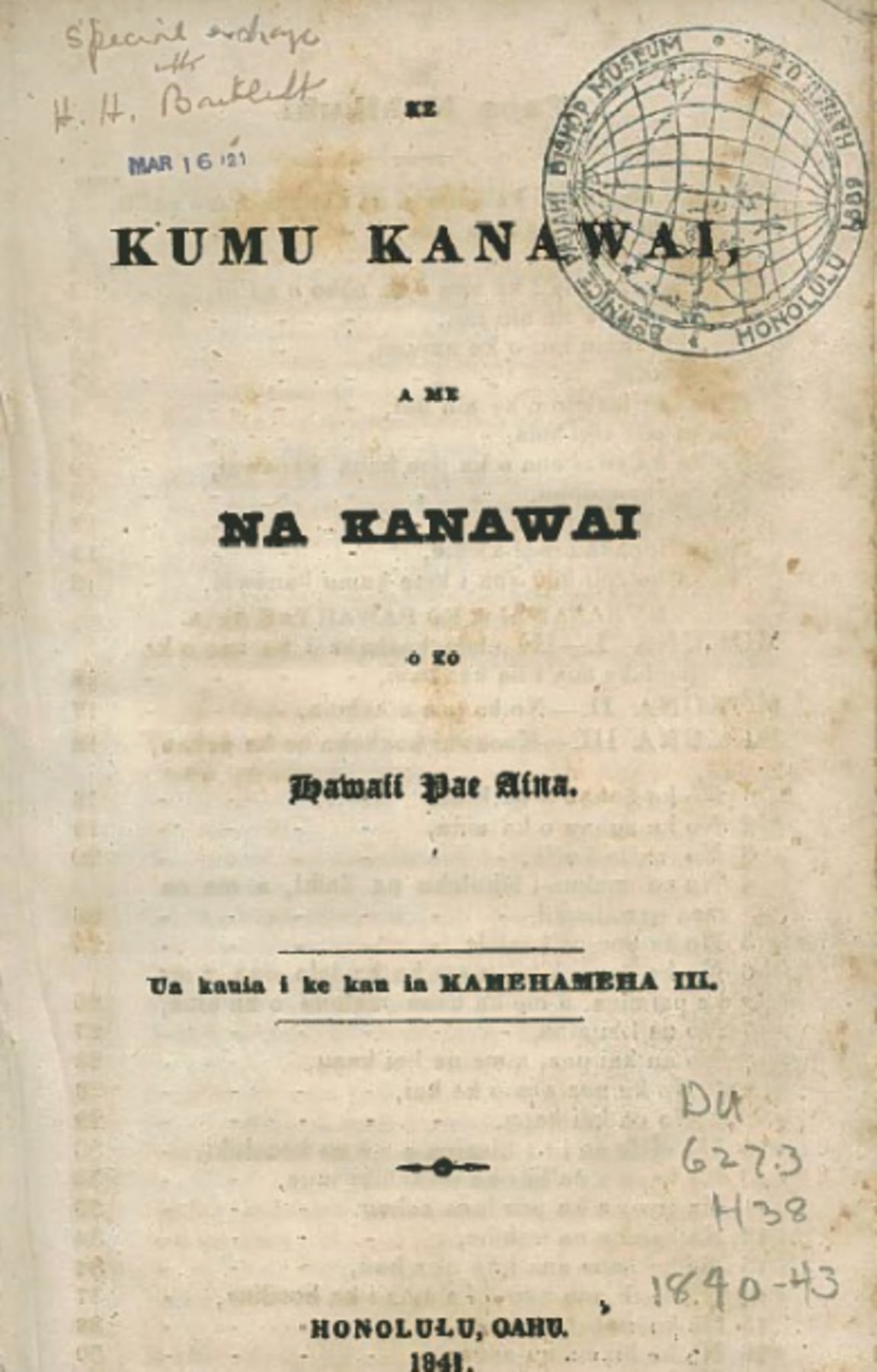
The Kingdom's first written constitution, promulgated under Kamehameha III in 1840, was drafted and published in Hawaiian. English was not an afterthought for long: by 1846, Kingdom law required that new enactments be published in both Hawaiian and English, and an English-language compilation of the laws printed as early as 1842 already acknowledged that translation had introduced small variations between the two texts. The problem this newsletter is about (what a bilingual government does when its two authoritative texts stop agreeing) did not begin with a single dramatic court case. It was built into the machinery from the start, and the Kingdom knew it.
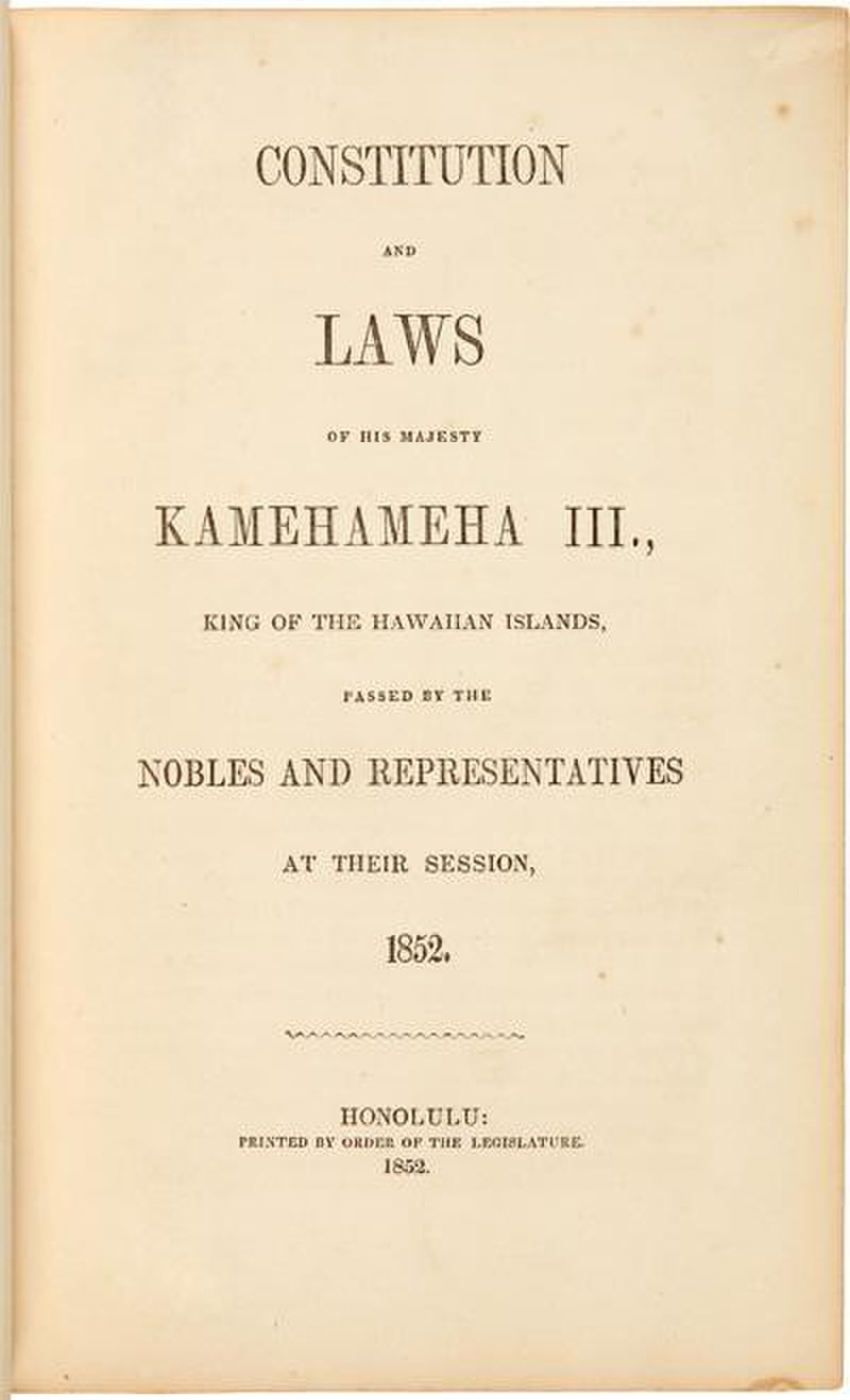
The 1852 Constitution, the Kingdom's second, was promulgated the same way: drafted, enacted, and printed in parallel Hawaiian and English editions. Both were meant to be read as the law, not one as the law and the other as a courtesy translation of it.
By the 1850s, that machinery was tested in court. Bureau of Conveyances practice required that certain instruments (mortgages, bills of sale, and other transfers) be stamped before they could be recorded. The English text of the statute said so plainly. The Hawaiian text did not carry the same requirement, or did not carry it as clearly, and a dispute over an indenture covering a Honolulu merchant's stock in trade turned on exactly that gap: was an unstamped mortgage of personal property still validly recorded, or not?
The case that chose the Hawaiian text
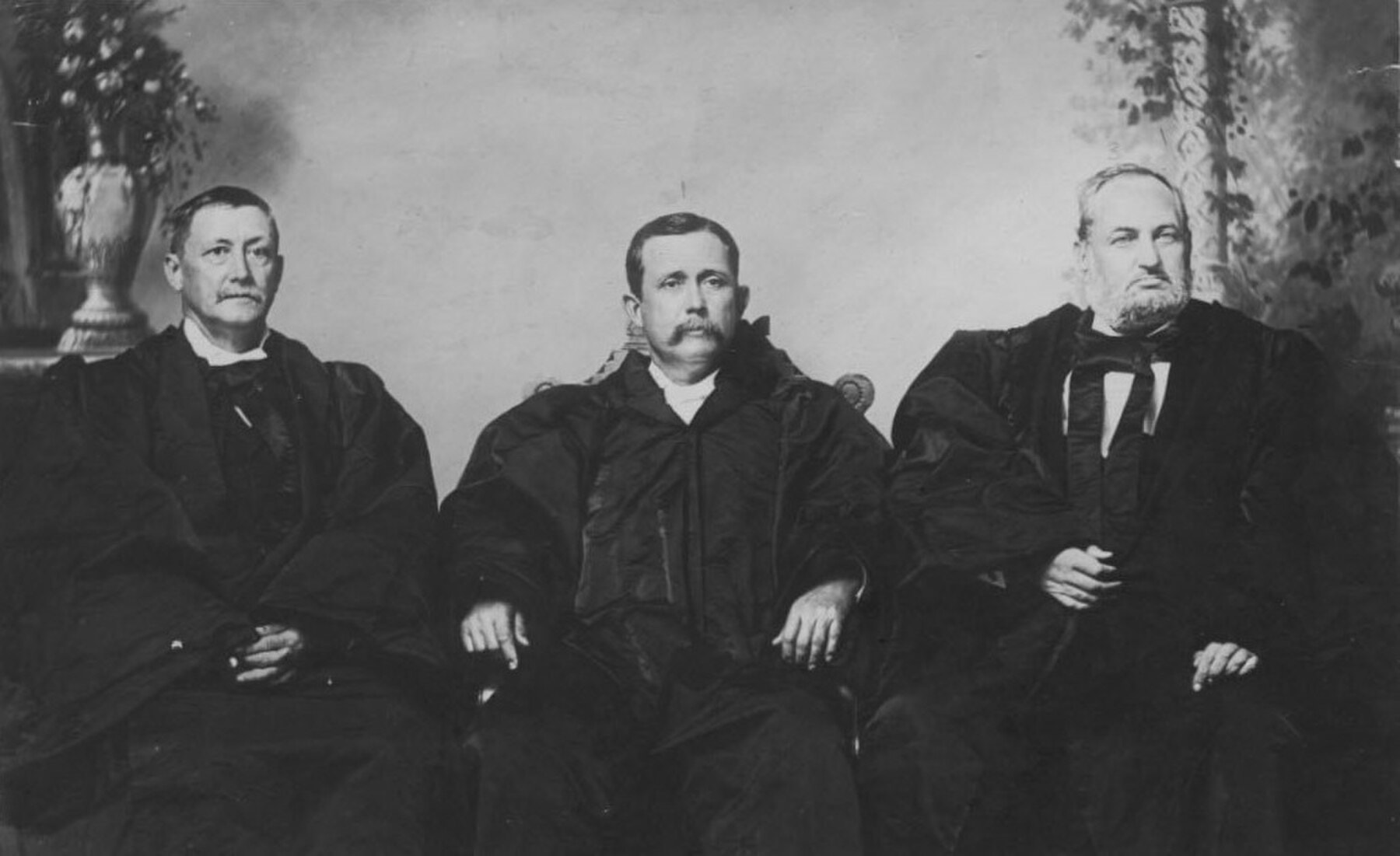
The case, Hardy v. Ruggles, reached the Hawaiian Supreme Court in 1856. Chief Justice William L. Lee did not treat the mismatch as an editing error to be smoothed over by picking whichever version was more convenient. He set out a rule for it. Where the two texts were only "obscure" or the contradiction "slight," Hawaiian and English could be read together, each helping to explain the other. But where the difference was, in his words, "radical and irreconcilable," one version had to control absolutely, and secondary sources report that Lee held that in that situation, the Hawaiian text governed, "because it is the language of the legislators of the country." That standard did not originate with Lee; by his own account it had first been laid down by the Kingdom's Superior Court in 1848 and had been followed consistently since. Hardy v. Ruggles did not invent the doctrine that Hawaiian was the law's home language when the two texts truly could not be reconciled: it confirmed and applied it.
The reversal
The Hardy rule did not last. Three years later, in 1859, the Kingdom legislature enacted a comprehensive Civil Code, and the drafting project for that code did something deliberate: it took on the job of "comparing the Hawaiian and English versions" of the law "and assimilating them as far as practicable", and it flipped Lee's rule while doing so. Under the Civil Code, when a radical and irreconcilable difference turned up between the two texts, the English version, not the Hawaiian, would be held binding. Secondary sources describing the legislative record attribute the push for that reversal to English-speaking interests who had grown more numerous, and more influential, in Kingdom government over the 1850s. Whatever the mix of motives, the effect was structural: for the first time, the Kingdom's own law declared that its English text, not its Hawaiian one, was the version to trust when the two could not be reconciled.
What provenance means for a disputed line
Resolving any disputed provision starts with provenance, not translation: which language was drafted first, who translated it, what text the legislature actually enacted, which printing is authentic, and whether a later amendment displaced the earlier form. Laws could originate through different drafting processes even within the same code, so the working question for any disputed line is documentary (what happened to this specific text on its way from one language to the other) not merely linguistic. A radical and irreconcilable difference is not usually a mystery about meaning. It is usually a paper trail question: which document is the one the legislature actually passed.
That is a hard question to answer once the trail thins out. Hawaiian-language publication of new statutes was not maintained indefinitely; by the mid-twentieth century, the Territory had moved to producing its laws in English only as a matter of routine practice, and the parallel-text model that let one language check the other quietly stopped being the default. When only one language is routinely produced, later researchers lose the comparison entirely. There is no second witness left to check the first against, not because the Hawaiian text was ever formally repealed as a source of law, but because it simply stopped being made.
Federal law supplies a compact example of how a legal system ranks competing versions of its own text. Under 1 U.S.C. § 204(a), the current edition of the Code of Laws of the United States, together with any supplement, “establish prima facie the laws of the United States” that are general and permanent in nature. A proviso follows: when a title has been enacted into positive law, its text becomes “legal evidence of the laws therein contained” in the courts of the United States, the several states, and the territories and insular possessions. The phrase prima facie describes a presumption, which a litigant may try to overcome with a better source. Section 112 of the same title names that source, providing that the United States Statutes at Large are “legal evidence of laws” in the same range of courts. A reader holding a printed code, then, holds a convenient arrangement of the law whose authority depends on which title it comes from.
The line between the two categories is drawn title by title, and the count has moved over time. Section 204 itself was enacted on July 30, 1947, and the editorial notes on the Cornell Legal Information Institute page for Title 1 record that the same Act of July 30, 1947 enacted Title 1 into positive law. The notes on that page list 27 titles enacted into positive law, with enactment years running from 1947 for the earliest group to 2014 for Title 54. The Office of the Law Revision Counsel page that would confirm the current figure was unavailable when checked, so the number is best read as the count shown on that page rather than as an official tally. The practical consequence is that the same Code can contain provisions that are legal evidence in their own right next to provisions that remain a presumption. Subsection 204(b) gives the Code of the District of Columbia the same prima facie footing, which shows that the arrangement is a general drafting choice rather than a quirk of one compilation.
The Supreme Court has said what happens when the presumption meets the original. In Stephan v. United States, decided June 1, 1943, the Court stated that the Code “cannot prevail over the Statutes at Large when the two are inconsistent.” A half century later, in United States National Bank of Oregon v. Independent Insurance Agents of America, decided June 7, 1993, Justice Souter wrote an opinion holding that a provision of the banking laws, 12 U.S.C. § 92, had not been repealed in 1918, because the 1916 Act had placed it in the Federal Reserve Act and the 1918 amendment did not reach it. The Court treated the Statutes at Large as the controlling record even though the provision had been left out of the Code. The same opinion approved the practice of courts being willing to “disregard punctuation, or repunctuate, if need be” when misplaced quotation marks reflect a scrivener’s error. A disagreement between versions, on this account, resolves toward the text the legislature enacted, and a drafting slip can be corrected by reading rather than by new legislation.
Authority can also vary inside a single publication that carries the word official. In Georgia v. Public.Resource.Org, decided April 27, 2020, the Court considered the Official Code of Georgia Annotated, whose annotations were prepared by Matthew Bender & Co., a LexisNexis division, under a work-for-hire agreement with Georgia’s Code Revision Commission. Chief Justice Roberts wrote for the Court that the annotations were ineligible for copyright under the government edicts doctrine, which rests on the principle that “no one can own the law.” Justices Thomas and Ginsburg dissented on different grounds, with Justice Thomas focusing on whether the material carries the force of law and Justice Ginsburg describing the annotations as commentary that follows enactment. The case concerns copyright, and it does not decide which of two conflicting texts prevails. It does show that a volume labeled official can combine statutory text, which the Court treated as the law, with commentary whose status was contested enough to reach the Supreme Court.
Where the law stands now
The current Hawai'i Revised Statutes section 1-13 names English and Hawaiian as the state's two official languages. But it keeps the 1859 outcome, not the 1856 one: when versions of a state law show a radical and irreconcilable difference, the English version is held binding, and Hawaiian is not required for public acts and transactions except where separately provided by law. More than a century and a half after Hardy v. Ruggles, the rule Chief Justice Lee announced has never been restored by statute. What has changed is that lawmakers have started asking, again, whether it should be.
The Hawaiʻi Constitution places the status of the Hawaiian text in the legislature’s hands. Article XV, section 4 provides that “English and Hawaiian shall be the official languages of Hawaii, except that Hawaiian shall be required for public acts and transactions only as provided by law.” The Legislative Reference Bureau page reports that the provision came through the 1978 Constitutional Convention and an election on November 7, 1978. The qualifying clause matters for any disagreement between language versions. The constitution names both languages as official and then leaves the circumstances in which a Hawaiian text is required to statute, so a rule about which version governs depends on a legislative choice that can be made, revised or left unmade. That structure helps explain why proposals to change the rule arrive as bills and why, on this reading, a court has little constitutional text to apply directly.
Hawaiʻi has also addressed the question of which copy counts in its own statutes. Its version of the Uniform Electronic Legal Material Act is now chapter 98 of the Hawaiʻi Revised Statutes. Section 98-2 defines legal material, “whether or not in effect,” to include the Constitution, the Session Laws, and the Hawaii Revised Statutes, and it names the revisor of statutes as the official publisher for each of those three. Section 98-4 provides that a publisher that issues legal material only in electronic form must designate the electronic record as official and comply with the act’s authentication, preservation and access sections. Under section 98-6, authenticated electronic legal material is presumed to be “an accurate copy of the legal material,” and the party disputing authenticity carries the burden by a preponderance of the evidence. Section 98-3 limits the act to material first published electronically on or after July 1, 2013, so older publications fall outside it.
The Hawaiʻi statute follows a national template with a stated purpose. The Uniform Law Commission approved the Uniform Electronic Legal Material Act in July 2011, and the National Conference of State Legislatures lists 22 states, the District of Columbia and the Virgin Islands as adopters, Hawaiʻi among them. The act is described as an “outcomes-based, technology-neutral approach” that asks official publishers to authenticate, preserve and provide permanent public access to electronic legal material. Its scope is limited. It tells a reader how to confirm that a given file is the version the official publisher issued, and it leaves untouched the older question of what to do when the session law and the compiled statute disagree about substance. The act therefore addresses the provenance of a copy and relies on existing doctrine for conflicts of content.
Two ways to reopen the question
In 2023, Senate Judiciary Chair Karl Rhoads introduced a bill (reported in coverage of that session as Senate Bill 16, with companion measures moving on the House side) that would have made a Hawaiian-language version of a law binding in a narrower, specific circumstance: where the law had originally been drafted in Hawaiian, translated into English, and never since amended or recodified in the English text. Rhoads was blunt about his reasoning in press coverage at the time: the current default preference for English "didn't seem right" to him. The bill did not ask legislators to relitigate every bilingual statute on the books, only to restore Hawaiian priority for the specific subset where Hawaiian, provably, came first and stayed untouched.
A newer Senate proposal, tracked into the 2025–2026 session under the SB109 line, uses the same kind of test as the 2023 bill, framing the standard around drafting history: the Hawaiian version would be binding where the law was originally drafted in Hawaiian, the English version was translated from it, and the law has not since been amended, codified, recodified, or reenacted in English. Both bills ask a documentary question (what was the original, and has it been superseded) rather than an interpretive one about what the lawmakers who passed the law actually meant to say. A legislature that has kept its drafts, translations, and committee reports can answer that question. One that has not is left asking a court to reconstruct the drafting history from whatever single-language record survived a century of retranscription and recodification. The bill reached a House Draft 1 in 2025 but never cleared the Legislature; the current text of HRS Section 1-13 does not contain its proviso. It drew support in committee testimony from the Department of Land and Natural Resources and the Judiciary's ʻŌlelo Hawaiʻi Program -- DLNR Chairperson Dawn N.S. Chang called it part of "the growing international movement to protect and promote the rights of indigenous peoples" -- and a caution from the Department of the Attorney General, which warned a broad rule could produce "a patchwork of binding language in both English and Hawaiian within the same law" and pushed for the same amend-or-recodify carve-out the bill already used. SB109 passed two Senate committees unanimously in early 2025 and was carried into 2026 with a House Draft, but it too failed to reach passage before the Legislature adjourned -- meaning the 1859 rule, restated at HRS Section 1-13, still stands.
Other legal systems have written the conflict rule into higher-order text. Article 33 of the Vienna Convention on the Law of Treaties, opened for signature on May 23, 1969 and in force since January 27, 1980, provides that a treaty authenticated in two or more languages is “equally authoritative in each language” unless the parties choose a prevailing text. Its terms are “presumed to have the same meaning in each authentic text,” and, if a difference survives the ordinary interpretive tools, “the meaning which best reconciles the texts, having regard to the object and purpose of the treaty, shall be adopted.” Section 18(1) of the Canadian Charter of Rights and Freedoms takes the equal-authority approach for federal statutes, providing that the statutes, records and journals of Parliament “shall be printed and published in English and French and both language versions are equally authoritative.” Both provisions treat equality as the starting point and supply a reconciliation method. Hawaiʻi’s post-1859 rule, which picks one language, operates on a different design, and the contrast shows that a choice between a priority rule and an equal-authority rule remains open to a legislature.
Scale does not just distribute an archive. It distributes whatever quality control that archive received on the way in. A Kingdom that printed two languages in parallel and cross-checked them built its own answer to that problem into the publication process. A government that prints in one language has to reconstruct the answer after the fact, if it can.
The durable, narrower lesson survives independent of which bill, if any, eventually passes: in a bilingual legal system, a translation is not a neutral copy standing beside the "real" law. It is part of the law, until a legislature decides (sometimes generations later, and sometimes more than once) that it no longer wants it to be. Hardy v. Ruggles decided that question one way in 1856. The 1859 Civil Code decided it the other way three years later. Both decisions were legislative and judicial choices, not linguistic inevitabilities, which is exactly why a future legislature is free to choose again. The same question of which text an institution will actually honor recurs today far from statute books; Law Happens Somewhere follows it into rooms, queues, and forms.
Sources
Hardy v. Ruggles (Haw. Sup. Ct. 1856): case listing and docket data via CourtListener (opinion nos. 6606170 and 8652246); the underlying slip opinion text was not independently retrievable this session.Chief Justice William L. Lee's holding language ("radical and irreconcilable difference... the latter must govern, because it is the language of the legislators of the country") as reproduced by: Paul F. Nāhoʻa Lucas, "Hawaiian Language Policy and the Courts" (University of Hawaiʻi at Mānoa, ScholarSpace/eVols); and Mokuola Honua, "'Officially' What?: The Legal Rights and Implications of ʻŌlelo Hawaiʻi" (mokuolahonua.com). · 1859 Civil Code, Section 1493 ("comparing the Hawaiian and English versions... and assimilating them as far as practicable"; English binding on radical and irreconcilable difference): as cited via Justia and capitol.hawaii.gov in prior research on this piece. · Hawaiʻi Revised Statutes § 1-13, Official languages: current text via Justia and capitol.hawaii.gov. · "Original ʻŌlelo Hawaiʻi versions of law would be held binding with new measure," Hawaiʻi Public Radio, Feb. 7, 2023: reporting on the 2023 Senate Bill 16 line and Sen. Karl Rhoads's rationale. · Senate Bill 109 (2025–2026 session) legislative tracking and committee testimony, via capitol.hawaii.gov and legislative tracking services. · 1846 bilingual-publication requirement and pre-1859 background: per University of Hawaiʻi Hawaiian-language research guide and Judiciary History Center materials, as previously sourced for this piece.
Sources added October 3, 2026 (each checked on that date): 1 U.S.C. 204 and 112, law.cornell.edu/uscode/text/1/204 and law.cornell.edu/uscode/text/1/112 (the count of positive-law titles is taken from the editorial notes on the Cornell page, not an official tally). Stephan v. United States, law.cornell.edu/supremecourt/text/319/423. United States National Bank of Oregon v. Independent Insurance Agents of America, law.cornell.edu/supremecourt/text/508/439. Georgia v. Public.Resource.Org, law.cornell.edu/supremecourt/text/18-1150. Hawaiʻi Revised Statutes chapter 98, data.capitol.hawaii.gov/hrscurrent/Vol02_Ch0046-0115/HRS0098/HRS_0098-0002.htm and HRS_0098-0003.htm. National Conference of State Legislatures, ncsl.org/about-state-legislatures/preserving-legislative-digital-records (undated count). Hawaiʻi Constitution, article XV, section 4, lrb.hawaii.gov/const/. Vienna Convention on the Law of Treaties, article 33, en.wikisource.org/wiki/Vienna_Convention_on_the_Law_of_Treaties. Canadian Charter of Rights and Freedoms, section 18, laws-lois.justice.gc.ca/eng/const/page-12.html.